
Is FIR Mandatory Under the SC-ST (Prevention of Atrocities) Act-1989?
Is FIR Mandatory Under the SC/ST (Prevention of Atrocities) Act, 1989? – A Complete Legal Guide
Introduction
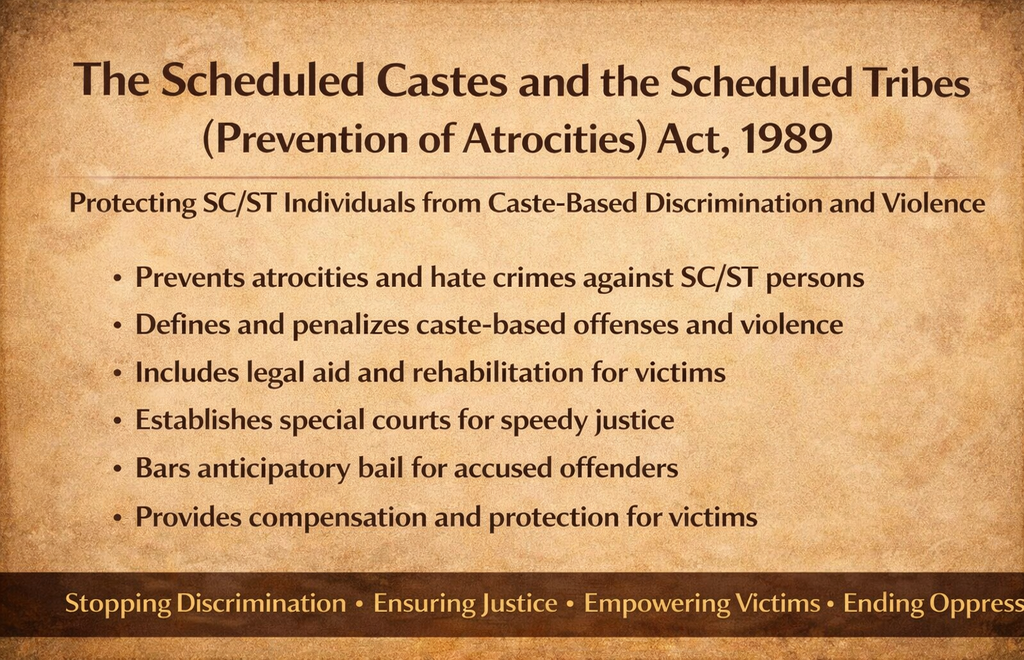
The Scheduled Castes and the Scheduled Tribes (Prevention of Atrocities) Act, 1989, popularly known as the SC/ST (Prevention of Atrocities) Act, 1989, is a special legislation enacted to protect members of Scheduled Castes and Scheduled Tribes from caste-based discrimination, humiliation, violence, exploitation, and other forms of social injustice. The Act was introduced because existing criminal laws were found inadequate to deal with the unique and deep-rooted nature of atrocities committed against SC/ST communities.
One of the most crucial procedural questions that arises in the implementation of this Act is whether registration of a First Information Report (FIR) is mandatory when a complaint of an offense under the SC/ST (Prevention of Atrocities) Act, 1989 is made. This question has been the subject of intense legal debate, multiple Supreme Court judgments, and statutory amendments.
Direct Answer:
Yes, registration of an FIR is mandatory under the SC/ST (Prevention of Atrocities) Act, 1989 whenever information discloses the commission of a cognizable offense under the Act, and no preliminary inquiry is required before registering such FIR.
This article provides a detailed, structured, and comprehensive explanation of the legal position on FIR registration under the SC/ST (Prevention of Atrocities) Act, 1989, including statutory provisions, judicial interpretations, procedural steps, safeguards against misuse, and practical guidance for both victims and accused persons.
1. Understanding FIR and Its Role in Criminal Law
1.1 What Is an FIR?
An FIR (First Information Report) is the first written record of information given to the police about the commission of a cognizable offense. It is governed by Section 173 of the Bharatiya Nagarik Suraksha Sanhita, 2023 (BNSS).
The primary purposes of an FIR are:
- To set the criminal law into motion
- To record the earliest version of events
- To enable the police to start investigation
- To safeguard the rights of both the complainant and the accused
In general criminal law, if the information discloses a cognizable offense, the police are legally bound to register an FIR.
2. Nature of Offenses Under the SC/ST (Prevention of Atrocities) Act, 1989
Most offenses under the SC/ST (Prevention of Atrocities) Act, 1989 are:
- Cognizable – Police can arrest without a warrant
- Non-bailable – Bail is not a matter of right
- Triable by Special Courts
Examples of cognizable offenses under the Act include:
- Intentional insult or humiliation in a public place
- Forcible dispossession of land or property
- Physical assault and sexual violence
- Social or economic boycott
- Abuse of official position by public servants
Because these offenses are cognizable, the general rule under Section 173 BNSS would require mandatory registration of FIR.
3. Early Judicial Safeguards and the Subhash Kashinath Mahajan Case
3.1 Background
In Subhash Kashinath Mahajan v. State of Maharashtra (2018), the Supreme Court expressed concern over the alleged misuse of the SC/ST (Prevention of Atrocities) Act, 1989 for settling personal and political scores.
3.2 Supreme Court Directions (2018)
The Court issued certain safeguards, including:
- A preliminary inquiry before registration of FIR in some cases
- Prior approval of a senior police officer before arrest
- Protection against immediate arrest of public servants
These directions temporarily diluted the mandatory nature of FIR registration in SC/ST Act cases.
4. Legislative Response: Section 18A and the 2018 Amendment
4.1 Introduction of Section 18A
In response to the Subhash Kashinath Mahajan judgment, Parliament enacted the Scheduled Castes and the Scheduled Tribes (Prevention of Atrocities) Amendment Act, 2018, which inserted Section 18A into the principal Act.
4.2 Key Provisions of Section 18A
Section 18A of the SC/ST (Prevention of Atrocities) Act, 1989 states that:
- No preliminary inquiry shall be required for registration of an FIR against any person accused of committing an offense under the Act.
- No approval shall be required for the arrest of any person accused of committing an offense under the Act.
- The provisions of Section 482 BNSS (anticipatory bail) shall not apply to any case involving arrest under this Act.
4.3 Effect of Section 18A
The insertion of Section 18A restored the original strict regime of the Act and made it clear that:
- FIR registration is mandatory
- Police cannot refuse to register an FIR
- No preliminary verification is required before recording the complaint
5. Supreme Court Clarification: Prathvi Raj Chauhan Case
In Prathvi Raj Chauhan v. Union of India (2020), the Supreme Court examined the constitutional validity of Section 18A.
5.1 Key Observations
The Court upheld Section 18A and clarified that:
- FIR must be registered if the complaint discloses an offense under the Act
- No preliminary inquiry is required
- The bar on anticipatory bail is constitutionally valid
- Courts can still examine whether a prima facie case exists to prevent abuse of the law
5.2 Significance
This judgment firmly settled the legal position that:
Registration of FIR is mandatory under the SC/ST (Prevention of Atrocities) Act, 1989 whenever information discloses the commission of an offense under the Act.
6. Current Legal Position: Is FIR Mandatory?
Based on statutory provisions and judicial rulings, the present legal position is as follows:
- Mandatory Registration
If a complaint or information reveals the commission of an offense under the SC/ST (Prevention of Atrocities) Act, 1989, the police are legally bound to register an FIR. - No Preliminary Inquiry
Police officers cannot conduct a preliminary inquiry before registering the FIR. The FIR must be registered immediately upon receipt of information. - No Prior Approval Required
No sanction or approval from senior officers is needed for FIR registration or arrest. - Applicability of Lalita Kumari Principle
The Supreme Court’s general rule in Lalita Kumari v. Government of Uttar Pradesh (2014), which mandates FIR registration in cognizable offenses, fully applies to SC/ST Act cases.
7. What If the Police Refuse to Register an FIR?
Despite the clear legal mandate, police sometimes refuse to register FIRs in SC/ST Act cases due to social pressure, political influence, or misunderstanding of the law.
7.1 Legal Remedies for the Victim
If the police refuse to register an FIR, the victim can:
- Approach the Superintendent of Police
Under Section 173(3) BNSS, a written complaint can be sent to the SP, who can direct registration of FIR. - File a Complaint Before a Magistrate
Under Section 175(3) BNSS, the victim can approach the Magistrate seeking a direction to the police to register an FIR and investigate. - Approach the Special Court
Since Special Courts under the SC/ST (Prevention of Atrocities) Act, 1989 can take direct cognizance of offenses, a complaint can be filed directly before the Special Court. - Approach the High Court
In extreme cases, a writ petition can be filed in the High Court seeking directions to the police for FIR registration.
8. Can Police Conduct a Preliminary Inquiry in Any Situation?
As a general rule:
- No preliminary inquiry is allowed before FIR registration under the SC/ST (Prevention of Atrocities) Act, 1989.
However, courts have clarified that:
- The police may conduct a limited inquiry only to ascertain whether the complaint actually discloses the basic ingredients of an offense under the Act.
- This inquiry cannot be used as a tool to delay FIR registration or to assess the truthfulness of the allegations.
9. Safeguards Against Misuse
While FIR registration is mandatory, courts have recognized the potential for misuse of the SC/ST (Prevention of Atrocities) Act, 1989. To balance victim protection with individual liberty, the judiciary has evolved certain safeguards:
9.1 Judicial Scrutiny
- Courts can examine whether a prima facie case exists.
- If the allegations do not disclose the essential ingredients of an offense, proceedings can be quashed.
9.2 Quashing of FIR
- An accused can approach the High Court under Section 528 BNSS or Article 226 of the Constitution to seek quashing of a false or motivated FIR.
9.3 Regular Bail
- Though anticipatory bail is barred, regular bail after arrest can be granted if no prima facie case is made out.
10. Practical Guidance for Victims
- Clearly mention the caste or tribal status in the complaint.
- Describe how the offense was committed on account of caste or tribal identity.
- Provide names of witnesses and supporting documents.
- Insist on immediate FIR registration.
- Seek help from the District Legal Services Authority if needed.
11. Practical Guidance for Accused Persons
- Obtain a copy of the FIR immediately.
- Examine whether the essential ingredients of the offense are present.
- Collect evidence showing false implication or personal enmity.
- Apply for regular bail promptly after arrest.
- Approach the High Court for quashing if the FIR is legally defective.
12. Frequently Asked Questions (FAQs)
Q1. Is FIR mandatory under the SC/ST (Prevention of Atrocities) Act, 1989?
Yes. FIR registration is mandatory if the complaint discloses a cognizable offense under the Act.
Q2. Can police refuse to register an FIR in an SC/ST Act case?
No. Refusal to register an FIR is illegal and can be challenged before higher authorities or courts.
Q3. Is preliminary inquiry allowed before FIR registration?
No. Section 18A expressly prohibits any preliminary inquiry before FIR registration.
Q4. Can a victim file a complaint directly before the Special Court?
Yes. Special Courts can take direct cognizance of offenses under the Act.
Q5. What remedy is available if a false FIR is registered?
The accused can seek quashing of the FIR from the High Court or apply for regular bail after arrest.
Conclusion
The SC/ST (Prevention of Atrocities) Act, 1989 is a powerful social justice legislation aimed at eradicating caste-based oppression and ensuring dignity and equality for members of Scheduled Castes and Scheduled Tribes. To fulfill this उद्देश्य, the law places a strict obligation on the police to act promptly and decisively when a complaint is made.
In clear and unequivocal terms, registration of an FIR is mandatory under the SC/ST (Prevention of Atrocities) Act, 1989 whenever information discloses the commission of a cognizable offense, and no preliminary inquiry is permitted before such registration.
This strict rule ensures that victims are not denied access to justice due to social bias or administrative delay. At the same time, judicial safeguards such as quashing of false FIRs and scrutiny of prima facie cases help prevent misuse of the law.
Understanding the mandatory nature of FIR registration under the SC/ST (Prevention of Atrocities) Act, 1989 is essential for both victims seeking justice and accused persons seeking to protect their legal rights. In all such cases, timely legal advice and informed action remain the most effective tools to navigate this sensitive and complex area of criminal law.
Disclaimer: This information is intended for general guidance only and does not constitute legal advice. Please consult with a qualified lawyer for personalized advice specific to your situation.
Advocate J.S. Rohilla (Civil & Criminal Lawyer in Indore)
Contact: 88271 22304
