
How Long Does a Case Take Under the SC-ST (Prevention of Atrocities) Act-1989?
How Long Does a Case Take Under the SC/ST (Prevention of Atrocities) Act, 1989? – A Detailed Legal Guide
Introduction
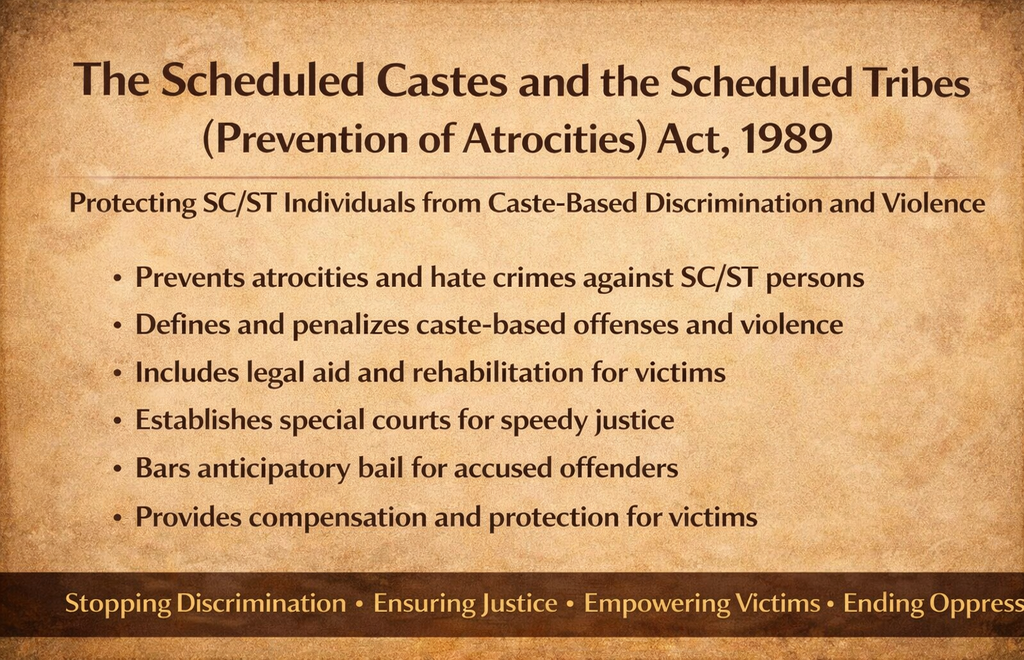
The Scheduled Castes and the Scheduled Tribes (Prevention of Atrocities) Act, 1989, commonly known as the SC/ST (Prevention of Atrocities) Act, 1989, is a special social justice statute designed to protect members of Scheduled Castes (SC) and Scheduled Tribes (ST) from caste-based discrimination, humiliation, violence, and other atrocities. The Act provides stringent penal provisions, special courts, denial of anticipatory bail, and protective relief mechanisms for victims.
When an incident occurs that falls within the scope of the SC/ST Act, a legal process is set in motion that typically begins with the registration of an FIR and may culminate in either conviction, acquittal, or other judicial orders.
A question that arises frequently among victims, accused persons, and legal practitioners is:
How long does a case take under the SC/ST (Prevention of Atrocities) Act, 1989?
Answering this question requires an exploration of the legal processes involved, statutory timelines, judicial practices, and practical realities of India’s criminal justice system.
Direct Answer:
A case under the SC/ST (Prevention of Atrocities) Act, 1989 can take anywhere from 1 to 7 years or more from FIR registration to final judgment, depending on the complexity of the case, the quality of investigation, trial court backlog, appeals, and procedural factors. However, the Act and judicial guidelines seek to expedite proceedings, and many cases conclude within 2 to 5 years.
This article provides a detailed, structured, and comprehensive analysis of the timelines involved in an SC/ST Act case, from FIR to final disposal, including delays, accelerators, and practical strategies to reduce compounding time.
1. The Legal Framework and Procedural Stages
Before understanding timelines, it is important to know the step-by-step process of a case under the SC/ST Act.
1.1 First Information Report (FIR) Registration
- As soon as an SC/ST atrocity is reported, the police must register an FIR without delay.
- The SC/ST Act expressly prohibits preliminary inquiry in genuine cases (Section 18A).
- Once the FIR is registered, the criminal process begins.
Typical time: Same day or within 24–48 hours of reporting.
1.2 Police Investigation
After FIR registration, the police investigate the case by:
- Recording statements of victims and witnesses
- Inspecting the scene of occurrence
- Collecting medical, documentary, and electronic evidence
- Arresting the accused (if necessary)
- Filing the investigation report (charge sheet) within statutory timelines
Statutory guideline: Investigations are expected to be completed within a reasonable period, typically within 60–90 days, though no fixed statutory limit is prescribed in the SC/ST Act itself.
1.3 Filing of Charge Sheet
Once investigation is complete, the police file a charge sheet (or final report) before the Special Court designated under Section 14 of the Act.
1.4 Trial Before Special Court
The SC/ST Act mandates trial by Special Courts or Exclusive Special Courts to ensure expedited proceedings. If no Special Court is designated, the Sessions Court with jurisdiction tries the case.
Steps during trial include:
- Framing of charges
- Prosecution evidence
- Defense evidence
- Arguments
- Judgment (conviction or acquittal)
Typical time: 2 to 4 years (can be more or less depending on case complexity).
1.5 Appeals
Either party can appeal the trial court’s decision to:
- High Court (under Section 374 Cr.P.C. or equivalent provisions)
- Supreme Court (in special circumstances)
Appeals can add 2 to 5 or more years, depending on court backlog and case complexity.
2. Stage-Wise Timeline Analysis
Below is an in-depth overview of each stage and how long it typically takes in practice.
2.1 FIR Registration: Quick but Crucial
As per the law and Supreme Court decisions:
- FIR should be registered immediately upon credible information.
- No preliminary inquiry is allowed, reinforcing prompt police action.
Expected time: Immediately or within 24–48 hours.
Practical delays: Police may delay FIR due to social pressure, political influence, or administrative backlog. A writ petition to the High Court or frantic follow-up may be necessary.
2.2 Investigation: 60 to 180 Days
Investigation is a critical phase. Ideally:
- Police complete investigation in 60 days for a straightforward case.
- The Supreme Court in Lalita Kumari v. U.P. (2014) emphasized timely investigation in cognizable crimes—though not specific to the SC/ST Act, the principle applies.
Factors affecting time:
- Number of witnesses
- Availability of forensic evidence (e.g., DNA, ballistic reports)
- Cooperation of medical authorities
- Geographic spread of evidence
- Police diligence
Practical reality: Cases often take 90–180 days or more in complex scenarios.
2.3 Trial in Special Court: 2 to 4 Years
After the charge sheet is filed, the case proceeds to trial:
- Framing of Charges:
- Court examines the charge sheet and frames charges under appropriate sections.
- Prosecution Evidence:
- Witnesses are examined
- Exhibits produced
- Defense Evidence:
- Accused may present defense witnesses, documents
- Cross-examination
- Arguments and Judgment:
- Final arguments
- Judgment pronounced
Total in Trial Court: Roughly 2–4 years, sometimes longer in high-caseload courts.
2.4 Appeals: 2 to 5+ Years
Even after trial court judgment, the case may continue:
- High Court Appeal:
- Conviction or acquittal can be challenged
- Arguments on legal errors, evidence, and interpretation
- Supreme Court Appeal:
- Only on substantial questions of law
- May add 1–3 years or more.
Total appellate time: 2–5+ years.
3. Realistic Case Completion Time
| Stage | Typical Time | Notes |
|---|---|---|
| FIR Registration | 1–3 days | Immediate, but sometimes delayed |
| Investigation | 60–180 days | Varies with complexity |
| Trial Court | 2–4 years | Depends on witnesses, evidence |
| High Court Appeal | 2–4 years | Case backlog affects time |
| Supreme Court Appeal | 1–3+ years | Only in select cases |
Total from FIR to final disposal: 5 to 10+ years in complex cases.
Typical range for most cases: 3 to 7 years.
4. Why Does an SC/ST Act Case Take So Long?
4.1 Special Court Backlog
- Although the Act mandates Special Courts, many districts have few designated judges.
- Heavy caseloads and shortage of judges lead to delays.
4.2 Complex Evidence and Witness Testimony
- Multiple witnesses
- Forensic examination
- Medical reports
- Conflicting testimonies
All contribute to longer trial duration.
4.3 Interplay with Other Laws
SC/ST Act cases often involve additional charges under:
- Indian Penal Code (IPC) or Bharatiya Nyaya Sanhita (BNS)
- Information Technology Act
- Evidence Act
Multiple charges complicate trial strategy and timelines.
4.4 High Court and Supreme Court Appeals
- Appellate courts deal with legal points
- Backlogs lead to long waits for hearing
4.5 Bail Proceedings
- Although anticipatory bail is generally barred, regular bail applications prolong early litigation.
- Frequent adjournments delay trial commencement.
5. Judicial Expectations and Speedy Trial Guidelines
5.1 Statutory Requirement of Speedy Trial
The SC/ST Act mandates:
- Special Courts
- Priority listing of cases
- Day-to-day trial where feasible
These aim to reduce delay.
5.2 Supreme Court Guidance in Lalita Kumari (2014)
Though not specific to the SC/ST Act, the Supreme Court held:
- In cognizable offenses, prompt FIR and investigation are mandatory
- Police must act without delay
- Justice delayed is justice denied
This principle influences SC/ST Act cases as well.
5.3 Role of District Legal Services Authorities (DLSA)
- Monitoring of SC/ST atrocity cases
- Ensuring timely production of victims, witnesses
- Promoting legal aid
6. Factors That Expedite Case Disposal
6.1 Prompt and Accurate Investigation
- Early arrest
- Complete charge sheet
- Forensic evidence gathered quickly
Reduces trial time.
6.2 Effective Witness Management
- Subpoena and protection of key witnesses
- Avoiding frequent adjournments
6.3 Legal Aid and Counsel Coordination
- Strong prosecution strategy
- Early defense preparation
6.4 Courts’ Pro-Active Listing
- Priority listing by Special Courts
- Fast tracking socially sensitive cases
7. Factors That Delay SC/ST Act Cases
7.1 Frequent Adjournments
- Parties seeking repeated adjournments
- Lawyers’ workload
7.2 Witness Absconder or Intimidation
- Witnesses reluctant to testify
- Need for police protection
7.3 Lack of Forensic Evidence
- Delays in scientific labs
- Waiting for reports
7.4 Caste and Political Sensitivities
- Local politics influencing case processes
- Social pressure on police, witnesses, or courts
8. Role of Victims in Speeding Up the Case
Victims can take certain positive steps:
- Provide complete and accurate information
- Cooperate with police and investigators
- Identify independent witnesses
- Avoid contradictions in statements
- Seek legal aid early
- File compensation and protection applications promptly
9. Role of Accused in Judicial Efficiency
Accused persons should also:
- Appear consistently in court
- Cooperate with investigation (without self-incrimination)
- Avoid unnecessary adjournments
- Opt for early bail applications if eligible
- Maintain proper legal representation
Obstruction by the defense also delays trial.
10. Impact of Delays on Justice
10.1 Victim Impact
- Trauma prolongation
- Social stigma
- Financial hardship
Delayed justice undermines confidence in the system.
10.2 Accused Impact
- Long interim custody or bail conditions
- Loss of reputation
- Economic and personal disruption
Justice delayed can become justice denied.
11. Reforms and Suggestions for Expedited Disposal
11.1 Additional Special Courts
State governments should designate more Special Courts.
11.2 Court-Monitored Timelines
Set timelines for:
- Investigation completion
- Charge sheet filing
- Framing of charges
- Evidence recording
11.3 Use of Technology
- Virtual hearings
- Digital evidence recording
- Remote witness testimony
11.4 Witness Protection Programs
Ensure witness safety to prevent intimidation and delays.
12. Frequently Asked Questions (FAQs)
Q1. Is there a fixed statutory timeline for SC/ST Act cases?
No, the law specifies procedures but does not prescribe a fixed timeline. Court guidelines and best practices drive speed.
Q2. Can a victim seek a specific time-bound order from the court?
Victims can request expedited hearings, but courts decide based on docket availability and case urgency.
Q3. Does every SC/ST Act case go to trial?
Not always. Some cases may be quashed, withdrawn (in rare situations), or settled at pre-trial stages if legally appropriate.
Q4. Can the accused get anticipatory bail in SC/ST Act cases?
Generally no, unless there is no prima facie case or the allegations are false or motivated, as clarified by the Supreme Court.
Q5. Does filing appeals extend the case indefinitely?
Appeals do extend the timeline, but courts encourage timely disposal at each appellate stage.
Conclusion
The time taken to dispose of a case under the SC/ST (Prevention of Atrocities) Act, 1989 varies widely based on:
- The nature and complexity of the offense
- Quality of investigation
- Court infrastructure and backlog
- Cooperation by victims, accused, and witnesses
- Availability of evidence and witnesses
While the ideal is speedy justice, practical realities mean cases can take anywhere from 1 to 10+ years, with most concluding between 3 and 7 years when all procedural and judicial stages are considered.
In clear terms:
An SC/ST Act case typically takes 3 to 7 years from FIR registration to final judgment, though it may take longer in complex situations involving appeals.
Efforts by courts, victims, defense counsel, police, and legal aid authorities are essential to ensure that the promise of the SC/ST Act—justice without delay, dignity, and protection for the oppressed—is translated into reality.
Disclaimer: This information is intended for general guidance only and does not constitute legal advice. Please consult with a qualified lawyer for personalized advice specific to your situation.
Advocate J.S. Rohilla (Civil & Criminal Lawyer in Indore)
Contact: 88271 22304
