
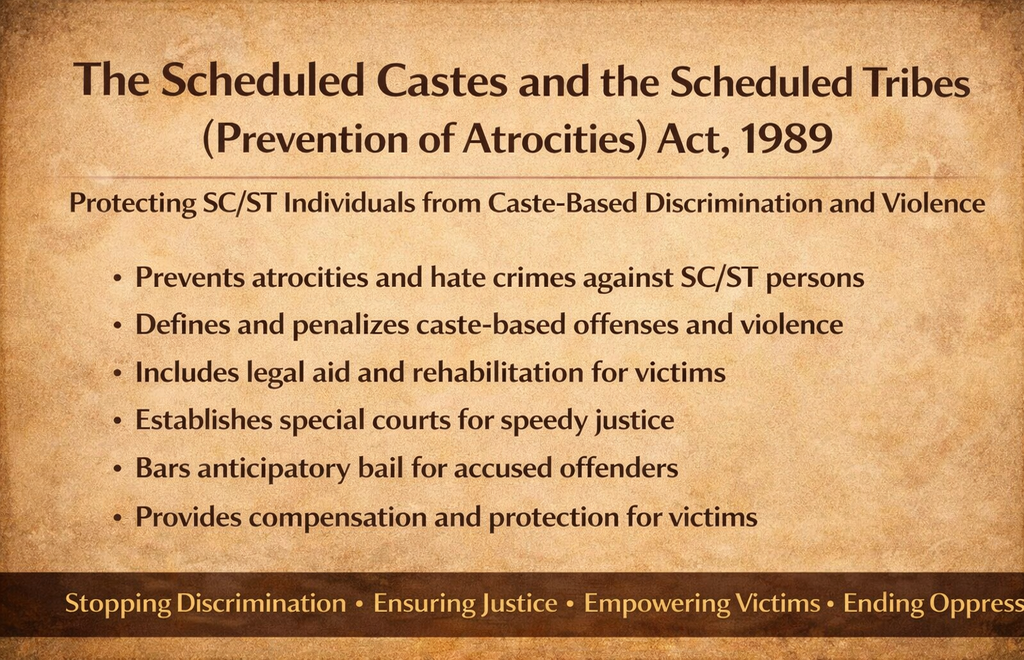
Can a Complainant Withdraw a Case Under the SC-ST (Prevention of Atrocities) Act-1989?
Direct Answer:
No, a complainant cannot unilaterally withdraw a criminal case under the SC/ST (Prevention of Atrocities) Act, 1989 simply by changing their mind or agreeing to compromise with the accused. The offences under this special Act are largely non-compoundable, cognizable, and of public importance. Once the legal process is set in motion, withdrawal or compromise depends on judicial discretion, availability of legal grounds, and the absence of caste-based atrocity elements. Courts may grant relief in exceptional cases but only after careful examination of facts.
Introduction
The Scheduled Castes and Scheduled Tribes (Prevention of Atrocities) Act, 1989 — commonly referred to as the SC/ST Act — is a powerful social justice law enacted to prevent atrocities, discrimination, violence, and humiliation against members of Scheduled Castes (SCs) and Scheduled Tribes (STs). Unlike many ordinary criminal statutes, the SC/ST Act is designed to protect vulnerable communities from deeply rooted societal injustices.
One critical question that arises in practice — especially in disputes involving personal relationships, property, economic transactions, or domestic matters — is:
Can a complainant withdraw a case registered under the SC/ST (Prevention of Atrocities) Act, 1989?
This blog post provides a detailed, deeply structured, and legally nuanced answer to that question, covering:
- Legal principles governing withdrawal of criminal cases
- The nature of offences under the SC/ST Act
- Compounding vs compromise
- Judicial precedents
- Practical scenarios
- Procedure, limitations, and safeguards
- What happens during trial and after conviction
1. What Is a “Withdrawal” of a Criminal Case?
Before analyzing the SC/ST Act, it is important to understand the legal concept of “withdrawal” (or “compounding/settlement”) in criminal law.
1.1 Withdrawal Means Different Things in Criminal Law
In ordinary criminal law:
- Compounding means the victims and accused agree to settle a case, usually for minor offences, and legal proceedings are dropped.
- Withdrawal often refers to a complainant withdrawing support, leading to the dismissal of a complaint, particularly in complainant-initiated cases.
However:
- Withdrawal or compounding is not automatically allowed in all offences.
- Some offences are non-compoundable by law, meaning withdrawal is not permitted even if the victim wants to settle.
2. Nature of Offences Under the SC/ST (Prevention of Atrocities) Act, 1989
The SC/ST Act covers a wide range of offences, including:
- Caste-based physical violence
- Social humiliation
- Denial of civil rights
- Economic exploitation
- Sexual assault and exploitation
- Caste-motivated intimidation or threats
These offences are characterized as:
- Cognizable: Police can arrest without warrant.
- Non-bailable: The accused is not entitled to bail as a matter of right; judicial discretion applies.
- Non-compoundable: Most offences under the SC/ST Act do not allow compounding or withdrawal by the complainant.
This classification highlights the public interest nature of caste atrocities: they are not private disputes between individuals, but offences against the dignity, equality, and constitutional rights of historically marginalized communities.
3. Statutory Provisions Governing Withdrawal and Compounding
3.1 Bharatiya Nagarik Suraksha Sanhita, 2023 (BNSS) and Non-Compoundable Offences
Under the BNSS (or its successor frameworks such as Bharatiya Nagarik Suraksha Sanhita), certain offences are listed as non-compoundable, meaning:
- The complainant cannot unilaterally withdraw the prosecution.
- Only courts may, in exceptional circumstances, allow withdrawal, generally when the offence is minor and does not affect public interest.
Most offences under the SC/ST Act are non-compoundable because:
- They involve public harm beyond individual interests.
- They implicate constitutional values of equality and dignity.
- Parliament explicitly intended strict enforcement and deterrence.
3.2 SC/ST Act: Absence of Compounding Provisions
The SC/ST Act does not contain any provision that allows the complainant to withdraw the case or settle with the accused. On the contrary:
- Section 18A bars anticipatory bail to ensure immediate investigation and arrest.
- Section 15A punishes intimidation of victims and witnesses.
- The Act requires speedy trial before Special Courts.
None of these clauses contemplate victim-initiated withdrawal.
4. Judicial Interpretation: Courts on Withdrawal in SC/ST Act Cases
4.1 Supreme Court Emphasis on Public Interest
The Supreme Court has repeatedly held:
- The SC/ST Act is a protective and remedial statute meant to uphold constitutional values.
- It is not a “second class” penal statute but a response to endemic social injustice.
- Withdrawal or compounding undermines the Act’s purpose unless no prima facie case exists.
In cases like Hitesh Verma v. State of Uttarakhand (2020) and Prathvi Raj Chauhan v. Union of India (2020), the Supreme Court reiterated that:
- Only when the allegations do not disclose an offence under the Act should courts consider quashing or dismissal.
- Mere willingness of a complainant to withdraw does not absolve judicial scrutiny.
4.2 High Court Directions on Withdrawal
High Courts have also clarified that:
- SC/ST Act cases cannot be treated like ordinary civil disputes subject to settlement.
- Courts must independently assess whether the conduct constitutes an atrocity.
- In rare cases where the allegations are clearly civil in nature and do not satisfy the cast-based motive required under the Act, courts may quash proceedings.
This judicial lens underscores that withdrawal is not complainant-driven; it is court-driven based on legality and public interest.
5. When Withdrawal May Be Considered
While unilateral withdrawal by a complainant is not permitted, courts may allow quashing or dismissal of proceedings in limited and exceptional circumstances.
5.1 When No Prima Facie Case Exists
If:
- The allegations do not disclose an offence under the SC/ST Act
- Caste motivation is absent
- The conduct is purely civil or personal
- The matter is a matrimonial dispute without caste atrocity elements
Then, the complainant (or accused) may approach the High Court under its inherent powers (Section 528 BNSS or corresponding constitutional jurisdiction) to seek quashing of FIR/charges.
In such cases:
- Courts examine whether a prima facie case under SC/ST Act ingredients exists.
- If not, the case may be quashed entirely.
5.2 Misuse or False Implication
If the complaint is clearly malicious or fabricated:
- Courts can intervene to quash the proceedings.
- False implication can itself attract penal consequences.
This is not withdrawal by the complainant but judicial nullification due to absence of legal basis.
6. Matrimonial and Domestic Disputes: A Special Consideration
Matrimonial, domestic, or family disputes often involve emotional, financial, or civil conflicts. Petitioners sometimes attempt to tag such disputes as SC/ST atrocities.
Courts have clarified that:
- Marriage disputes per se do not attract the SC/ST Act unless caste-based atrocity elements are proven.
- Personal disagreements, property issues, or domestic arguments without caste insult, humiliation, or caste-motivated conduct are not offences under the Act.
In such cases, courts may quash proceedings, not because a complainant “withdrew,” but because:
- The legal ingredients are not satisfied
- The Act is not attracted to ordinary civil or family conflicts
This distinction — between true legal withdrawal (which is generally unavailable) and quashing due to misapplication of law — is crucial.
7. Compounding vs. Withdrawal in Legal Terms
It is important to draw clear distinctions:
7.1 Compounding
- Permitted in specific offences listed as compoundable by statute.
- Means the parties mutually settle and ask the court to record settlement and drop the case.
SC/ST Act offences are largely non-compoundable.
7.2 Withdrawal
- Means stopping prosecution after it has been initiated.
- In SC/ST Act cases, withdrawal cannot be initiated solely by the complainant.
7.3 Quashing
- Judicial nullification of FIR or proceedings on legal grounds.
- Not a complainant-driven withdrawal; it is a judicial remedy based on prima facie analysis.
8. When Courts Can Quash an SC/ST Act Case
8.1 No Caste Motivation
If caste identity is not the cause of the alleged conduct, courts can quash.
8.2 No Atrocity as Defined
If the conduct does not fit any clause in Section 3 of the Act, quashing may be appropriate.
8.3 Purely Civil or Matrimonial Dispute
If the matter is primarily personal and devoid of caste atrocity, quashing can be allowed.
8.4 Delay or Laches
Excessive delay and lack of urgency by the complainant may justify dismissal, though this is rare in SC/ST Act cases.
9. Procedure for Seeking Quashing (When Applicable)
9.1 High Court Under Section 528 BNSS
The High Court may entertain a petition to quash FIR/charges if:
- No prima facie case is made out
- The conduct is not an atrocity under the Act
- The matter is purely personal or civil
9.2 Constitutional Jurisdiction (Article 226/227)
Victims or the accused can seek constitutional remedies when fundamental rights are at stake.
In both cases, the court independently examines:
- Whether the legal ingredients are present
- Whether continuing prosecution would be an abuse of process
10. Bail and Withdrawal: How They Interact
Even where withdrawal is not permitted:
- An accused can apply for regular bail (though anticipatory bail is generally barred under Section 18/18A).
- Denial of withdrawal does not automatically preclude bail if no prima facie case exists.
Thus, while the complainant cannot unilaterally stop proceedings, the judicial system still provides checks and balances.
11. Practical Scenarios
Scenario 1: Genuine Caste Atrocity
Victim from SC community is insulted publicly by caste slurs and humiliated by a group of non-SC individuals.
- Cannot be withdrawn unilaterally.
- Proceed to investigation and trial.
Scenario 2: Matrimonial Dispute Mislabelled
Couple from different castes have a personal conflict involving property. Complainant allege caste insult as secondary element.
- Court examines if caste atrocity ingredient is established.
- If not, case may be quashed.
Scenario 3: False Implication
Complainant fabricates allegations to settle a personal score.
- Court can quash based on absence of caste motive.
- False implication can attract penal action.
12. Safeguards Against Misuse of the SC/ST Act
Judicial and statutory safeguards include:
- Prima Facie Scrutiny
— Courts assess whether SC/ST Act is triggered by the allegations. - High Court Review
— Section 528 BNSS allows quashing where legal basis is absent. - Non-Compoundability Safeguard
— The law’s non-compoundable nature ensures public interest is not overridden by personal settlement. - Punitive Measures Against False Cases
— False complaints can attract penal consequences.
These safeguards aim to balance protection of SC/ST communities with fairness to the accused.
13. Frequently Asked Questions (FAQs)
Q1. Can a complainant simply ask the police to close an SC/ST Act case?
No. Police cannot close an SC/ST Act case at the behest of a complainant; only courts can quash proceedings after legal scrutiny.
Q2. Can the SC/ST Act be withdrawn if the victim forgives the accused?
Not automatically. Victim’s forgiveness is relevant as evidence, but only courts decide on continuation or quashing.
Q3. Can a complainant enter into a settlement outside court to end the case?
No. Settlements do not legally terminate SC/ST Act cases; courts must assess whether the Act was even applicable.
Q4. Is the SC/ST Act applicable only to non-bailable, serious offences?
Yes. Most offences are non-bailable and non-compoundable, reflecting the public interest nature of the law.
Q5. Can an SC/ST Act FIR be quashed as a form of withdrawal?
Yes, but only by the High Court or Supreme Court on legal grounds — not by mere complainant withdrawal.
14. Conclusion
A complainant cannot unilaterally withdraw a case under the SC/ST (Prevention of Atrocities) Act, 1989.
This is because:
- Most offences under the Act are non-compoundable and serious in nature.
- The Act protects constitutional values and public interest beyond private disputes.
- Withdrawal based solely on personal settlement would undermine the deterrent purpose of the law.
However:
- Courts have the power to quash cases when there is no prima facie case, absence of caste atrocity ingredients, or purely personal/civil disputes incorrectly labeled as caste offences.
- Relief such as quashing is available through judicial remedies, not complainant withdrawal.
The SC/ST Act embodies a social justice mandate — protecting marginalized communities from caste oppression. Its procedural structure reflects the belief that caste atrocities affect society at large, not just private parties. Therefore, legal withdrawal is not a simple personal choice; it must be grounded in legal principles and judicial evaluation.
For anyone navigating an SC/ST Act case — whether victims, accused persons, or legal practitioners — it is critical to understand that the Act imposes public-oriented criminal obligations and does not permit casual withdrawal once the wheels of justice begin to turn.
Disclaimer: This information is intended for general guidance only and does not constitute legal advice. Please consult with a qualified lawyer for personalized advice specific to your situation.
Advocate J.S. Rohilla (Civil & Criminal Lawyer in Indore)
Contact: 88271 22304
