
Can an FIR Be Quashed in Cases Under the SC-ST (Prevention of Atrocities) Act-1989?
Can an FIR Be Quashed in Cases Under the SC/ST (Prevention of Atrocities) Act, 1989? – A Detailed Legal Guide
Introduction
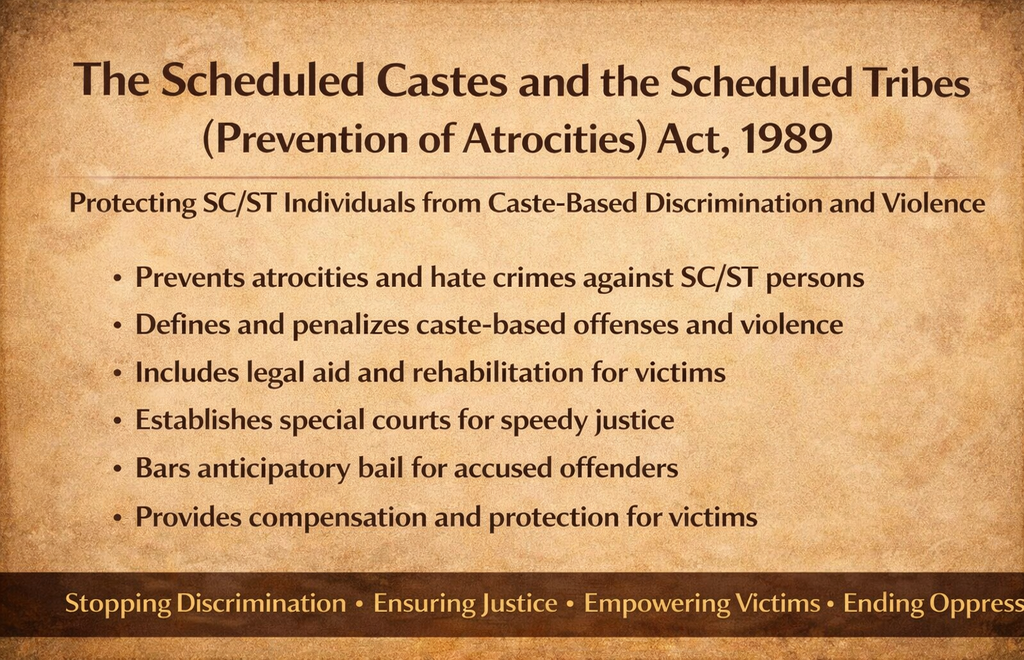
The Scheduled Castes and the Scheduled Tribes (Prevention of Atrocities) Act, 1989, widely known as the SC/ST (Prevention of Atrocities) Act, 1989, is a landmark social justice legislation aimed at protecting the historically marginalized Scheduled Castes (SC) and Scheduled Tribes (ST) from caste-based atrocities, humiliation, discrimination, and violence.
While the Act provides robust protections for SC/ST communities, including strict penal provisions, the right to legal remedy, and fast-track trial mechanisms, it has also been a source of legal debate concerning the quashing of First Information Reports (FIRs) filed under it. Given the stringent nature of the Act, especially after the amendments made in 2016 and 2018 (notably Sections 18 and 18A), questions often arise about whether courts can quash an FIR under this legislation, and if so, under what circumstances.
Direct Answer:
Yes, an FIR can be quashed in cases under the SC/ST (Prevention of Atrocities) Act, 1989, but only in exceptional circumstances, such as when it is apparent that no prima facie case is made out, the allegations are false or motivated, or the essential ingredients of an offense under the Act are absent.
This article provides a comprehensive, structured, and detailed guide to FIR quashing under the SC/ST (Prevention of Atrocities) Act, 1989, covering statutory provisions, judicial interpretations, legal principles, procedural mechanisms, and practical guidance for victims and accused persons.
1. Understanding FIR Quashing in Criminal Law
1.1 What Is an FIR?
A First Information Report (FIR) is a written document prepared by the police when they receive information about the commission of a cognizable offense. It is governed by Section 173 of the Bharatiya Nagarik Suraksha Sanhita, 2023 (BNSS).
The purposes of an FIR are:
- To formally initiate a criminal investigation
- To record the earliest version of events
- To protect both victims and accused by maintaining an official record
- To set the criminal law in motion
1.2 Quashing of FIR
Quashing refers to the act of a court nullifying or setting aside the FIR, thereby preventing further investigation or trial. In general criminal law, courts can quash an FIR under Section 528 BNSS or through writ petitions under Article 226 of the Constitution, but only in exceptional circumstances where continuing proceedings would be unjust or legally impermissible.
2. FIR Under the SC/ST (Prevention of Atrocities) Act, 1989
2.1 Mandatory FIR Registration
- Section 18A of the SC/ST (Prevention of Atrocities) Act, 1989 explicitly provides that no preliminary inquiry is required before registration of an FIR.
- Police are mandatorily required to register an FIR if the complaint discloses a cognizable offense under the Act.
- Anticipatory bail under Section 482 BNSS is barred for SC/ST Act offenses, emphasizing the seriousness of the law.
Thus, the Act strengthens the protection of victims by ensuring prompt police action, but also raises questions about the possibility of quashing in cases of false or malicious FIRs.
3. Can FIRs Under the SC/ST (Prevention of Atrocities) Act Be Quashed?
3.1 General Rule
While FIR registration is mandatory, courts have held that FIRs can be quashed in exceptional circumstances, provided:
- The FIR does not disclose the essential ingredients of an offense under the Act.
- There is no prima facie case against the accused.
- The FIR is malicious, motivated, or false, often aimed at harassment or personal vendetta.
This principle is derived from general criminal jurisprudence under Section 528 BNSS and reinforced by several Supreme Court and High Court judgments.
4. Key Judicial Pronouncements
4.1 Subhash Kashinath Mahajan v. State of Maharashtra (2018)
- The Supreme Court initially expressed concern over the misuse of the SC/ST (Prevention of Atrocities) Act, 1989 for personal or political reasons.
- It directed that preliminary inquiry before registration of FIR should be conducted in certain cases and safeguards against arbitrary arrests were necessary.
- Though later overridden by amendments, this case highlighted judicial awareness of misuse and laid the foundation for quashing principles.
4.2 Prathvi Raj Chauhan v. Union of India (2020)
- The Court clarified that Section 18A, which prohibits preliminary inquiry, is constitutionally valid.
- Importantly, it observed that courts could still examine the prima facie existence of an offense before proceeding further, establishing that quashing remains possible in cases with no genuine allegations.
4.3 State of Haryana v. Bhajan Lal (1992)
- Though not SC/ST-specific, this landmark judgment outlined circumstances for FIR quashing, many of which are applicable:
- If allegations do not constitute any offense
- If allegations are motivated or false
- If continued investigation would be an abuse of process
4.4 High Court Quashing Orders in SC/ST Act Cases
High Courts across India have consistently quashed FIRs under the SC/ST Act when:
- Allegations were vague, generalized, or unsubstantiated
- There was a civil or domestic dispute being wrongly projected as a caste atrocity
- Essential ingredients of caste-based discrimination were absent
5. Legal Principles Governing Quashing of FIRs
While considering an application for quashing an FIR under the SC/ST Act, courts apply the following principles:
5.1 Prima Facie Case
- The court examines whether the basic elements of an offense under the Act are present.
- These include:
- Victim belongs to SC/ST community
- Accused is not a member of the same community
- Act was committed due to caste or tribal identity
- Offense falls under one of the sections enumerated in the Act
5.2 Malicious or False Allegation
- FIR can be quashed if it is obvious that the FIR is lodged for revenge, personal rivalry, or property dispute.
5.3 Abuse of Process
- Courts ensure the law is not misused to harass innocent persons.
- Quashing prevents the misuse of arrest powers, detention, and prolonged litigation.
5.4 No Preliminary Inquiry
6. Statutory Provisions Governing Quashing
- Section 528 BNSS – inherent powers of High Court to quash FIR
- Article 226 of the Constitution – power of High Court to issue writs, including quashing
- Section 18A of the SC/ST Act – mandates FIR registration but does not bar quashing under exceptional circumstances
- Lalita Kumari v. Uttar Pradesh (2014) – principles regarding FIR registration and judicial intervention
7. Procedure to Quash an FIR Under the SC/ST Act
7.1 Filing the Petition
- A petition under Section 528 BNSS or Article 226 can be filed in the High Court.
- Grounds for quashing should be clearly mentioned, including:
- No prima facie case
- False or malicious allegations
- Absence of essential elements of offense
7.2 Notice to State
- The High Court issues notice to the State or the Public Prosecutor.
7.3 Hearing and Examination
- Court examines FIR, charge sheet (if filed), and investigation material.
- Limited inquiry is conducted only to assess prima facie validity, not to probe the merits of the case.
7.4 Order of Quashing
- If satisfied, the High Court can quash the FIR entirely or partially, thereby stopping further investigation or trial.
- Courts often impose conditions while quashing, such as:
- No further harassment of complainant or accused
- No repetition of malicious complaint
8. Limits of Quashing in SC/ST Act Cases
- Exceptional Remedy – Quashing is not routine; FIR cannot be quashed merely because allegations appear inconvenient.
- Social Purpose of the Act – Courts are cautious to uphold the protective intent of the Act.
- Investigation Continuation – If the police have collected credible evidence, quashing may be denied.
- Nature of Offense – Serious offenses like sexual assault, physical violence, or social boycott are rarely quashed at the FIR stage.
9. Practical Considerations for Victims
- Ensure that complaint clearly specifies caste/tribal identity of victim and accused.
- Provide evidence and witness details to support allegations.
- Obtain prompt FIR registration.
- Cooperate with Special Courts and Special Public Prosecutors.
- If false quashing is sought by accused, maintain documentation to prevent dismissal of claims.
10. Practical Considerations for Accused Persons
- Seek legal advice immediately after FIR registration.
- Apply for regular bail if arrested.
- Examine FIR for absence of essential elements.
- File Section 528 BNSS petition in the High Court for quashing.
- Produce evidence to demonstrate false, malicious, or motivated filing.
11. Frequently Asked Questions (FAQs)
Q1. Can FIRs under the SC/ST (Prevention of Atrocities) Act, 1989 be quashed?
Yes, but only in exceptional cases where no prima facie case exists, allegations are false or malicious, or essential ingredients of the offense are missing.
Q2. Does Section 18A bar quashing of FIRs?
No. Section 18A mandates FIR registration and bars preliminary inquiry but does not prevent quashing in exceptional circumstances.
Q3. Which court can quash an FIR under the SC/ST Act?
The High Court under Section 528 BNSS or Article 226 of the Constitution.
Q4. Can Special Courts quash FIRs?
Generally, Special Courts try cases but the power to quash FIR lies with the High Court.
Q5. Can a false or motivated FIR be quashed before investigation begins?
Yes. Courts can quash FIRs at the early stage if it is clear from the record that no offense is made out.
Conclusion
The SC/ST (Prevention of Atrocities) Act, 1989 is a crucial protective law aimed at safeguarding historically marginalized communities from caste-based atrocities. FIR registration under the Act is mandatory and no preliminary inquiry is required, reflecting Parliament’s intent to ensure immediate action and protection for victims.
However, an FIR under the SC/ST Act can be quashed in exceptional circumstances where the allegations are false, malicious, or do not disclose essential elements of the offense. Judicial intervention ensures a balance between protecting victims and preventing harassment of innocent accused persons.
In clear terms: quashing is possible but rare, discretionary, and guided by strict legal principles. Both victims and accused must be aware of their rights and legal remedies to navigate SC/ST Act cases effectively. Timely legal guidance is essential for ensuring justice while upholding the objectives of this landmark social legislation.
Disclaimer: This information is intended for general guidance only and does not constitute legal advice. Please consult with a qualified lawyer for personalized advice specific to your situation.
Advocate J.S. Rohilla (Civil & Criminal Lawyer in Indore)
Contact: 88271 22304
