
Can the SC-ST (Prevention of Atrocities) Act-1989 Be Added Later During Investigation?
Direct Answer
Yes, the SC/ST (Prevention of Atrocities) Act, 1989 can be added later during investigation if fresh material, evidence, or facts emerge showing that the offence involved caste-based atrocity elements as defined under the Act. The police and the court are legally empowered to add relevant sections of the SC/ST Act at any stage of investigation or even during trial, provided a prima facie case is made out and the statutory ingredients are satisfied.
Introduction
Criminal investigations in India are dynamic processes. An FIR is only the starting point; it is not the final word on the nature or scope of offences. As the investigation unfolds, new facts, witness statements, documents, electronic evidence, or forensic findings may emerge that materially alter the legal character of a case.
One frequently asked and highly practical legal question is:
Can the SC/ST (Prevention of Atrocities) Act, 1989 be added later during investigation?
This question arises especially in cases that begin as ordinary IPC/BNS offences (such as assault, criminal intimidation, trespass, mischief, or sexual harassment) and later reveal caste-based abuse, humiliation, coercion, or discriminatory motives.
This blog post provides a deeply structured, legally grounded, and comprehensive analysis of this issue, covering:
- The legal framework of FIRs and investigations
- Powers of police to add sections
- Specific applicability to the SC/ST Act
- Judicial precedents
- Procedural safeguards
- Consequences for the accused and victim
- Practical scenarios and strategic considerations
1. Understanding the Nature of an FIR and Investigation
1.1 FIR Is Not a Final Legal Classification
An FIR (First Information Report) is merely the initial information provided to the police about the commission of a cognizable offence. It:
- Sets the criminal law in motion
- Does not conclusively determine all offences committed
- Is subject to modification, expansion, or correction during investigation
Indian courts have consistently held that:
The police are not bound by the initial legal sections mentioned in the FIR and may add, alter, or delete sections based on evidence collected during investigation.
This principle applies uniformly to all penal statutes, including special laws such as the SC/ST (Prevention of Atrocities) Act, 1989.
1.2 Legal Power of Police to Add Sections
Under Bharatiya Nagarik Suraksha Sanhita, 2023 (BNSS)
- Police have statutory authority to investigate all cognizable offences.
- During investigation, if evidence discloses commission of additional offences:
- The Investigating Officer (IO) may add new penal sections.
- No fresh FIR is required; supplementary case diaries or reports are sufficient.
This legal principle ensures that justice is not defeated by technicalities or incomplete initial reporting.
2. SC/ST (Prevention of Atrocities) Act, 1989 – A Special Statute
2.1 Purpose and Scope of the Act
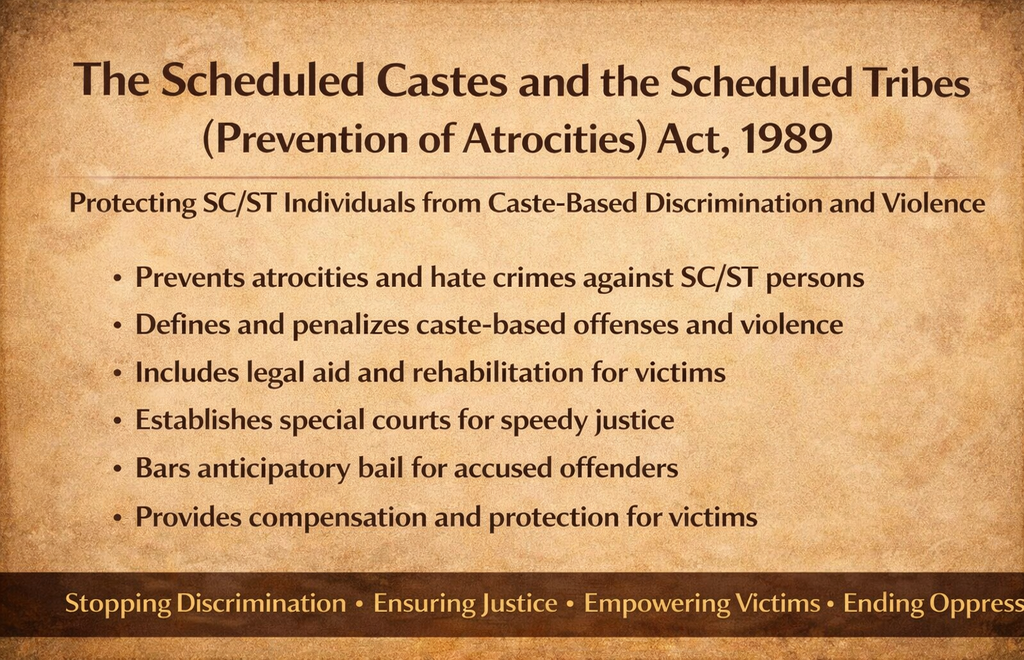
The SC/ST (Prevention of Atrocities) Act, 1989 is a protective social justice legislation aimed at:
- Preventing caste-based discrimination, humiliation, and violence
- Deterring atrocities against Scheduled Castes and Scheduled Tribes
- Ensuring speedy justice through Special Courts
- Providing relief, rehabilitation, and witness protection
It criminalizes a wide range of conduct under Section 3, including:
- Caste-based verbal abuse or humiliation
- Forcible dispossession of land
- Assault, sexual exploitation, or intimidation
- Social or economic boycott
- Destruction of property
- Denial of civil rights
Importantly, the Act can apply even if the initial complaint did not mention caste abuse, provided later evidence establishes the required ingredients.
3. Can the SC/ST Act Be Added Later? – The Legal Position
3.1 Statutory Basis
There is no legal prohibition in the SC/ST Act or the BNSS preventing the addition of SC/ST Act sections at a later stage of investigation.
On the contrary:
- The general investigative power under criminal law allows the police to add any relevant sections if the facts justify them.
- The special nature of the SC/ST Act does not restrict its invocation only at the FIR stage.
Therefore:
If evidence collected during investigation discloses caste-based atrocity elements, the Investigating Officer is duty-bound to add appropriate sections of the SC/ST Act, even if they were absent in the FIR.
3.2 Why the SC/ST Act Is Often Added Later
In real-life scenarios, the SC/ST Act is frequently added later because:
- Victims may hesitate initially to disclose caste identity or caste-based abuse due to fear, stigma, or pressure.
- Trauma or shock may prevent a detailed narration at the FIR stage.
- Witness statements recorded later may reveal caste insults or humiliation.
- Electronic evidence (audio, video, messages) may surface later.
- Independent witnesses may confirm caste-based motive during investigation.
- Medical or forensic evidence may strengthen atrocity allegations.
All these factors can justify the later addition of SC/ST Act provisions.
4. Judicial Interpretation on Adding the SC/ST Act Later
Indian courts have consistently upheld the power of police and courts to add SC/ST Act sections during investigation if justified by evidence.
4.1 Supreme Court Principles
The Supreme Court has held in multiple decisions that:
- An FIR is not an encyclopedia of all facts.
- The police can add new sections if fresh material discloses new offences.
- Courts should not quash proceedings merely because the SC/ST Act was not mentioned in the original FIR.
The guiding judicial principle is:
Substance over form — if the facts disclose an atrocity, the SC/ST Act must be applied, regardless of when those facts come to light.
4.2 High Court Decisions
High Courts across India have repeatedly ruled that:
- Addition of SC/ST Act sections during investigation is legally valid.
- Delay in invoking the Act is not fatal if properly explained.
- What matters is whether prima facie ingredients of the Act are satisfied.
However, courts also emphasize that:
- Mechanical addition without evidence is impermissible.
- There must be a clear caste-based element in the alleged conduct.
5. Procedural Mechanism for Adding the SC/ST Act
5.1 At the Investigation Stage
When new evidence emerges, the Investigating Officer may:
- Record supplementary statements of the victim or witnesses.
- Add relevant sections of the SC/ST Act in the case diary.
- Inform superior officers and the Special Public Prosecutor.
- Continue investigation under the expanded legal framework.
No fresh FIR is required. The same FIR number continues, but additional sections are formally incorporated.
5.2 At the Charge-Sheet Stage
At the time of filing the charge-sheet (final report under Section 193 BNSS):
- The IO can include SC/ST Act sections if supported by evidence.
- The Special Court or Magistrate examines:
- Whether prima facie ingredients of the Act are satisfied.
- Whether cognizance under the SC/ST Act should be taken.
5.3 During Trial
Even during trial:
- If evidence emerges during examination of witnesses showing caste atrocity elements:
- The court may frame additional charges under the SC/ST Act.
- This is permissible under criminal procedure law.
Thus, the Act can be added even after the charge-sheet is filed, provided due process is followed.
6. Essential Conditions for Adding the SC/ST Act Later
The mere emergence of new allegations is not enough. Courts require strict compliance with the legal ingredients of the Act.
6.1 Mandatory Legal Ingredients
To lawfully add SC/ST Act sections, the following must be prima facie established:
- The victim belongs to a Scheduled Caste or Scheduled Tribe.
- The accused belongs to a non-SC/ST community (in most cases).
- The alleged act falls within Section 3 of the Act.
- The act was committed because of the victim’s caste identity.
- There is some material evidence supporting the allegations.
6.2 Evidence That Justifies Addition
Courts generally look for:
- Witness testimony corroborating caste abuse or humiliation.
- Audio/video recordings.
- Written threats or messages.
- Medical evidence of assault linked to caste motive.
- Independent eyewitness accounts.
- Prior history of caste discrimination.
Without such material, courts may strike down the addition as arbitrary or abusive.
7. Consequences of Adding the SC/ST Act Later
Adding the SC/ST Act later significantly changes the legal complexion of a case.
7.1 Impact on Bail
Once SC/ST Act sections are added:
- Anticipatory bail is generally barred under Sections 18 and 18A.
- Regular bail becomes stricter and discretionary.
- Courts apply a higher threshold before granting bail.
This is why accused persons often challenge the late addition in High Courts.
7.2 Jurisdictional Shift to Special Courts
With the addition of SC/ST Act sections:
- The case must be tried by a Special Court designated under the Act.
- Procedural timelines and trial priorities change.
7.3 Enhanced Punishment and Compensation
- Punishments become more severe.
- Victims may become entitled to compensation under victim relief schemes.
- Witness protection provisions may be triggered.
8. Safeguards Against Misuse of Late Addition
Because of the serious legal consequences, courts have developed safeguards.
8.1 Judicial Review of Prima Facie Case
High Courts may quash the addition if:
- The dispute is purely civil or personal.
- No caste-based motive is visible.
- Allegations are vague or belated without explanation.
8.2 Protection Against Mechanical Addition
Courts have warned that:
- The SC/ST Act should not be added mechanically or vindictively.
- Police must conduct a reasoned analysis before invoking the Act.
9. Remedies Available to the Accused
If the SC/ST Act is added later unfairly or maliciously, the accused may:
9.1 File a Quashing Petition
Approach the High Court under Section 528 BNSS or Article 226 to:
- Quash the FIR or additional sections.
- Argue absence of caste motive or legal ingredients.
9.2 Seek Bail
If prima facie evidence is weak:
- Courts may grant regular bail.
- In rare cases, anticipatory bail may be considered where no prima facie case exists.
10. Remedies Available to the Victim
Victims also have legal remedies:
- Seek monitoring of investigation by senior officers.
- Demand prompt addition of relevant SC/ST Act sections.
- Approach courts for proper application of the Act.
- Claim compensation and protection.
11. Practical Scenarios
Scenario 1: Assault Case Turning Into Atrocity Case
Initially registered as IPC assault.
Later, witness states accused used caste slurs during the assault.
SC/ST Act can be added later.
Scenario 2: Property Dispute With Caste Abuse Emerging Later
Initial FIR for trespass and mischief.
Later evidence shows accused humiliated the victim due to caste identity.
SC/ST Act can be lawfully added.
Scenario 3: False or Tactical Addition
Initial commercial dispute.
After bail is granted, complainant alleges caste abuse without corroboration.
Court may quash the SC/ST Act addition.
12. Frequently Asked Questions (FAQs)
Q1. Can police add the SC/ST Act without court permission?
Yes. Police can add sections during investigation, subject to later judicial scrutiny.
Q2. Is delay in invoking the Act fatal to the case?
No. Delay alone is not fatal if properly explained and supported by evidence.
Q3. Can SC/ST Act sections be added after filing charge-sheet?
Yes. Courts can frame additional charges if evidence emerges later.
Q4. Does late addition automatically mean misuse?
No. Late addition is legally valid if supported by credible material.
Q5. Can accused challenge the late addition?
Yes. Accused may approach the High Court for quashing or seek bail relief.
Conclusion
Yes, the SC/ST (Prevention of Atrocities) Act, 1989 can be added later during investigation if credible evidence emerges showing that the alleged offence involved caste-based atrocity elements as defined under the Act. The law clearly empowers police and courts to add relevant sections at any stage of investigation or trial, provided the statutory ingredients are satisfied.
However, this power is not absolute. Courts insist on:
- A clear caste-based motive,
- Prima facie material supporting the allegations, and
- Strict adherence to the legal definition of “atrocity.”
Late addition is legally valid, but mechanical or malicious invocation is impermissible. High Courts retain the authority to quash unjustified additions to protect accused persons from misuse, while still preserving the protective purpose of the SC/ST Act.
In essence, the legal system strives to strike a careful balance — ensuring that genuine caste-based atrocities are fully addressed even if discovered later, while preventing the Act from being misused as a strategic tool in ordinary disputes.
Disclaimer: This information is intended for general guidance only and does not constitute legal advice. Please consult with a qualified lawyer for personalized advice specific to your situation.
Advocate J.S. Rohilla (Civil & Criminal Lawyer in Indore)
Contact: 88271 22304
