
Can the SC-ST (Prevention of Atrocities) Act-1989 Be Invoked in Property Disputes?
Direct Answer
Yes, the SC/ST (Prevention of Atrocities) Act, 1989 can be invoked in property disputes, but only if the alleged acts involving property reflect caste-based atrocities as defined under the Act. Simply having a property dispute between parties, even if they belong to Scheduled Castes (SC) and non–SC communities, does not automatically invoke the SC/ST Act. The key requirement is that the dispute must involve conduct that, in its nature and motivation, constitutes an “atrocity” committed because the victim belongs to a Scheduled Caste or Scheduled Tribe.
Introduction
Property disputes are among the most common civil conflicts in India, arising from inheritance issues, boundary disagreements, partition suits, sale and purchase issues, family settlements, and adverse possession claims. Most property disputes are governed by civil law — primarily the Transfer of Property Act, 1882, the Indian Succession Act, Hindu Succession Act, and the Code of Civil Procedure (CPC).
However, sometimes disputes over property acquire a criminal dimension when violent, coercive, or discriminatory behavior is alleged in connection with the dispute. One frequently asked legal question in this context is:
Can the SC/ST (Prevention of Atrocities) Act, 1989 be invoked in property disputes?
To answer this question comprehensively, we must explore the objectives and scope of the SC/ST Act, the circumstances in which it applies to property issues, the essential legal requirements to invoke it, judicial interpretations, practical scenarios, procedural implications, and safeguards against misuse.
1. Understanding the SC/ST (Prevention of Atrocities) Act, 1989
1.1 Purpose of the Act
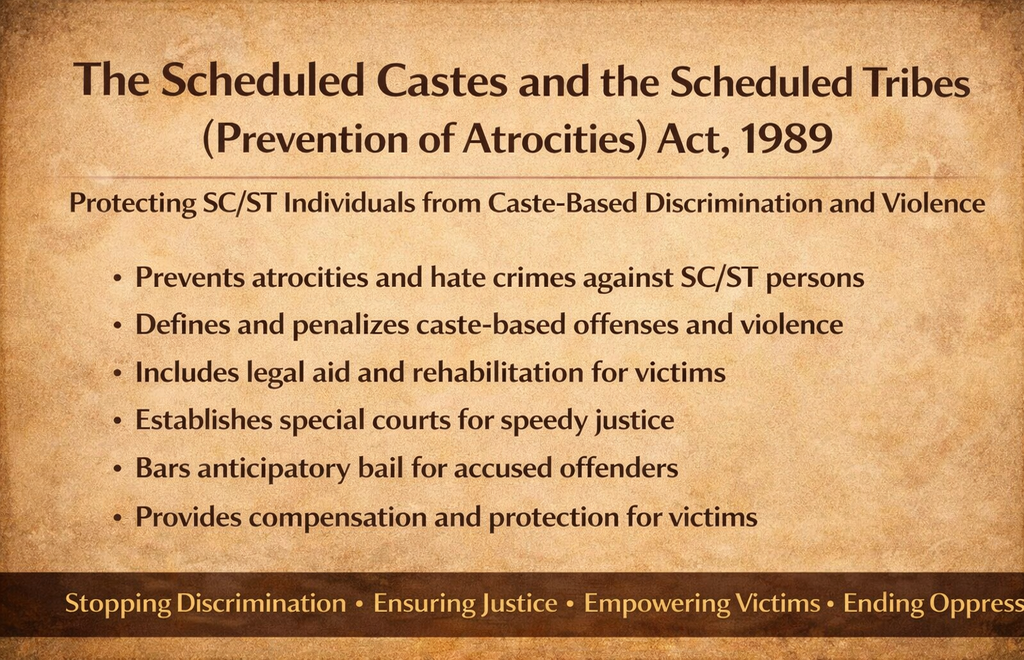
The SC/ST (Prevention of Atrocities) Act, 1989 was enacted as a social justice legislation to:
- Prevent the commission of atrocities against members of Scheduled Castes (SCs) and Scheduled Tribes (STs).
- Punish acts of caste-based discrimination, violence, humiliation, and social exclusion.
- Ensure relief, rehabilitation, and protection to victims.
- Provide for Special Courts and expedited trials.
The Act is therefore not a property law; rather, it is a protective criminal statute designed to combat historical oppression based on caste identity.
1.2 What Constitutes an “Atrocity” Under the Act?
The SC/ST Act defines a wide range of offences under Section 3, which includes:
- Physical assault
- Verbal abuse or humiliation in public view
- Denial of access to public spaces or services
- Social and economic boycott
- Forcible dispossession of land or premises
- Destruction or damage of property
- Intimidation or threats
- Exploitation or extortion related to caste identity
Importantly, several of these offences involve interference with property or land rights — but only when the conduct is motivated by caste discrimination and oppression.
2. Property and the SC/ST Act: Conceptual Framework
The key legal question is not whether a property dispute exists, but whether the conduct involved amounts to an atrocity based on caste. The mere fact that a case involves a property dispute does not automatically attract the SC/ST Act — it must show that:
- The victim belongs to a Scheduled Caste or Scheduled Tribe, and
- The accused belongs to a non-SC/ST community (in most cases), and
- The alleged conduct is committed because the victim belongs to an SC/ST community, and
- The act complained of has the ingredients of an atrocity defined under the Act.
Only when these conditions are satisfied, can the SC/ST Act be invoked in a property dispute.
3. SC/ST Act in Property-Related Context: Relevant Provisions
Certain clauses of Section 3 of the SC/ST Act expressly deal with property interference:
3.1 Forcible Occupation or Dispossession of Land or Premises
One of the listed atrocities is:
- Illegally occupying or dispossessing an SC/ST person of land or premises.
This provision directly refers to property and land issues but only if:
- The act is accompanied by caste-based motive, and
- The offender targets the victim because of their SC/ST identity.
3.2 Damage or Destruction of Property
The Act also penalizes:
- Destruction, damage, or defilement of any property owned by an SC/ST person, in his residence or otherwise.
Again, the distinguishing feature is that the offence must arise from caste motives, not a simple land dispute or breach of civil rights.
4. Property Dispute Alone Is Not Enough
There are many property disputes in India involving individuals from different castes. The SC/ST Act does not apply simply because:
- One party is SC/ST and the other is non-SC/ST
- A boundary dispute exists
- A will or succession dispute arises
- A mortgage or rental conflict exists
These are civil matters. If caste is not the motivating factor and the conduct does not fit into the statutory definition of atrocity, the SC/ST Act does not apply.
Example:
Two siblings dispute inheritance of agricultural land. One sibling happens to be SC and the other non-SC. If the dispute is over entitlement and valuation with no caste-motivated conduct, the SC/ST Act is inapplicable. Instead, the dispute must be resolved through civil courts under property and succession law.
5. Circumstances Where the SC/ST Act May Apply in Property Disputes
The SC/ST Act may apply where a property dispute escalates into caste-motivated atrocity conduct. Some typical situations include:
5.1 Caste-Motivated Forceful Eviction
Suppose a landowner tries to evict an SC person from their ancestral land, not merely on civil grounds, but by humiliating them, using caste slurs, damaging the property, threatening violence, or organizing social boycott. Here:
- The eviction is not a simple civil action.
- The conduct involves humiliation, intimidation, and forced dispossession.
- The accused treats the victim as inferior because of caste.
In such situations, the SC/ST Act can be invoked because the crux of the offence is caste-based atrocity intertwined with property interference.
5.2 Destruction of Property Coupled with Caste Abuse
If a non-SC neighbour destroys the property of an SC person and uses casteist language while doing so, the combination of property damage and caste humiliation transforms the act into a possible atrocity under Section 3.
5.3 Threat or Intimidation Based on Caste in Property Contexts
If threats, intimidation, or coercion about a property are expressed in caste terms (e.g., “we will teach you your place because you are SC”), courts may find the SC/ST Act applicable.
5.4 Economic Exploitation Targeting Property Rights
If one party exploits or coerces an SC person into giving up property rights through caste-based threats or social exclusion, the Act may be attracted, provided the caste motive is clear.
6. Judicial Interpretation on Property Disputes and the SC/ST Act
Indian courts have addressed the overlap between property disputes and caste atrocity allegations at length. Two guiding principles emerge from judicial decisions:
6.1 Caste Motivation Must Be Established
In Hitesh Verma v. State of Uttarakhand (2020), the Supreme Court held that for the SC/ST Act to apply:
The offence must be committed on the ground that the victim belongs to an SC/ST community.
This applies to property contexts as well: mere property conflict is insufficient. It must be demonstrated that caste identity was the reason behind the conduct.
6.2 Civil Remedies Are Primary in Pure Property Conflicts
If the dispute is purely about property entitlement, valuation, or procedural civil issues — even if castes of the parties differ — civil remedies under property and succession laws must be exhausted before invoking a criminal atrocity provision.
Many High Courts have quashed SC/ST Act FIRs where property disputes were mislabelled as caste atrocities without prima facie evidence of a caste motive.
7. Procedural and Evidentiary Considerations
Invoking the SC/ST Act in property disputes involves procedural and evidentiary nuances:
7.1 FIR Registration and Police Investigation
- The complainant must lodge an FIR under appropriate sections of the SC/ST Act.
- Under Section 18A, the police must register the FIR without preliminary inquiry if it discloses an atrocity.
- Police are obliged to investigate promptly.
7.2 Judicial Scrutiny of Caste Motive
In court proceedings, the prosecution must establish:
- That the victim is an SC/ST person,
- That the accused is not an SC/ST person,
- That the alleged conduct involved violence, intimidation, humiliation, dispossession, or other atrocity, and
- That the conduct was caste-motivated.
The burden of proof lies with the prosecution, but initial prima facie satisfaction is enough to frame charges.
7.3 Civil and Criminal Parallel Proceedings
Often, property disputes attract simultaneous civil suits (for rights) and criminal complaints under the SC/ST Act (for caste atrocities). Courts often coordinate these parallel tracks:
- Civil cases continue for property entitlement
- Criminal proceedings address caste atrocity components
8. Examples to Illustrate Application
Example 1: Forceful Caste-Motivated Dispossession
An SC individual holds ancestral land. A powerful non-SC neighbour forcibly enters the land, destroys boundary markers, humiliates the SC person with caste epithets, threatens violence, and seizes the land.
Here:
- Property interference is linked to caste humiliation and coercion.
- SC/ST Act applies.
Example 2: Pure Property Succession Dispute
Two siblings — one SC and one non-SC — dispute ancestral property succession. They argue in civil court, but no caste insults, threats, or discriminatory conduct occur.
Here:
- SC/ST Act is not attracted.
- Civil courts decide on inheritance rights.
Example 3: Property Litigation with a Single Insult
During a property negotiation, a party utters a single casteist insult but immediately apologizes and the dispute remains a financial disagreement.
Here:
- Courts may scrutinize whether the conduct constituted an atrocity.
- A single insult may not satisfy the elements of the SC/ST Act unless part of a broader pattern of hatred and discrimination.
9. Interplay With Other Laws
When property disputes involve criminal conduct, multiple laws may overlap:
9.1 Indian Penal Code (IPC) / Bharatiya Nyaya Sanhita (BNS)
- Criminal intimidation
- Wrongful restraint or confinement
- Mischief/damage to property
- Criminal trespass
These provisions apply regardless of caste motive, but do not address caste oppression.
9.2 Civil Laws
- Transfer of Property Act
- Indian Succession Act
- Hindu Succession Act
- Specific Relief Act
These govern ownership, succession, partition, and rights, irrespective of caste.
9.3 SC/ST Act as Overlay
When property conflict also involves caste discrimination and humiliation, the SC/ST Act provides additional criminal liability and broader social protection.
10. Safeguards Against Misuse
Because property disputes are common, courts have developed safeguards:
- Prima facie examination of caste motive
- Quashing FIRs when no atrocity elements are present
- Judicial scrutiny to prevent frivolous invocation
- Requirement that caste identity and motive be clearly linked
These safeguards ensure that the SC/ST Act is not used as a shield for ordinary civil disputes.
11. Judicial Remedies in Property–SC/ST Act Cases
11.1 Quashing/Declining to Take Cognizance
Courts may quash an FIR or decline to take cognizance if:
- No caste atrocity is prima facie evident
- The dispute is purely civil or contractual
- Allegations are vague or unrelated to caste
11.2 Trial
Where caste atrocity elements exist, courts will:
- Frame charges under relevant sections
- Conduct trial in a Special Court
- Consider property and caste atrocity evidence
11.3 Compensation and Relief
Victims may be entitled to:
- Victim compensation schemes
- Restitution or restoration of property
- Protective orders
12. Challenges in Application
12.1 Determining Caste Motive
Proving that property interference was because of caste identity requires:
- Clear patterns of discrimination or humiliation
- Evidence that conduct goes beyond normal civil dispute behavior
12.2 Mixed Motives
In many disputes, motives may be mixed (property + personal animosity). Courts must carefully untangle caste elements from civil conflicts.
12.3 Delay in Civil Resolution
Overlap with civil disputes may delay resolution of the caste atrocity component or complicate evidence gathering.
13. Frequently Asked Questions (FAQs)
Q1. Can every property dispute involving SC and non-SC parties attract the SC/ST Act?
No — only where the conduct involves caste-based atrocity, not just a civil property conflict.
Q2. Are compensation and criminal penalties both possible?
Yes — the SC/ST Act can provide criminal liability and compensation, whereas civil courts ensure property rights.
Q3. What happens if a property dispute turns violent but without caste motive?
Criminal laws such as IPC/BNS apply; the SC/ST Act does not.
Q4. Can the SC/ST Act support injunctions in civil courts?
No — the SC/ST Act is criminal; injunctive relief in civil disputes is a separate remedy.
Q5. Is caste documentation required to invoke the Act?
Yes — proof of the victim’s SC/ST status and accused’s non-SC/ST status is crucial.
14. Conclusion
Yes, the SC/ST (Prevention of Atrocities) Act, 1989 can be invoked in property disputes — but only where the conduct involves caste-based atrocities and not merely a civil property disagreement. The decisive factor is not the existence of a property conflict, but whether one party’s actions against an SC/ST person reflect caste-motivated humiliation, intimidation, coercion, dispossession, or discriminatory conduct that satisfies the statutory definition of an “atrocity” under Section 3 of the Act.
To invoke the Act:
- Establish caste identity clearly;
- Demonstrate that the alleged conduct went beyond ordinary civil dispute behavior;
- Provide credible evidence that caste was the motivating factor;
- Show that acts fall within the ambit of the specific atrocity provisions.
If these conditions are missing, courts will treat the matter as a civil or ordinary criminal dispute and will not apply the SC/ST Act.
Understanding this distinction is crucial for litigants, lawyers, police officers, and judges — ensuring that the Act is appropriately used as a protective shield against caste atrocities rather than as a tool for routine property controversies. For anyone dealing with complex property disputes that may have caste dimensions, expert legal advice and careful evidence gathering are essential to navigate the intersection of civil property law and criminal atrocity provisions effectively.
Disclaimer: This information is intended for general guidance only and does not constitute legal advice. Please consult with a qualified lawyer for personalized advice specific to your situation.
Advocate J.S. Rohilla (Civil & Criminal Lawyer in Indore)
Contact: 88271 22304
