
Is compromise permitted in cases under the SC-ST (Prevention of Atrocities) Act-1989?
Is Compromise Permitted in Cases Under the SC/ST (Prevention of Atrocities) Act, 1989? – A Comprehensive Legal Analysis
Introduction
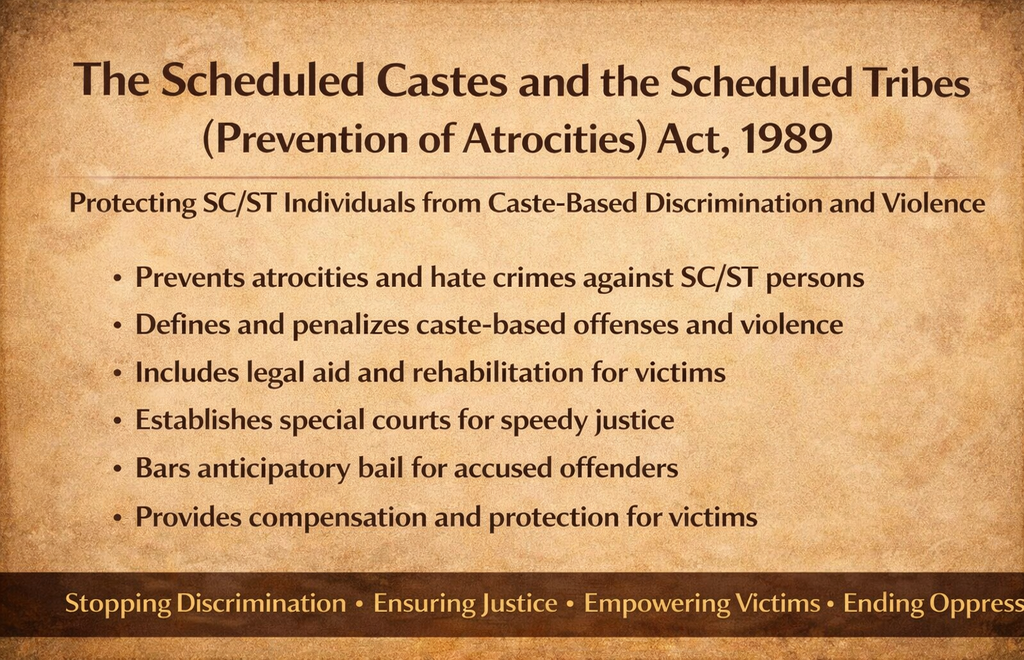
The Scheduled Castes and the Scheduled Tribes (Prevention of Atrocities) Act, 1989, widely known as the SC/ST (Prevention of Atrocities) Act, 1989, is a special criminal legislation enacted to prevent and penalize caste-based atrocities and discrimination against members of Scheduled Castes (SC) and Scheduled Tribes (ST). The Act was enacted in recognition of the historical marginalization, social injustice, and oppression faced by these communities and aims to provide swift legal recourse, protection, and rehabilitation to victims.
One of the frequently asked questions in cases under this Act is whether compromise or settlement between the parties is legally permissible. This is a critical question because, unlike ordinary criminal cases, the SC/ST Act is designed to protect victims from structural and social oppression, and thus the scope for compromise is heavily restricted.
Direct Answer:
No, compromise is generally not permitted in cases under the SC/ST (Prevention of Atrocities) Act, 1989, because the offenses are considered crimes against the state and the society, not merely against the individual victim. However, courts have limited discretion to consider restitution or reconciliation in extremely exceptional cases where the offense is minor and both parties voluntarily seek settlement.
This article provides a structured, detailed, and comprehensive guide on the issue of compromise in SC/ST Act cases, including statutory provisions, judicial interpretations, exceptions, and practical implications for victims, accused, and legal practitioners.
1. Understanding the Nature of Offenses Under the SC/ST Act
1.1 Categorization of Offenses
The SC/ST (Prevention of Atrocities) Act, 1989 criminalizes a wide range of acts against members of Scheduled Castes and Scheduled Tribes, including:
- Physical assault and sexual violence
- Humiliation, harassment, and insult in public or private settings
- Social and economic boycott
- Forcible dispossession of property
- Abuse of official position by public servants
- Denial of access to public services, public spaces, and resources
1.2 Nature of Offenses
- Most offenses under the SC/ST Act are cognizable, non-bailable, and punishable with imprisonment of 3-10 years or more.
- These are considered offenses against the state and society, not merely private disputes between two individuals.
- Because of this public interest dimension, compromise is not automatically allowed, unlike in minor criminal cases.
2. Statutory Provisions Regarding Compromise
2.1 Section 18 of the SC/ST Act
- Section 18 provides that no anticipatory bail shall be granted, and emphasizes stringent procedural safeguards to prevent abuse of the law.
- Although it does not directly mention compromise, it reinforces that the Act prioritizes public justice and victim protection over private settlement.
2.2 Sections 14 and 15 – Role of Special Courts
- Special Courts under the SC/ST Act are tasked with ensuring speedy trial and delivering justice.
- These courts are generally not empowered to allow compromise that would result in the withdrawal of criminal proceedings, except in minor or exceptional circumstances.
3. Judicial Approach to Compromise in SC/ST Act Cases
Judicial decisions have clarified that compromise is generally prohibited but can be considered under exceptional and limited circumstances.
3.1 State vs. Dinesh Kumar (Punjab & Haryana High Court)
- The court held that offenses under the SC/ST Act are non-compoundable by law, even if the victim expresses a desire to settle the matter.
- The rationale is that these offenses are against public order and the social dignity of the community, not just the individual.
3.2 Subhash Kashinath Mahajan v. State of Maharashtra (2018, Supreme Court)
- The Court acknowledged the possibility of minor disputes being resolved amicably, but clarified that:
- Major offenses involving assault, humiliation, sexual abuse, or dispossession cannot be compromised.
- Any settlement should not affect the mandatory investigation or prosecution of serious offenses.
3.3 Prathvi Raj Chauhan v. Union of India (2020)
- Reaffirmed that the SC/ST Act prioritizes state intervention to protect victims.
- Courts can encourage reconciliation in minor cases, but quashing of FIR or withdrawal of prosecution based on compromise is rarely permitted.
3.4 High Court Observations
- High Courts across India, including Madras, Kerala, and Delhi High Courts, have consistently held that compromise cannot be used as a tool to evade criminal liability under the SC/ST Act.
- In some cases, courts have considered restorative justice measures such as apologies, restitution, or compensation without affecting the criminal proceedings.
4. Minor vs. Serious Offenses: Differentiating Scope for Compromise
4.1 Minor Offenses
- Examples: Minor verbal insult, petty harassment, or social slights.
- Courts may consider amicable settlement or reconciliation, especially if:
- Both parties voluntarily agree
- No serious physical, sexual, or property-related harm occurred
- Settlement is documented without coercion
4.2 Serious Offenses
- Examples: Physical assault, sexual violence, forcible dispossession, social boycott.
- Courts do not permit compromise, as these offenses are considered crimes against society and SC/ST communities at large.
- Allowing compromise in serious cases would undermine the deterrent purpose of the Act.
5. Role of Victim Consent
While victim consent is important, it does not automatically allow compromise in SC/ST Act cases.
- Courts can consider victim statements in mitigation of punishment, or for recommending reconciliation programs, but cannot terminate the case solely based on victim consent.
- Section 18A and subsequent amendments emphasize mandatory investigation, making victim consent irrelevant for quashing or stopping prosecution in serious cases.
6. Role of Special Courts in Handling Compromise
6.1 Discretionary Powers
- Special Courts can consider restitution, apologies, or social reconciliation programs, particularly in minor disputes.
- However, they cannot discharge the accused based on compromise alone unless:
- The offense is minor
- There is clear evidence that no significant harm to public or victim rights occurred
- Public interest is not adversely affected
6.2 Limitations
- Courts have clarified that compromise cannot affect investigation, FIR registration, or trial in major offenses.
- Any attempt to evade prosecution through private settlement in serious offenses may lead to contempt of court or prosecution for obstruction of justice.
7. Practical Considerations for Victims
- Victim Empowerment: Victims may express willingness to forgive or settle minor disputes but must understand that serious crimes cannot be compromised.
- Restorative Justice: Courts may facilitate measures like apology letters, mediation, or compensation, even while criminal proceedings continue.
- Legal Representation: Victims should retain lawyers to ensure their rights are protected, including the right to compensation and rehabilitation.
8. Practical Considerations for Accused Persons
- Seek Legal Advice Early: Understand which offenses are non-compoundable.
- Explore Restorative Measures: In minor cases, voluntarily offering apology or restitution may be considered in mitigation of punishment.
- Do Not Attempt Illegal Compromise: Trying to evade prosecution through coercion or bribery can worsen legal consequences.
9. Exceptions Where Courts May Consider Settlement
- Minor verbal insult or humiliation
- Property disputes without physical harm
- Offenses without any public or community impact
- Both parties voluntarily approach the court seeking reconciliation
Even in these cases, compromise is at the discretion of the Special Court, and the court ensures that the social purpose of the SC/ST Act is not undermined.
10. Frequently Asked Questions (FAQs)
Q1. Is compromise allowed in SC/ST Act cases?
Generally, no. Compromise is prohibited in most cases as offenses are against public interest and social dignity of SC/ST communities.
Q2. Can courts consider reconciliation or restitution?
Yes, in minor cases, courts may facilitate apologies, restitution, or mediation without terminating criminal proceedings.
Q3. Does victim consent allow quashing of FIR under the SC/ST Act?
No. Victim consent alone does not allow quashing or withdrawal of prosecution in serious offenses.
Q4. What is the role of Special Courts in compromise?
Special Courts may consider minor settlements, mitigation, or restorative measures, but cannot discharge accused in serious offenses based on compromise.
Q5. Are there exceptions to the no-compromise rule?
Yes, minor verbal, social, or non-violent disputes may be considered for settlement, at the discretion of the court.
Conclusion
The SC/ST (Prevention of Atrocities) Act, 1989 is a robust social justice legislation aimed at protecting the dignity, rights, and social position of Scheduled Castes and Scheduled Tribes. Given the serious public and societal nature of the offenses under this Act, compromise or settlement is generally prohibited, particularly for serious offenses involving violence, sexual assault, property dispossession, or social humiliation.
Directly stated: Compromise is not permitted in cases under the SC/ST (Prevention of Atrocities) Act, 1989 in most circumstances, except in rare, minor, and non-violent disputes where the court may allow reconciliation or restorative measures.
Courts carefully balance victim protection, societal interest, and the rights of the accused, ensuring that the Act’s purpose of eradicating caste-based atrocities is not undermined by private settlements. Both victims and accused must approach the matter with full legal guidance to navigate the sensitive and complex provisions of the SC/ST Act effectively.
Disclaimer: This information is intended for general guidance only and does not constitute legal advice. Please consult with a qualified lawyer for personalized advice specific to your situation.
Advocate J.S. Rohilla (Civil & Criminal Lawyer in Indore)
Contact: 88271 22304
