
Is Prior Sanction Required to Prosecute Under the SC-ST (Prevention of Atrocities) Act-1989?
Is Prior Sanction Required to Prosecute Under the SC/ST (Prevention of Atrocities) Act, 1989? – A Detailed Legal Guide
Introduction
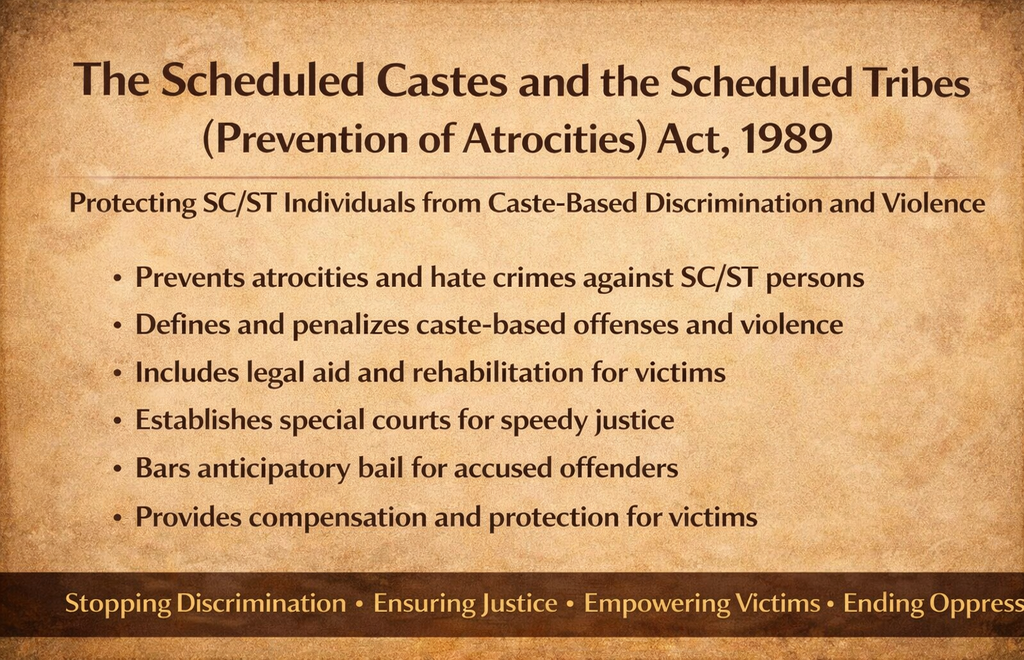
The Scheduled Castes and the Scheduled Tribes (Prevention of Atrocities) Act, 1989 is a special social welfare legislation enacted to prevent caste-based discrimination, humiliation, violence, and exploitation against members of Scheduled Castes (SC) and Scheduled Tribes (ST). The Act was designed to provide speedy justice, strict punishment, and effective protection to victims who historically faced systemic oppression and denial of legal remedies.
One of the most frequently asked and legally significant questions in cases under this Act is:
Is prior sanction required to prosecute an accused under the SC/ST (Prevention of Atrocities) Act, 1989?
This question becomes even more critical when the accused is a public servant, such as a police officer, revenue official, or government employee, because under general criminal law, prior government sanction is often mandatory to prosecute public officials for acts done in the course of official duty.
Direct Answer:
No, prior sanction is generally not required to prosecute an accused under the SC/ST (Prevention of Atrocities) Act, 1989, including public servants, when the alleged act constitutes an atrocity or willful neglect of duty under the Act.
This article provides a detailed, structured, and comprehensive analysis of the law relating to sanction under the SC/ST Act, including statutory provisions, judicial interpretations, differences from Cr.P.C. sanction rules, special cases involving public servants, and practical guidance for both victims and accused persons.
1. Understanding the Concept of “Prior Sanction” in Criminal Law
1.1 What Is Prior Sanction?
Prior sanction refers to formal approval from a competent authority (usually the government or a department head) before a criminal court can take cognizance of an offense against certain categories of persons, particularly public servants.
The purpose of sanction is to:
- Protect honest officials from frivolous or vexatious litigation
- Allow government to assess whether prosecution is necessary
- Prevent interference with administrative functioning
1.2 Sanction Under the Code of Criminal Procedure (Cr.P.C.)
Under Section 197 of the Cr.P.C., prior sanction is required to prosecute a public servant for offenses alleged to have been committed:
- While acting
- Or purporting to act
- In the discharge of official duty
Without sanction, the court cannot take cognizance of such offenses.
1.3 Sanction Under Special Laws
Many special laws, including anti-corruption and social welfare statutes, override Section 197 Cr.P.C. and lay down their own rules regarding sanction.
The SC/ST (Prevention of Atrocities) Act, 1989 is one such special law.
2. Statutory Scheme of the SC/ST (Prevention of Atrocities) Act, 1989
The SC/ST Act is a self-contained code intended to ensure immediate legal action and deterrence. Its provisions reflect a legislative intent to:
- Remove procedural hurdles
- Prevent administrative delays
- Ensure accountability of both private individuals and public servants
2.1 Does the SC/ST Act Mention Sanction Anywhere?
The Act does not contain any provision requiring prior sanction from the government or any authority before:
- Registering an FIR
- Investigating an offense
- Filing a charge sheet
- Taking cognizance by the Special Court
This omission is intentional, indicating that Parliament did not want the prosecution of atrocities to be delayed or blocked by bureaucratic approvals.
2.2 Section 4 – Punishment for Neglect of Duties by Public Servants
Section 4 specifically deals with public servants and provides that:
Whoever, being a public servant but not being a member of a Scheduled Caste or a Scheduled Tribe, willfully neglects his duties required to be performed by him under this Act, shall be punishable with imprisonment for a term which shall not be less than six months but which may extend to one year.
Notably, Section 4 does not require any sanction for prosecuting such public servants.
3. Direct Answer to the Main Question
Is prior sanction required to prosecute under the SC/ST (Prevention of Atrocities) Act, 1989?
No, prior sanction is not required to prosecute any person, including a public servant, under the SC/ST (Prevention of Atrocities) Act, 1989, if the alleged act constitutes an offense under the Act or amounts to willful neglect of duty.
This principle flows from:
- The special nature of the Act
- Its overriding effect over general laws
- Judicial interpretation by constitutional courts
4. Why Prior Sanction Is Not Required Under the SC/ST Act
4.1 The SC/ST Act Is a Special Law
Under settled principles of statutory interpretation:
- A special law prevails over a general law
- The SC/ST Act prevails over the Cr.P.C.
- Therefore, Section 197 Cr.P.C. cannot be used to block prosecution under the SC/ST Act
4.2 Legislative Intent Behind Removing Sanction Barriers
The SC/ST Act was enacted because:
- Police often refused to register FIRs
- Officials shielded influential accused persons
- Victims were denied access to justice
- Delays destroyed evidence and intimidated witnesses
Requiring sanction would:
- Reintroduce delay
- Enable political interference
- Undermine victim protection
4.3 Acts Under the SC/ST Act Are Not “Official Duties”
Courts have consistently held that:
- Caste abuse
- Violence
- Dispossession
- Sexual exploitation
- Willful neglect of duty
Are not legitimate acts of official duty.
Therefore, even under Section 197 Cr.P.C., sanction is not needed because:
- The acts complained of do not arise from lawful official functions
- They are personal and illegal conduct
5. Judicial Interpretation on Sanction Under the SC/ST Act
Indian courts have repeatedly clarified that prior sanction is not a pre-condition for prosecution under the SC/ST Act.
5.1 Supreme Court in Subhash Kashinath Mahajan v. State of Maharashtra (2018)
Although the Court initially introduced safeguards, it observed that:
- Public servants are not immune under the SC/ST Act
- Protection under Section 197 Cr.P.C. is limited
- Atrocities and neglect of duty fall outside official functions
5.2 Supreme Court in Prathvi Raj Chauhan v. Union of India (2020)
The Court upheld:
- The constitutional validity of strict provisions
- The legislative intent to ensure immediate action
- The absence of sanction requirements
It reaffirmed that:
- Courts must balance misuse concerns
- But victim protection takes precedence
5.3 High Court Rulings
Various High Courts have consistently held that:
- No sanction is required to prosecute public servants under the SC/ST Act
- Delay in granting sanction cannot stall prosecution
- The Act overrides Cr.P.C.
6. Difference Between SC/ST Act and Other Laws on Sanction
| Aspect | SC/ST Act | BNSS Section 218 | Prevention of Corruption Act |
|---|---|---|---|
| Is sanction required? | No | Yes (for official acts) | Yes |
| Applies to public servants? | Yes | Yes | Yes |
| Overrides general law? | Yes | No | Yes |
| Victim-centric? | Yes | No | No |
| Speedy trial objective? | Yes | No | Yes |
7. Special Case: Public Servants as Accused
7.1 When Public Servants Commit Atrocities
If a public servant:
- Abuses by caste name
- Assaults an SC/ST person
- Denies public services
- Illegally arrests
- Dispossesses land
They can be prosecuted without any sanction.
7.2 When Public Servants Neglect Their Duties
If a public servant:
- Refuses to register FIR
- Delays investigation
- Suppresses evidence
- Denies compensation
- Fails to protect victims
They can be prosecuted under Section 4 without sanction.
8. Can Accused Persons Take a Defence Based on Lack of Sanction?
8.1 General Position
In most SC/ST Act cases:
- Courts reject the defense of lack of sanction
- Prosecution proceeds unhindered
8.2 Exceptional Situations
In rare cases where:
- The act is purely administrative
- There is no caste element
- The complaint is manifestly malicious
Courts may:
- Quash proceedings
- Protect honest officials
But even then, quashing is based on lack of prima facie case, not absence of sanction.
9. Practical Implications for Victims
Victims should:
- Lodge FIR immediately
- Mention caste-based motive clearly
- Name public servant accused if involved
- Demand action under relevant sections
- Approach Special Court directly
- Seek compensation and protection
- File writ or contempt if police delay action
They do not need to:
- Obtain any sanction
- Wait for government approval
10. Practical Implications for Accused Persons
Accused persons, including public servants, should:
- Seek legal counsel immediately
- Cooperate with investigation
- Avoid contacting the victim
- Preserve official records
- Challenge false cases in High Court
- Apply for regular bail after arrest
- Avoid relying solely on sanction defenses
11. Frequently Asked Questions (FAQs)
Q1. Is sanction required to register an FIR under the SC/ST Act?
No, FIR can be registered immediately without sanction.
Q2. Is sanction required to file a charge sheet under the SC/ST Act?
No, police can file a charge sheet without sanction.
Q3. Is sanction required if the accused is a police officer?
No, police officers can be prosecuted without sanction.
Q4. Can courts take cognizance without sanction?
Yes, Special Courts can take cognizance directly.
Conclusion
The SC/ST (Prevention of Atrocities) Act, 1989 was enacted to eliminate procedural obstacles that historically denied justice to SC/ST victims. One of the most significant barriers in ordinary criminal law—the requirement of prior sanction—has been consciously excluded from this special legislation.
In clear and direct terms:
Prior sanction is not required to prosecute any person, including public servants, under the SC/ST (Prevention of Atrocities) Act, 1989 when the alleged act constitutes an atrocity or willful neglect of duty.
This legal position ensures:
- Immediate registration of FIRs
- Speedy investigation
- Accountability of public officials
- Protection of victims
- Effective deterrence against caste-based crimes
At the same time, Indian courts have maintained a careful balance by allowing quashing of false or malicious cases, thereby protecting honest officials and innocent individuals from misuse.
Ultimately, the absence of a sanction requirement strengthens the Act’s core purpose—delivering swift, meaningful, and uncompromised justice to members of Scheduled Castes and Scheduled Tribes, in line with constitutional values of equality, dignity, and social justice.
Disclaimer: This information is intended for general guidance only and does not constitute legal advice. Please consult with a qualified lawyer for personalized advice specific to your situation.
Advocate J.S. Rohilla (Civil & Criminal Lawyer in Indore)
Contact: 88271 22304
