
What reliefs and compensation are available to victims under the SC-ST (Prevention of Atrocities) Act-1989?
Reliefs and Compensation Available to Victims Under the SC/ST (Prevention of Atrocities) Act, 1989 – A Comprehensive Guide
Introduction
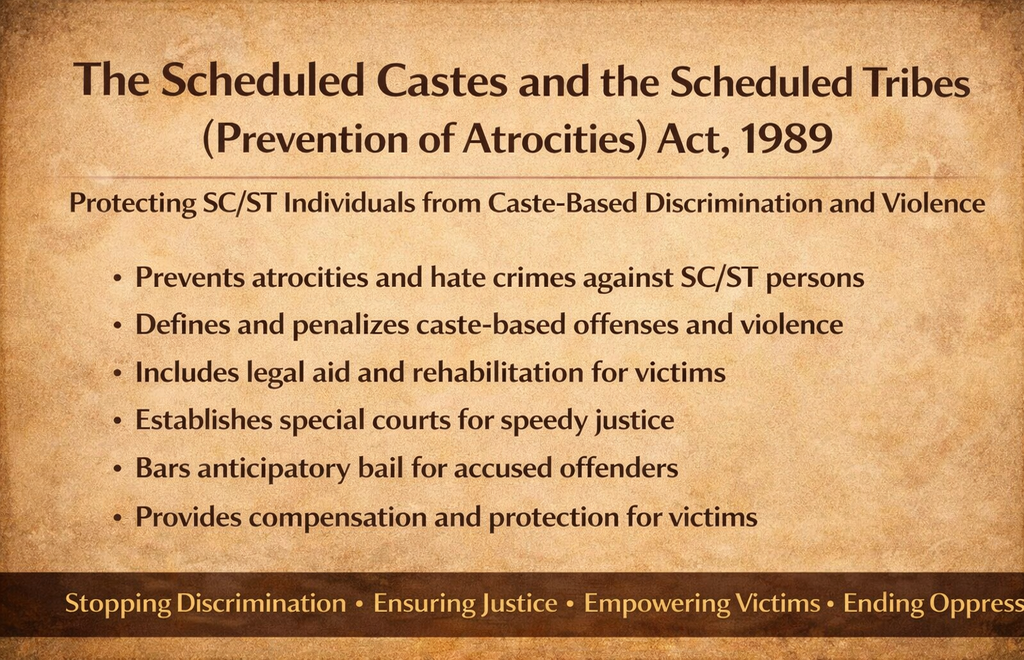
The Scheduled Castes and the Scheduled Tribes (Prevention of Atrocities) Act, 1989, widely known as the SC/ST (Prevention of Atrocities) Act, 1989, was enacted to provide stringent protection to members of Scheduled Castes (SC) and Scheduled Tribes (ST) against caste-based atrocities, humiliation, social discrimination, and violence. Over time, the Act has been strengthened through judicial interpretations and legislative amendments, particularly through the Scheduled Castes and Scheduled Tribes (Prevention of Atrocities) Amendment Act, 2015 and 2018, to ensure that victims receive timely relief, rehabilitation, and compensation.
Victims of atrocities under this Act face not only physical and psychological trauma but also social and economic disadvantages. Recognizing this, the law provides for multiple forms of legal, financial, and social relief to help victims regain dignity and stability.
Direct Answer:
Victims under the SC/ST (Prevention of Atrocities) Act, 1989 are entitled to reliefs including compensation for physical and mental harm, rehabilitation, legal aid, protection from harassment, and expedited trial through Special Courts.
This article presents a detailed, structured, and comprehensive overview of all forms of relief and compensation available to victims under the SC/ST (Prevention of Atrocities) Act, 1989, including statutory provisions, judicial interpretations, procedural mechanisms, and practical guidance.
1. Types of Relief and Compensation under the SC/ST Act
Relief and compensation for victims under the SC/ST (Prevention of Atrocities) Act, 1989 can broadly be categorized into:
- Monetary Compensation
- Rehabilitation and Resettlement
- Legal Aid and Court Support
- Protection and Security Measures
- Psychological and Social Assistance
1.1 Monetary Compensation
Monetary compensation is one of the most direct and immediate forms of relief to victims, ensuring that they are financially supported after an atrocity.
1.1.1 Compensation for Physical Harm
- Victims who have suffered injuries or physical assault are entitled to compensation for medical treatment, loss of earnings, and pain and suffering.
- The State Governments are directed under the Act to maintain Victim Compensation Schemes for SC/ST victims, which include:
- Cost of hospitalization and medical care
- Compensation for temporary or permanent disability
- Reimbursement for income lost during recovery
1.1.2 Compensation for Mental Trauma
- SC/ST victims of verbal abuse, humiliation, or psychological harassment can claim compensation for mental trauma or emotional distress.
- Courts and state authorities recognize that caste-based humiliation can have long-term social and psychological consequences, and awards are made accordingly.
1.1.3 Judicial Precedents
- State of Karnataka v. L. Chandrakala (2009): Compensation awarded to victim for severe physical assault under SC/ST Act.
- State of Haryana v. Dalbir Singh (2017): Court emphasized that financial relief should be proportionate to the injury and social impact suffered.
1.2 Rehabilitation and Resettlement
Victims often face long-term social and economic difficulties due to caste-based atrocities. The SC/ST Act mandates rehabilitation measures to restore their social dignity.
1.2.1 Provision of Shelter
- Victims displaced due to caste-based violence may receive temporary housing or resettlement assistance from the State.
- This ensures protection from further harassment or threats.
1.2.2 Educational and Employment Support
- SC/ST victims may receive priority access to scholarships, vocational training, or employment opportunities to rebuild their lives.
- State governments provide special programs for children of victims to ensure continuation of education.
1.2.3 Social Reintegration
- The law encourages community-based rehabilitation, ensuring that victims can safely return to their villages or neighborhoods.
- District Collectors or Special Officers are often tasked with monitoring social reintegration programs.
1.3 Legal Aid and Court Support
The SC/ST Act recognizes that victims often lack access to legal resources, and therefore provides for legal relief and assistance.
1.3.1 Free Legal Aid
- Victims are entitled to free legal representation under the Legal Services Authorities Act, 1987.
- Legal aid ensures that SC/ST victims are not deterred from filing complaints due to financial constraints.
1.3.2 Special Courts for Expedited Trials
- The SC/ST Act mandates Special Courts for speedy trial of offenses.
- These courts are empowered to dispose of cases promptly, reducing prolonged harassment of victims.
1.3.3 Protection Against Retaliation
- Courts may issue protection orders to prevent harassment, intimidation, or threats to the victim or their witnesses.
- Police officers are directed to provide security arrangements if necessary, especially in high-risk cases.
1.4 Protection and Security Measures
The SC/ST Act and its amendments focus on ensuring personal safety and dignity of victims.
1.4.1 Police Protection
- Section 18A and related rules empower police to ensure immediate protection for victims facing threats from accused individuals.
- Special patrols, safe houses, or emergency helplines may be provided.
1.4.2 Prohibition of Anticipatory Bail for Accused
- Section 18A explicitly bars anticipatory bail for accused in SC/ST atrocity cases.
- This ensures that accused persons cannot intimidate or harass the victim during investigation and trial.
1.4.3 Social Awareness and Community Intervention
- District authorities are required to raise awareness in communities to prevent further victimization.
- Community policing, awareness campaigns, and rapid response mechanisms are often deployed.
1.5 Psychological and Social Assistance
Victims of caste-based atrocities suffer severe emotional trauma, which may require professional intervention.
1.5.1 Counseling Services
- Victims are entitled to psychological counseling under state rehabilitation programs.
- This includes trauma therapy, mental health support, and rehabilitation planning.
1.5.2 Support Groups
- Social organizations and government-supported groups provide peer support for victims and families.
- This helps in reducing stigma, social isolation, and emotional distress.
2. Statutory Provisions and Guidelines for Compensation
2.1 Section 14 – Relief and Compensation
- Provides that victims of atrocities are entitled to rehabilitation, restitution, and financial compensation.
- Directs State Governments to formulate schemes and policies to ensure timely disbursement of compensation.
2.2 Section 15 – Special Officer for Monitoring
- States must appoint Special Officers at district or sub-district level to monitor relief and rehabilitation measures.
- These officers ensure coordination between police, courts, and social welfare departments for victim support.
2.3 Scheduled Castes and Tribes (Prevention of Atrocities) Rules
- State governments implement rules for compensation calculation, relief distribution, and rehabilitation programs.
- Victim compensation often includes:
- Medical expenses
- Loss of income or property damage
- Psychological counseling
- Housing and educational support
3. Judicial Approach to Victim Compensation
3.1 Guidelines from the Supreme Court
- D.K. Basu v. State of West Bengal (1997): Courts must ensure prompt relief and protection for vulnerable victims.
- State of Karnataka v. L. Chandrakala (2009): Monetary compensation should reflect physical, emotional, and social harm.
- Dalbir Singh v. State of Haryana (2017): Courts emphasized timely disbursement of compensation to restore dignity and economic stability.
3.2 Compensation Beyond Court Awards
- Victims may receive state-provided financial assistance in addition to any judicial award.
- Programs often cover long-term rehabilitation, medical care, and educational support for dependents.
4. Procedure for Claiming Relief and Compensation
4.1 Filing a Complaint
- Victims must register an FIR under the SC/ST Act (mandatory under Section 18A).
- Police or Special Courts then initiate investigation and trial.
4.2 Application for Compensation
- Victims can apply for compensation to:
- Special Court
- District Magistrate / Collector
- State Social Welfare Department
- Supporting documents required:
- Medical reports
- FIR copy
- Proof of loss of income or property
- Identity proof of victim as SC/ST
4.3 Disbursement
- Compensation is generally disbursed within 30 to 90 days of approval.
- Special Officers monitor timely delivery and ensure no bureaucratic delays.
5. Practical Guidance for Victims
- Ensure FIR Registration: Immediate registration of FIR under the SC/ST Act triggers eligibility for relief and compensation.
- Document Evidence: Keep detailed records of injury, property loss, medical bills, and psychological impact.
- Apply for Compensation Early: Approach Special Courts or District Collectors promptly.
- Seek Legal Aid: Free legal aid is available under Legal Services Authorities Act.
- Follow Up: Maintain communication with Special Officers for timely disbursement of relief.
6. Practical Guidance for Accused Persons
- Understand that relief and compensation provisions are for victims, not accused.
- Cooperate with investigation to avoid additional charges for obstruction or harassment.
- In minor disputes, voluntary restitution or reconciliation may be considered without affecting statutory penalties.
7. Frequently Asked Questions (FAQs)
Q1. What types of compensation are available to victims under the SC/ST Act?
Monetary compensation for physical and mental harm, loss of income, property damage, and cost of medical treatment.
Q2. Can victims receive legal aid for SC/ST Act cases?
Yes, victims are entitled to free legal representation under the Legal Services Authorities Act.
Q3. Are there special courts for SC/ST Act cases?
Yes, Special Courts ensure speedy trial and relief.
Q4. Can victims be rehabilitated if displaced due to atrocities?
Yes, the law mandates rehabilitation, housing, educational support, and employment assistance.
Q5. Is protection against harassment available for victims?
Yes, police and courts can provide security, restraining orders, and preventive measures.
Conclusion
The SC/ST (Prevention of Atrocities) Act, 1989 is a comprehensive law aimed not only at punishing offenders but also at providing relief, rehabilitation, and compensation to victims. The Act recognizes the multi-dimensional harm faced by SC/ST victims, including physical, psychological, social, and economic challenges.
In clear terms:
Victims under the SC/ST (Prevention of Atrocities) Act, 1989 are entitled to reliefs including financial compensation, medical care, rehabilitation, legal aid, protection from harassment, and access to Special Courts for speedy justice.
The law ensures that victims are not left vulnerable after an atrocity, and state mechanisms, coupled with judicial oversight, provide a holistic framework for justice, dignity, and restoration.
By understanding the full spectrum of relief and compensation, both victims and legal practitioners can effectively navigate the SC/ST Act to ensure justice is delivered swiftly and comprehensively.
Disclaimer: This information is intended for general guidance only and does not constitute legal advice. Please consult with a qualified lawyer for personalized advice specific to your situation.
Advocate J.S. Rohilla (Civil & Criminal Lawyer in Indore)
Contact: 88271 22304
