
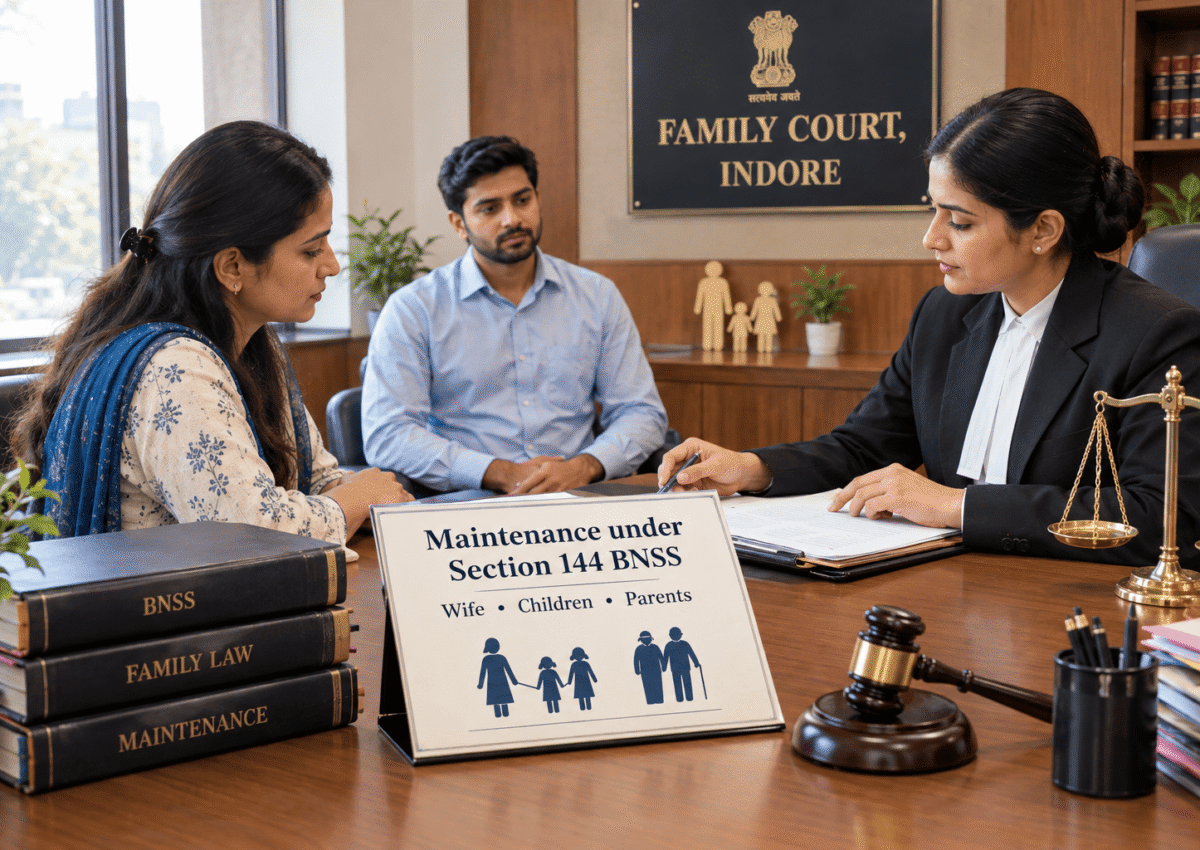
My Wife Has Filed a Maintenance Case Against Me in Family Court Indore. What Should I Do?
If your wife has filed a maintenance case against you before the Family Court, Indore, you should take the court notice seriously and immediately consult an experienced maintenance lawyer. Do not assume that the case will automatically be dismissed merely because you believe that your wife is not entitled to maintenance.
A maintenance proceeding requires the Court to examine several factual and legal questions, including the wife’s entitlement, the husband’s means, the wife’s own income and financial resources, the circumstances in which the parties are living separately, the reasonable needs of the claimant, previous maintenance orders, and the financial responsibilities of both parties.
Section 144 of the Bharatiya Nagarik Suraksha Sanhita, 2023 (BNSS) deals with orders for maintenance of wives, children and parents. Sections 145, 146 and 147 deal respectively with procedure, alteration in allowance and enforcement of maintenance orders.
The Family Courts Act, 1984 gives Family Courts jurisdiction over maintenance proceedings and also provides that a Family Court exercises the jurisdiction that was exercisable by a Magistrate of the First Class under the earlier provisions concerning maintenance of wives, children and parents.
1. First, do not ignore the notice from Family Court, Indore
The first and most important step is to carefully read the notice or summons received from the Family Court, Indore.
You should identify:
- the case number;
- the name of the case;
- the provision under which the case has been filed;
- the date fixed before the Court;
- whether an application for interim maintenance has also been filed;
- whether a separate application for litigation expenses has been filed;
- the allegations made against you;
- the amount of maintenance claimed;
- the documents filed by your wife; and
- whether any previous matrimonial, domestic violence, maintenance or other proceedings are mentioned.
Do not wait until the date of hearing to start examining the case.
In a maintenance case, the first response can be strategically important, particularly where the wife has simultaneously sought interim maintenance.
2. Obtain and read the complete petition filed by your wife
Do not prepare your defence merely on the basis of the summons.
Obtain the complete set of papers filed by your wife, including:
- maintenance application/petition;
- application for interim maintenance;
- affidavit of income/assets, if filed;
- documents concerning marriage;
- documents relating to children;
- salary or income documents;
- bank documents;
- property documents;
- medical documents;
- photographs or electronic material;
- previous court orders;
- complaints or police documents;
- domestic violence proceedings, if any; and
- any other documents relied upon by her.
Your lawyer should prepare a paragraph-wise response to the allegations rather than giving a general denial.
3. Find out exactly what your wife is claiming
A maintenance case may involve more than one monetary claim.
Your wife may seek:
- monthly maintenance for herself;
- maintenance for minor children;
- interim maintenance;
- expenses of proceedings;
- arrears;
- enhancement of an existing maintenance amount; or
- other reliefs under a different statute.
Therefore, first determine precisely what has been claimed.
For example, if your wife has claimed ₹50,000 per month for herself and ₹30,000 per month for a child, your defence should address the factual basis of each component instead of merely stating that the entire claim is false.
4. Examine whether Family Court, Indore has jurisdiction
Territorial jurisdiction should be examined at the beginning of the case.
Section 145 BNSS contains provisions concerning the place where proceedings under Section 144 may be instituted. Depending upon the circumstances, the place of residence of the respondent, residence of the wife, the place where the parties last resided together and other statutory jurisdictional factors can become relevant.
Therefore, if your wife has filed the case in Indore, your lawyer should examine:
- where you presently reside;
- where your wife presently resides;
- where you and your wife last lived together;
- where the matrimonial relationship was actually lived;
- whether either party has a relevant residence in Indore; and
- whether Family Court, Indore has territorial jurisdiction on the facts of your case.
A jurisdictional objection should not be raised mechanically. It should be based upon the actual facts and applicable law.
5. Do not assume that living separately automatically defeats her maintenance claim
This is one of the most common mistakes made by husbands.
A husband may say:
“My wife left my house, therefore she cannot claim maintenance.”
That proposition is legally incomplete.
Section 144 BNSS contains specific provisions concerning circumstances in which a wife may or may not be entitled to maintenance. The Court may have to examine whether there was sufficient reason for her to live separately, whether the parties are living separately by mutual consent, and other circumstances specified by the statute.
Therefore, the real question is:
Why did the wife leave or why are the parties living separately?
If you allege that she left without sufficient reason, your reply should state the factual circumstances and supporting evidence.
6. Examine whether your wife has sufficient independent income
The wife’s income and financial resources can be highly relevant to the determination of maintenance.
However, the defence should not simply state:
“My wife is educated.”
or
“My wife is working.”
The relevant financial facts should be established through appropriate evidence.
Your lawyer should examine:
- her employment;
- salary;
- business;
- professional income;
- rental income;
- investments;
- other sources of income;
- financial assets;
- actual expenditure; and
- other relevant financial resources.
The fact that a wife has some income does not automatically mean that every maintenance claim fails. The Court must consider the financial circumstances of both parties and the applicable law.
7. Be completely truthful about your own income
One of the worst strategies in a maintenance case is to conceal income.
If you are employed, produce the relevant salary and employment documents.
If you are self-employed, your financial position should be properly disclosed.
If you operate a business, your lawyer may need to examine:
- income-tax returns;
- GST records, where applicable;
- bank statements;
- financial statements;
- business ownership;
- partnership interests;
- company directorships;
- property income;
- investments;
- loans and liabilities; and
- other relevant financial records.
The Supreme Court has emphasized disclosure of financial information in maintenance proceedings. The framework arising from Rajnesh v. Neha requires disclosure of assets, liabilities, income and expenditure through the prescribed affidavit, and the Supreme Court continues to refer to that framework in subsequent proceedings.
Therefore, attempting to artificially show a very low income while maintaining a substantially higher lifestyle can seriously damage credibility.
8. Prepare your Assets and Liabilities affidavit carefully
This is an extremely important aspect of modern maintenance litigation.
The Supreme Court’s directions in Rajnesh v. Neha, (2021) 2 SCC 324 require disclosure of financial circumstances through an affidavit of assets and liabilities in maintenance proceedings.
The disclosure can cover matters such as:
- employment;
- monthly income;
- income from other sources;
- bank accounts;
- investments;
- immovable properties;
- vehicles;
- loans;
- liabilities;
- household expenditure;
- medical expenses;
- dependants;
- children’s expenses; and
- other relevant financial information.
Accordingly, before filing your affidavit, prepare your financial information systematically.
Do not make casual statements about your income.
9. Do not hide bank accounts, property or business interests
If your wife alleges that you own substantial property or operate a business, the allegation should be answered factually.
For example, if she alleges:
“The respondent owns three properties in Indore.”
your response should clarify:
- whether the properties actually belong to you;
- whether they are ancestral or jointly owned;
- your actual share;
- whether they generate income;
- whether the property is mortgaged;
- whether it is occupied;
- whether it is commercial or residential; and
- the relevant documentary position.
Similarly, if you have a business that is not generating the income alleged by your wife, produce appropriate records.
A vague denial is usually less useful than a documented explanation.
10. What if your wife has exaggerated your income?
This is a common issue in maintenance proceedings.
Suppose your wife claims that you earn ₹2 lakh per month but your actual income is ₹70,000 per month.
Your reply should not simply say:
“The allegation is false.”
You should explain the actual financial position and, wherever possible, support it with documents.
For a salaried employee, this may include:
- salary slips;
- Form 16;
- income-tax returns;
- bank statements;
- employment certificate; and
- other reliable documents.
For a businessman or professional, the relevant evidence may be different.
The Court is concerned with the real financial circumstances, not merely the figure asserted by either party.
11. What if you are presently unemployed?
Unemployment does not automatically determine the maintenance issue in your favour.
The Court may examine your actual circumstances, qualifications, work history, earning capacity and financial resources.
You should therefore explain:
- why you are unemployed;
- when your employment ended;
- whether you are actively seeking employment;
- whether you have any alternative income;
- whether you possess business or professional assets;
- your liabilities; and
- your genuine financial circumstances.
If unemployment is genuine, supporting evidence should be produced wherever available.
12. Your liabilities are important, but not every liability automatically reduces maintenance
A husband may have:
- home loan;
- vehicle loan;
- business loan;
- personal loan;
- medical expenses;
- dependent parents;
- dependent children;
- educational expenses;
- other unavoidable financial obligations.
These facts can be relevant.
However, it would be incorrect to assume that every voluntary financial commitment automatically has priority over a maintenance obligation.
Your lawyer should distinguish between genuine and unavoidable liabilities and discretionary expenditure.
For example, a genuine medical obligation may require different consideration from expenditure on luxury items.
13. Prepare a realistic monthly budget
Before your lawyer files the reply, prepare a proper monthly financial statement.
For example:
| Particular | Approximate Monthly Amount |
|---|---|
| Net income | ₹_____ |
| House rent/EMI | ₹_____ |
| Electricity and utilities | ₹_____ |
| Medical expenses | ₹_____ |
| Dependent parents | ₹_____ |
| Children’s expenses | ₹_____ |
| Existing maintenance obligation | ₹_____ |
| Loan obligations | ₹_____ |
| Essential household expenditure | ₹_____ |
| Other unavoidable expenses | ₹_____ |
The figures should be truthful and supported where possible.
This helps your advocate present a coherent financial picture before the Family Court, Indore.
14. If your wife has filed an interim maintenance application, address it immediately
This is particularly important.
A final maintenance proceeding may take time, but the wife may seek interim maintenance during the pendency of the case.
Section 144 BNSS specifically provides for interim maintenance and expenses of proceedings, and states that such an application should, as far as possible, be disposed of within 60 days from service of notice.
Therefore, do not focus only on the final maintenance claim.
Your lawyer should separately prepare a response to the interim maintenance application.
15. What should you say if your wife is already earning?
If your wife has employment or substantial independent income, this should be specifically pleaded and supported with evidence.
Possible evidence may include:
- salary information;
- professional profile;
- business information;
- publicly available professional information;
- documents already disclosed in other proceedings;
- bank records where lawfully available;
- income-tax records where obtainable through appropriate procedure; and
- other admissible evidence.
Do not rely solely on social-media photographs showing an apparently comfortable lifestyle. Such material may require proper proof and context.
16. What if your wife is deliberately concealing her income?
If you have genuine material suggesting that your wife has concealed income or assets, bring it to the Court’s attention through a properly supported pleading.
The Supreme Court’s financial-disclosure framework makes accurate disclosure important for both parties. The affidavit itself requires disclosure of income, expenditure, assets and liabilities and contains a declaration regarding completeness and accuracy.
If contradictory financial statements are filed, your lawyer should point out the contradictions with documents and dates.
The better approach is documentary contradiction rather than personal allegations.
17. If your wife has filed a domestic violence case also
Do not assume that the maintenance case and domestic violence case are completely unrelated.
A wife may seek monetary relief/maintenance in more than one proceeding depending upon the facts and applicable statutes.
Your lawyer should therefore prepare a complete litigation chart containing:
| Proceeding | Court | Case No. | Relief Claimed | Amount Claimed | Present Status |
|---|---|---|---|---|---|
| Maintenance | Family Court, Indore | _____ | Maintenance | ₹_____ | _____ |
| Domestic Violence | _____ | _____ | Monetary relief | ₹_____ | _____ |
| Matrimonial case | _____ | _____ | _____ | _____ | _____ |
| Other proceedings | _____ | _____ | _____ | _____ | _____ |
This prevents inconsistent pleadings and helps the Court appreciate the overall litigation history.
18. Previous maintenance orders must be disclosed
If your wife has already obtained maintenance from another court, inform your lawyer immediately.
Likewise, if you have already been paying an amount under another order, maintain documentary proof of payment.
Do not allow the record to suggest that you have paid nothing when you have actually made substantial payments.
Keep:
- bank transfer records;
- UPI records;
- receipts;
- court deposit receipts;
- salary deductions;
- payment acknowledgments; and
- other reliable proof.
19. What if your wife is claiming maintenance for children?
The children’s claim should be separately examined.
Your lawyer should ascertain:
- number of children;
- age;
- education;
- school fees;
- tuition;
- medical expenses;
- transportation;
- special needs;
- other necessary expenses; and
- the financial contribution already being made by you.
If you are directly paying school fees, medical expenses or other substantial expenses, preserve the receipts.
However, do not assume that direct payment of some expenses automatically eliminates every maintenance liability.
20. Do not use your children as a weapon in the litigation
A maintenance case can become emotionally difficult, particularly where matrimonial relations have broken down.
But the defence should remain legally focused.
Avoid:
- pressuring children;
- threatening your wife;
- sending abusive messages;
- making social-media allegations;
- creating unnecessary confrontations;
- withholding necessary documents;
- or attempting to influence witnesses.
Such conduct can create additional litigation and may adversely affect the overall case.
21. If there are allegations of cruelty or domestic violence, deal with them carefully
If your wife’s maintenance petition alleges cruelty, harassment, violence, dowry demands or other serious conduct, the reply should answer the allegations specifically.
Do not write an emotional counter-allegation merely because you are angry.
Instead, identify:
- the date;
- place;
- persons involved;
- relevant event;
- documents;
- communications;
- police complaints;
- medical records;
- previous proceedings; and
- other evidence.
The objective is to create a clear evidentiary record.
22. Do not file a false criminal case merely to pressure your wife
Maintenance litigation should not become a strategy of retaliatory litigation.
If you have a genuine legal grievance, discuss it with your advocate and proceed according to law.
But filing unnecessary proceedings merely to create pressure can complicate the matrimonial dispute and may affect your credibility before the Family Court.
23. What should you do on the first date before Family Court, Indore?
On the first effective date, you should generally ensure that:
- You or your advocate appears.
- The notice has been properly dealt with.
- A copy of the wife’s petition and applications has been obtained.
- The interim maintenance application is identified.
- Your documents are being prepared.
- The next procedural step is clear.
- Any jurisdictional objection is examined.
- Previous cases/orders are disclosed.
- Your financial affidavit/disclosure is prepared as required.
- You understand whether a reply is to be filed on the next date.
The exact procedure will depend upon the stage and orders passed by the Family Court, Indore.
24. What if you cannot afford the amount claimed by your wife?
Do not simply tell the Court:
“I cannot pay.”
Explain why.
For example:
- actual net income is ₹_____;
- monthly essential expenditure is ₹_____;
- existing liabilities are ₹_____;
- dependent parents require ₹_____;
- children require ₹_____;
- existing maintenance order is ₹_____;
- wife has independent income of ₹_____, if properly established;
- claimed amount is disproportionate to actual financial circumstances.
The Court should be given a complete and credible financial picture.
25. What if your wife is demanding an unreasonable amount?
A maintenance claim is not necessarily granted merely because a particular amount has been demanded.
The Court determines the appropriate amount after considering the statutory requirements and the financial circumstances of the parties.
Your lawyer should therefore challenge an exaggerated claim with:
- your actual income;
- your liabilities;
- your wife’s income/resources;
- actual household circumstances;
- children’s expenses;
- previous payments;
- existing maintenance orders; and
- documentary evidence.
A reasoned financial defence is much stronger than simply calling the wife’s claim “false” or “excessive.”
26. Can you seek reduction or alteration later?
Yes, circumstances can change.
Section 146 BNSS deals with alteration in the allowance where there is a change in circumstances.
For example, if after an order:
- your income substantially decreases;
- you lose employment;
- you suffer a serious financial setback;
- your liabilities materially change;
- the claimant’s financial circumstances materially improve; or
- another legally relevant circumstance changes,
an appropriate application may be considered.
Similarly, if your income substantially increases or the claimant’s needs materially change, the opposite party may seek enhancement.
27. What happens if you do not pay an amount ordered by Family Court, Indore?
This is an area where husbands should exercise particular caution.
Once a maintenance order has been passed, simply refusing to comply can result in enforcement proceedings.
Section 147 BNSS deals with enforcement of maintenance orders.
Therefore, if you are unable to comply with an order because of a genuine subsequent change in circumstances, the appropriate legal course is ordinarily to seek appropriate relief rather than simply accumulating arrears.
Maintain proof of every payment.
28. Do not allow maintenance arrears to accumulate unnecessarily
If the Court has already passed an interim maintenance order, calculate the monthly liability immediately.
For example:
Monthly maintenance: ₹25,000
Order effective from: January 2026
Payments made: ₹50,000
Months outstanding: 6
The exact arrears should be calculated from the terms of the order and payments actually made.
Your advocate can then advise whether payment, modification, stay, appeal/revision or another appropriate remedy should be considered depending upon the circumstances.
29. What if you disagree with the maintenance order?
Do not assume that an adverse order has no remedy.
Depending upon the nature of the order, the statutory provision involved, the court that passed it and the procedural stage, appropriate appellate/revisional or other legal remedies may be available.
The correct remedy must be identified from the actual order, not merely from the fact that you have lost an interim application.
Immediately obtain a certified/court copy of the order and have it examined by your advocate.
30. Keep your defence consistent across all courts
This is extremely important in matrimonial litigation.
Suppose you state before one court:
“I have no income.”
but in another proceeding you state:
“I am successfully running my business.”
Such contradictions can seriously affect credibility.
Similarly, if you claim that your wife has independent income, ensure that your statements about the source and amount are consistent and supported by evidence.
Your lawyer should examine all pleadings previously filed by you before:
- Family Court;
- Magistrate Court;
- Civil Court;
- High Court;
- police authorities;
- mediation proceedings; and
- other forums.
31. What documents should a husband in Indore collect immediately?
A husband who has received a maintenance notice should generally collect, as applicable:
Personal and matrimonial documents
- marriage certificate;
- marriage photographs;
- identity documents;
- address proof;
- children’s documents;
- relevant correspondence;
- previous matrimonial orders.
Income documents
- salary slips;
- Form 16;
- income-tax returns;
- bank statements;
- business records;
- GST records;
- professional receipts;
- pension records, if applicable.
Property and asset documents
- property documents;
- loan documents;
- vehicle documents;
- investment statements;
- insurance documents;
- demat/mutual fund statements.
Liability documents
- home loan;
- vehicle loan;
- business loan;
- medical expenditure;
- dependent-parent expenses;
- children’s education expenses.
Litigation documents
- previous maintenance orders;
- domestic violence case papers;
- divorce petition;
- criminal complaints;
- replies;
- mediation records;
- settlement agreements;
- payment receipts.
32. Prepare a chronology of the matrimonial dispute
A simple chronology can be extremely useful.
For example:
| Date | Event |
|---|---|
| //____ | Marriage |
| //____ | Parties shifted to Indore |
| //____ | First matrimonial dispute |
| //____ | Wife left matrimonial home |
| //____ | Police complaint |
| //____ | Mediation |
| //____ | Other proceedings |
| //____ | Maintenance petition filed |
| //____ | Notice received |
This helps the advocate understand the case quickly and identify contradictions in the wife’s pleadings.
33. What should you tell your lawyer at the first consultation?
Do not tell your advocate only:
“My wife has filed a false maintenance case.”
Give the complete facts—even facts that you believe may be unfavorable.
Tell your lawyer:
- actual marriage date;
- actual separation date;
- where both parties lived;
- reason for separation;
- your actual income;
- wife’s actual income, if known;
- children’s details;
- properties;
- loans;
- dependent family members;
- previous cases;
- previous payments;
- police complaints;
- settlement attempts;
- mediation;
- communications;
- and any other relevant fact.
Your advocate can defend an unfavorable fact much more effectively when he knows about it in advance.
34. Never destroy or delete evidence
Do not delete WhatsApp chats, emails, photographs, bank records, payment records or other relevant material merely because litigation has started.
Preserve original electronic material.
If a particular electronic document is going to be relied upon, discuss with your advocate how it should be properly produced and proved before the Court.
35. What is the biggest mistake husbands make in maintenance cases?
In my experience, one of the biggest mistakes is treating the maintenance case as a personal fight with the wife rather than as a financial and evidentiary proceeding before a court of law.
The Court is ultimately concerned with facts and evidence.
Therefore, instead of saying:
“She is lying.”
your defence should establish:
“This particular allegation is incorrect; this is the actual financial position; and these documents support my statement.”
That difference can be significant.
36. A practical strategy for a husband facing maintenance proceedings in Family Court, Indore
A sensible defence strategy can be divided into five stages.
Stage 1: Understand the claim
Read the complete petition and identify exactly what has been claimed.
Stage 2: Check jurisdiction and maintainability
Examine the statutory provision, territorial jurisdiction, previous proceedings and previous orders.
Stage 3: Prepare complete financial disclosure
Prepare accurate information concerning income, assets, liabilities and expenditure.
Stage 4: Challenge unsupported allegations with evidence
Deal with the wife’s income, alleged income, circumstances of separation, claimed expenses and other material allegations through documents wherever possible.
Stage 5: Address interim maintenance separately
Do not wait for the final case. If an interim maintenance application is pending, prepare a focused response to it.
37. What if the wife has filed the case in Indore but both parties are living elsewhere?
This requires a factual jurisdictional examination.
Section 145 BNSS specifies relevant places where proceedings may be instituted, including circumstances concerning residence and the place where the parties last resided together.
Therefore, simply saying:
“Neither of us currently lives in Indore.”
may not necessarily end the matter.
Your advocate should examine the complete jurisdictional facts before deciding whether to raise an objection.
38. Can a husband and wife settle a maintenance case?
Yes, matrimonial disputes, including maintenance disputes, can in appropriate circumstances be resolved through settlement/mediation, subject to the nature of the proceedings and the legal requirements applicable to the particular case.
If settlement is being considered, it should be carefully drafted.
A settlement should clearly specify, as applicable:
- monthly maintenance;
- lump-sum settlement;
- child expenses;
- arrears;
- withdrawal/disposal of proceedings;
- future claims;
- property issues;
- education expenses;
- medical expenses;
- compliance dates; and
- consequences of default.
Do not rely merely on an oral understanding.
39. Should you personally attend Family Court, Indore?
Whether personal appearance is required on a particular date depends upon the nature and stage of the proceeding and the order passed by the Court.
Section 145 BNSS contains procedural provisions concerning personal attendance and representation.
Therefore, do not simply assume that your advocate’s presence is sufficient on every date.
Follow the specific direction of the Family Court, Indore and the advice of your advocate.
40. Final advice to a husband who has received a maintenance notice in Indore
If your wife has filed a maintenance case against you before the Family Court, Indore, do not panic and do not ignore it.
Your immediate priorities should be:
- Obtain the complete case papers.
- Note the next date of hearing.
- Identify whether interim maintenance is claimed.
- Examine territorial jurisdiction.
- Prepare a complete matrimonial chronology.
- Calculate your actual monthly income.
- Collect proof of income.
- Collect proof of genuine liabilities.
- Identify your wife’s actual income/resources, if any, through lawful evidence.
- Collect previous court orders and payment records.
- Prepare the required financial disclosure carefully.
- Give your advocate all relevant facts—even unfavorable ones.
- File a specific, evidence-based reply.
- Respond separately to the interim maintenance claim.
- Do not make false financial disclosures.
- Do not create unnecessary retaliatory litigation.
- Comply with court orders unless an appropriate legal remedy has been obtained.
- Keep complete records of every payment.
Conclusion
A maintenance case before the Family Court, Indore is not decided merely on the basis of who is husband or wife. The Court has to examine the statutory requirements, the circumstances of the parties, their financial position, the claimant’s needs, the respondent’s means and the evidence placed before it.
Section 144 BNSS provides the statutory framework for maintenance of wives, children and parents, while Section 145 deals with procedure, Section 146 with alteration of maintenance and Section 147 with enforcement.
For a husband who has received a maintenance notice in Indore, the strongest approach is generally not to avoid the proceedings but to prepare a complete, truthful and document-supported defence.
In particular, the husband should pay close attention to income disclosure, assets and liabilities, the wife’s financial position, circumstances of separation, previous maintenance proceedings, interim maintenance and existing court orders. The Supreme Court’s directions in Rajnesh v. Neha make financial disclosure a central feature of maintenance litigation.
If the case is properly prepared from the first effective hearing, the husband is in a much better position to place his actual financial circumstances and legal defence before the Family Court, Indore.
This article is intended for general legal information. The appropriate defence in an individual case should be settled after examining the actual maintenance petition, interim application, documents and previous orders.
Disclaimer: This information is intended for general guidance only and does not constitute legal advice. Please consult with a qualified lawyer for personalized advice specific to your situation.
Advocate J.S. Rohilla (Civil & Criminal Lawyer in Indore)
Contact: 88271 22304
