
What Is the Difference Between Court Marriage and Arya Samaj Marriage in India
Couples planning marriage in India often use the expressions “court marriage” and “Arya Samaj marriage” as though they mean the same thing. They do not.
Both can result in a legally recognized marriage when the applicable legal requirements are properly fulfilled, but the procedure, law, ceremony, authority, documentation, notice requirement and registration process are different.
This distinction becomes particularly important in Indore, where couples may approach an Arya Samaj temple for a Vedic marriage or approach the competent Marriage Officer for a marriage under the Special Marriage Act, 1954.
What is the difference between court marriage and Arya Samaj marriage?
A court marriage is generally a civil marriage solemnized before a Marriage Officer under the Special Marriage Act, 1954, whereas an Arya Samaj marriage is a Hindu marriage solemnized through Vedic/customary ceremonies, ordinarily governed by the Hindu Marriage Act, 1955; an Arya Samaj ceremony and its temple-issued certificate should not be confused with government registration of the marriage.
In simple terms:
Court Marriage = Civil solemnization under the Special Marriage Act
Arya Samaj Marriage = Hindu marriage through Vedic/customary ceremonies, followed where applicable by government registration
The difference is much more significant than merely choosing between a court and a temple.
What is a court marriage?
The expression “court marriage” is commonly used in India for a marriage solemnized under the Special Marriage Act, 1954.
Strictly speaking, the marriage is not necessarily solemnized inside a conventional court such as a District Court or Family Court.
It is solemnized before the Marriage Officer appointed under the Special Marriage Act.
The Special Marriage Act was enacted to provide a special form of marriage and also contains provisions concerning registration and matrimonial relief.
The important feature of this route is that the marriage is essentially a civil marriage.
The couple does not have to perform a Hindu religious wedding ceremony merely to solemnize the marriage under the Special Marriage Act.
What is an Arya Samaj marriage?
An Arya Samaj marriage is a marriage performed according to the Vedic rites and ceremonies followed by an Arya Samaj institution.
Where the parties are Hindus and the essential requirements of Hindu law are satisfied, the marriage is generally governed by the Hindu Marriage Act, 1955.
Section 7 of the Hindu Marriage Act provides that a Hindu marriage may be solemnized according to the customary rites and ceremonies of either party. Where those rites and ceremonies include Saptapadi, the marriage becomes complete and binding when the seventh step is taken.
Thus, the legal foundation of an Arya Samaj marriage is not simply the piece of paper issued by an Arya Samaj temple.
The actual solemnization and applicable Hindu marriage law are important.
The two marriages are governed by different legal frameworks
This is the first major difference.
Court marriage
The principal law is:
Special Marriage Act, 1954
The Act provides for:
- conditions for marriage;
- notice of intended marriage;
- publication of notice;
- objections;
- inquiry into objections;
- solemnization;
- marriage certificate;
- registration;
- matrimonial relief.
Arya Samaj marriage
The principal statutory framework ordinarily includes:
Hindu Marriage Act, 1955
particularly:
- Section 5 — conditions for a Hindu marriage;
- Section 7 — ceremonies for a Hindu marriage;
- Section 8 — registration of Hindu marriages.
The Arya Marriage Validation Act, 1937 is also relevant in its specific field. Its purpose is to remove doubts regarding the validity of inter-marriages among Arya Samajists. Section 2 provides that a marriage between two persons who are Arya Samajists is not invalid merely because they belonged to different castes or sub-castes of Hindus, or because either or both previously belonged to a religion other than Hinduism.
It is important not to misunderstand this 1937 Act as though it were the general registration law for every Arya Samaj marriage.
Is court marriage a religious marriage?
No.
The Special Marriage Act provides a civil form of marriage.
This is one of the major reasons why couples from different religious backgrounds consider the Special Marriage Act.
For example, a Hindu and a Muslim may seek a marriage under the Special Marriage Act without requiring one person to convert to the religion of the other merely for the purpose of solemnizing the marriage under that Act.
The Special Marriage Act itself provides that a marriage between two persons may be solemnized under the Act if its statutory conditions are satisfied.
Is Arya Samaj marriage a religious marriage?
It is a Hindu marriage solemnized through Vedic/Arya Samaj ceremonies.
The ceremony normally involves Vedic rituals and prayers rather than the civil declaration used in a Special Marriage Act solemnization.
The precise ceremony performed can depend on the applicable customs and the practices of the Arya Samaj institution.
For legal purposes, however, what matters is not simply the label “Arya Samaj marriage.”
The question is whether the marriage was validly solemnized under the applicable Hindu marriage law.
Difference in religion requirement
This is one of the most important practical differences.
Special Marriage Act
The Special Marriage Act is designed as a secular form of marriage and does not require the couple to belong to the same religion merely because they are marrying under that Act.
For example, an eligible Hindu and an eligible Muslim may seek solemnization under the Special Marriage Act without converting merely for the purpose of using that statutory route.
Arya Samaj marriage
The position is different.
An Arya Samaj ceremony is a form of Hindu marriage.
Therefore, a couple cannot simply assume that any two persons of any religions can go to an Arya Samaj temple and automatically create a valid Hindu marriage merely because the temple performs a ceremony.
Where conversion is involved, the legal position becomes more complicated and must be examined carefully.
The Arya Marriage Validation Act specifically deals with marriages between persons who are Arya Samajists and protects them from invalidity merely because of earlier caste or religious background, but that does not mean that an Arya Samaj institution can simply change a person’s religion through paperwork and thereby eliminate every legal issue.
Court marriage does not require a religious ceremony
Under the Special Marriage Act, the marriage may be solemnized in the manner prescribed by the Act.
Section 12 provides that the marriage may be solemnized at the office of the Marriage Officer or at another permitted place, and the parties may adopt a form of solemnization of their choice, subject to the statutory declaration required in the presence of the Marriage Officer and three witnesses.
Therefore, a Hindu wedding ceremony is not the legal basis of a Special Marriage Act marriage.
Arya Samaj marriage requires ceremonies
The Hindu Marriage Act expressly deals with ceremonies.
Section 7 states that a Hindu marriage may be solemnized according to customary rites and ceremonies of either party.
Where Saptapadi forms part of those ceremonies, the marriage becomes complete and binding upon the seventh step.
Therefore, in an Arya Samaj marriage, the performance of the legally relevant ceremonies is extremely important.
The biggest procedural difference: 30-day notice
A major difference between the two routes concerns the Notice of Intended Marriage.
Court marriage under the Special Marriage Act
Section 5 requires the parties intending to marry under the Act to give written notice to the Marriage Officer of the district where at least one party has resided for at least 30 days immediately before the notice.
The notice is then subject to statutory publication and objection provisions.
Therefore, a Special Marriage Act court marriage is ordinarily not a same-day marriage simply because both parties are adults and have all their documents.
Arya Samaj marriage
The Hindu Marriage Act does not contain the same Section 5–7 public-notice procedure applicable to a fresh Special Marriage Act marriage.
An Arya Samaj ceremony can therefore generally be conducted without following the Special Marriage Act’s 30-day notice procedure.
However, this should not be misunderstood to mean that every Arya Samaj marriage can be completed without documentation, verification or later registration requirements.
Why do people say Arya Samaj marriage is “same day”?
The expression generally refers to the religious ceremony.
An Arya Samaj ceremony can often be conducted much more quickly than a Special Marriage Act marriage because the statutory 30-day notice-and-objection process of the Special Marriage Act does not govern an ordinary Hindu marriage ceremony under Section 7 of the Hindu Marriage Act.
However, the subsequent government registration of that marriage is a separate legal and administrative step.
Therefore:
Same-day Arya Samaj ceremony does not necessarily mean same-day government registration.
Is an Arya Samaj certificate the same as a government marriage certificate?
This is a very important issue.
No, an Arya Samaj temple certificate should not automatically be treated as equivalent to a marriage certificate issued by the competent statutory authority.
The Supreme Court in 2022 made observations rejecting reliance on an Arya Samaj certificate in a criminal bail proceeding and stated that Arya Samaj had no authority to issue a government marriage certificate in the sense being asserted in that case. The context of that order was a criminal case involving allegations concerning a minor, so the observation should be understood in that procedural context; nevertheless, it highlights an important distinction between a certificate issued by a religious organization and statutory registration by a competent authority.
Recent judicial discussion has likewise emphasized that an Arya Samaj certificate by itself should not automatically be treated as conclusive proof of a valid marriage. A 2025 Allahabad High Court decision, for example, held that the certificate issued by an Arya Samaj institution did not have statutory force by itself, while recognizing that evidence of the ceremony could be relevant in proving that a marriage was actually solemnized.
This distinction is extremely important for couples.
What is the government certificate in a court marriage?
Under Section 13 of the Special Marriage Act, after solemnization, the Marriage Officer enters the certificate in the Marriage Certificate Book.
The certificate is signed by the parties and the three witnesses. The statutory Fourth Schedule contains the prescribed certificate format.
Thus, the statutory certificate under the Special Marriage Act is fundamentally different from a certificate issued by a private religious organization.
What happens after an Arya Samaj marriage?
After the Arya Samaj ceremony, the couple should consider registration with the competent government authority under the applicable Hindu marriage registration framework.
Section 8 of the Hindu Marriage Act deals with registration of Hindu marriages and allows the State Government to make rules concerning the registration of Hindu marriages.
The exact registration procedure, authority and documentation can depend upon the applicable state rules.
For a couple in Indore, the local procedure should therefore be verified before assuming that the Arya Samaj certificate alone is sufficient for every purpose.
Court marriage vs Arya Samaj marriage: important differences
| Point | Court Marriage | Arya Samaj Marriage |
|---|---|---|
| Main law | Special Marriage Act, 1954 | Hindu Marriage Act, 1955, with Arya Marriage Validation Act relevant in its specific field |
| Nature | Civil/statutory marriage | Hindu marriage through Vedic/customary ceremonies |
| Religious ceremony | Not required as the basis of marriage | Essential applicable ceremonies must be performed |
| Same religion required? | No, as such | Hindu-law requirements apply |
| 30-day SMA notice | Yes | No such SMA notice procedure |
| Public notice under SMA | Yes | Not under the SMA route |
| Marriage Officer | Yes | Ceremony is not solemnized as an SMA marriage |
| Three witnesses | Required at SMA solemnization | Witness requirements may arise under applicable registration/procedure; ceremony and registration rules should be checked |
| Government certificate | Marriage Officer issues statutory certificate | Government registration should be separately obtained under applicable law |
| Interfaith couple | Possible without conversion under SMA | Requires careful examination; Arya Samaj ceremony is not a substitute for SMA for every interfaith situation |
| Religious rituals | Not required | Vedic/customary rituals |
| Typical speed | Requires statutory notice process | Ceremony can generally be conducted faster |
| Main jurisdiction issue | Section 5 residence requirement | Registration and applicable local rules after solemnization |
| Place of ceremony | Marriage Officer’s office/permitted place | Arya Samaj temple/appropriate place for ceremony |
| Legal proof | Statutory marriage certificate under SMA | Ceremony evidence plus statutory registration where applicable |
Court marriage in Indore
For couples in Indore who want a Special Marriage Act marriage, the official District Indore website publishes an Application Form for Special Marriage Act, 1954 and identifies the associated office as the Collector Office, New Administrative Sankul, Indore.
The statutory jurisdiction, however, must be examined under Section 5.
At least one party must have resided in the relevant district for the required 30-day period immediately preceding the notice.
Therefore, a couple should not assume that they can select Indore merely because they prefer to marry there.
Arya Samaj marriage in Indore
An Arya Samaj marriage in Indore is fundamentally different because the couple is undertaking a Hindu marriage ceremony rather than a civil solemnization under the Special Marriage Act.
The couple should verify:
- whether both parties are legally eligible for a Hindu marriage;
- their ages;
- existing marital status;
- prohibited relationship issues;
- identity documents;
- applicable ceremony requirements;
- witness requirements;
- Arya Samaj institution requirements; and
- the procedure for government registration after the ceremony.
Age requirements
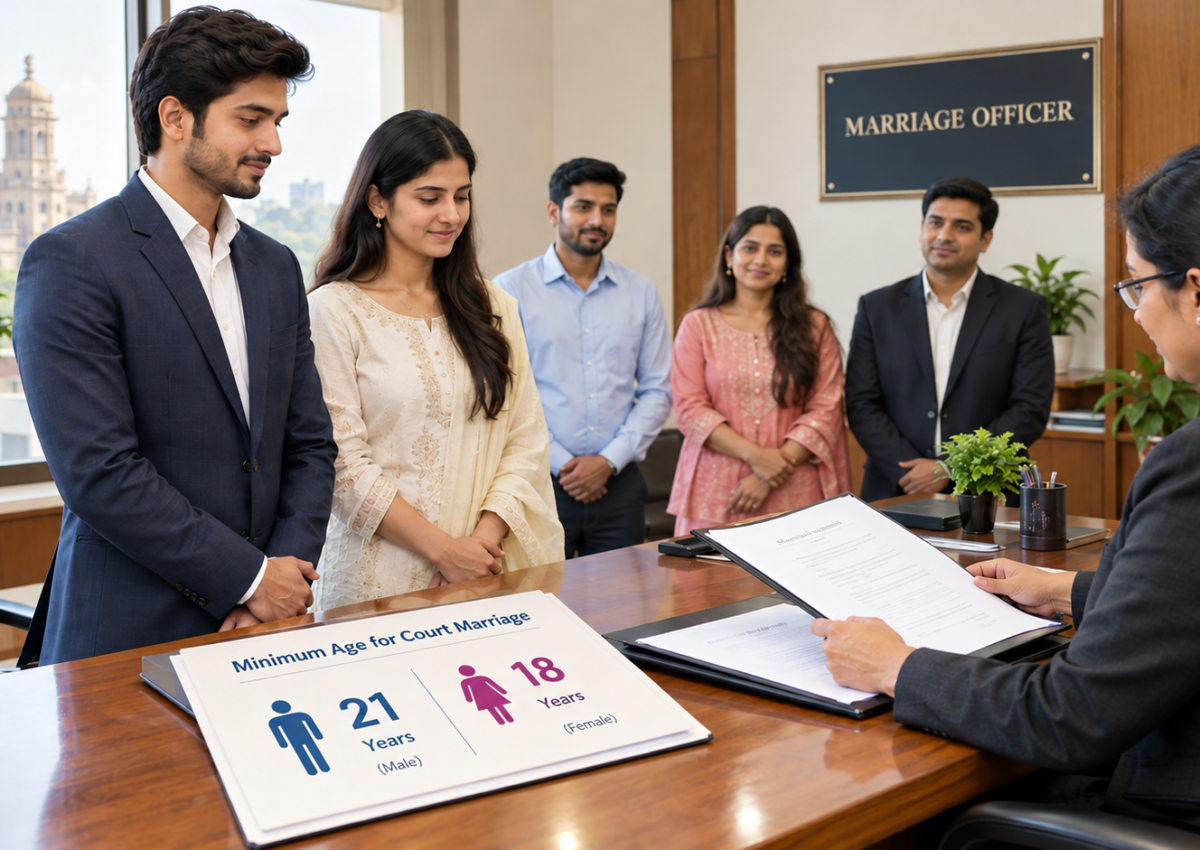
The age requirements under the two statutes are broadly similar in the commonly encountered male-female marriage context.
Under Section 4(c) of the Special Marriage Act, the male must have completed 21 years and the female 18 years.
The Hindu Marriage Act likewise provides the corresponding age conditions under Section 5.
Age, however, is only one requirement.
A couple cannot treat completion of the required age as automatically making the marriage valid.
Existing spouse
Both routes contain restrictions concerning an existing spouse.
Under Section 4 of the Special Marriage Act, neither party can have a spouse living at the time of the marriage.
The Hindu Marriage Act contains a similar condition in Section 5(i): neither party should have a spouse living at the time of the marriage.
Therefore, a person cannot avoid the legal prohibition on bigamy merely by choosing an Arya Samaj ceremony.
Prohibited relationship
Both legal frameworks also regulate prohibited relationships.
The Special Marriage Act contains its own rules in Section 4.
The Hindu Marriage Act contains corresponding conditions in Section 5.
Therefore, the couple’s relationship should be checked before either route is selected.
Inter-caste marriage
An inter-caste couple can face fewer conceptual difficulties than an inter-religious couple because caste difference does not automatically prevent a Hindu marriage where the statutory requirements are satisfied.
The Arya Marriage Validation Act, 1937 specifically states that a marriage between two Arya Samajists is not invalid merely because they belonged to different castes or sub-castes of Hindus.
An inter-caste Hindu couple may therefore choose an Arya Samaj ceremony if the applicable requirements are fulfilled.
A Special Marriage Act marriage is also available subject to its own statutory conditions.
Inter-religious marriage
This is where the distinction becomes especially important.
Suppose:
Bride: Hindu
Groom: Muslim
If both want to retain their respective religions and marry through a secular statutory route, the Special Marriage Act is the relevant legal framework to examine.
An Arya Samaj ceremony should not simply be treated as a substitute for an SMA marriage.
Questions concerning conversion, religious status and the validity of the ceremony require separate legal analysis.
Hindu-Muslim marriage: Arya Samaj versus court marriage
For a Hindu-Muslim couple, the two routes should not be casually treated as interchangeable.
If the couple wants a civil marriage without requiring one party to convert, the Special Marriage Act is the statutory route specifically designed to provide a civil form of marriage between persons irrespective of their religious backgrounds, subject to the Act’s conditions and procedure.
An Arya Samaj ceremony, by contrast, is a Hindu religious ceremony.
Therefore, a lawyer advising an interfaith couple should first determine what legal route the parties actually intend to use rather than simply asking which ceremony is faster.
Is parental consent required?
For adult couples, parental consent is generally not the statutory basis of either route.
The relevant statutory conditions concern matters such as:
- age;
- existing spouse;
- legal capacity;
- prohibited relationship; and
- the applicable procedure.
Parents may object socially or personally, but parental disagreement is not automatically a statutory ground for preventing an otherwise lawful adult marriage.
The precise circumstances of a particular case should nevertheless be examined.
Difference in privacy
The Special Marriage Act involves a statutory notice and publication process.
This means couples should understand that the process is not designed as a completely private marriage procedure.
Section 5 requires notice, and Sections 6 and 7 provide for publication and objections.
An Arya Samaj ceremony does not involve the same Special Marriage Act notice procedure.
Therefore, couples sometimes consider Arya Samaj marriage when they want a ceremony without the SMA public-notice process.
However, avoiding the SMA notice procedure does not eliminate the need for proper legal documentation and subsequent registration.
Can Arya Samaj marriage be registered?
Yes, a Hindu marriage can be registered under the applicable Hindu marriage registration framework.
Section 8 of the Hindu Marriage Act deals with registration and is intended to facilitate proof of Hindu marriages.
This is one of the most important practical recommendations for couples who have undergone an Arya Samaj ceremony.
They should not simply assume that the temple certificate will be sufficient for every future legal, governmental, immigration, banking or matrimonial purpose.
Why registration is important after Arya Samaj marriage
A properly maintained government record can be extremely useful.
For example, the couple may subsequently require proof of marriage for:
- passport matters;
- visa applications;
- immigration;
- opening or changing joint records;
- insurance;
- nomination;
- employment benefits;
- property transactions;
- succession-related matters;
- court proceedings;
- matrimonial litigation;
- maintenance proceedings;
- child-related documentation;
- foreign authorities.
Registration provides strong documentary evidence of the marriage.
Can a court marriage be registered later?
The Special Marriage Act itself contains provisions dealing with registration of marriages already celebrated in other forms, subject to statutory conditions.
This is different from a fresh marriage under the Special Marriage Act.
Therefore, one should distinguish:
Marriage solemnized under Section 12 of the Special Marriage Act
from
Registration of a marriage already celebrated in another form under the relevant statutory provisions.
This distinction is especially important when advising couples who have already completed an Arya Samaj or Hindu ceremony.
Can an Arya Samaj marriage be converted into a court marriage?
The expression “convert into court marriage” can be misleading.
A marriage that has already been solemnized is not simply “converted” into another marriage by obtaining a certificate.
Depending upon the facts, the parties may need to use the appropriate statutory registration mechanism.
The lawyer should first determine:
- whether the original marriage was valid;
- under which law it was solemnized;
- whether registration is available;
- which authority has jurisdiction; and
- whether the parties are seeking registration or a new solemnization.
What is the role of the Arya Marriage Validation Act, 1937?
The name of this Act sometimes creates confusion.
The Arya Marriage Validation Act, 1937 is not a general replacement for the Hindu Marriage Act.
Its principal purpose was to remove doubts concerning inter-marriages among Arya Samajists.
Section 2 provides that a marriage between two persons who were Arya Samajists at the time of marriage is not invalid merely because they belonged to different Hindu castes or sub-castes or because either or both previously belonged to another religion.
Therefore, the Act has a specific validating function.
It should not be described inaccurately as though it is the general law under which every Arya Samaj wedding is registered.
Which marriage gives a statutory marriage certificate?
A marriage solemnized under the Special Marriage Act results in the statutory certificate provided under Section 13, entered in the Marriage Certificate Book and signed by the parties and three witnesses.
An Arya Samaj institution’s certificate is different.
The Supreme Court’s 2022 observations are particularly important in this regard: an Arya Samaj institution should not be confused with the statutory authority responsible for issuing a government marriage certificate.
What is the difference in witnesses?
For a Special Marriage Act solemnization, three witnesses are expressly contemplated.
Section 13 and the Fourth Schedule require the parties and three witnesses to sign the marriage certificate.
In an Arya Samaj ceremony, the practical witness requirements can depend upon the ceremony and subsequent registration process.
The couple should therefore obtain the exact local requirements from the Arya Samaj institution and the registering authority rather than assuming that the witness rules are identical to the Special Marriage Act.
What documents are generally required?
The precise list varies according to the route and local authority, but couples commonly need documents establishing:
- identity;
- age;
- residence/address;
- photographs;
- marital status;
- divorce, if previously married;
- death certificate of a former spouse, where applicable;
- affidavits/declarations where required; and
- witness identity documents.
For Special Marriage Act proceedings in Indore, the District Administration publishes SMA-related forms, including Section 4 affidavits and Section 15 affidavits.
The actual document checklist should be verified before filing.
Court marriage versus Arya Samaj marriage for a couple from different states
Suppose the bride is from Indore and the groom is from Varanasi.
The fact that the parties belong to different states does not automatically prevent marriage.
Under the Special Marriage Act, jurisdiction must be examined under Section 5.
At least one party must satisfy the relevant residence requirement.
In an Arya Samaj marriage, the focus is different because it is a Hindu marriage ceremony followed by registration under the applicable law.
Therefore, the couple’s permanent addresses are not by themselves the decisive difference between the two routes.
What if one person is an NRI?
An NRI may potentially marry an Indian citizen under the Special Marriage Act if the statutory conditions and jurisdictional requirements are satisfied.
An Arya Samaj ceremony raises additional questions depending on the person’s religious status and the applicable Hindu marriage framework.
NRI documentation can also involve:
- passport;
- foreign address;
- visa/residence permit;
- marital-status documentation;
- divorce decree;
- death certificate;
- affidavit;
- authentication or apostille where required.
Therefore, NRI cases should not be treated as ordinary local marriages merely because the ceremony occurs in India.
What if one party is a foreign national?
The distinction becomes even more important.
A foreign national may potentially marry under the Special Marriage Act, subject to the Act and applicable procedural requirements.
A proposed Arya Samaj ceremony should be examined separately, particularly where the foreign national does not fall within the Hindu-law framework.
The couple should not assume that obtaining a temple certificate automatically resolves nationality, immigration or marriage-recognition issues.
Which route has a 30-day waiting period?
The Special Marriage Act route involves the statutory notice and objection period.
The Notice of Intended Marriage is given under Section 5, and publication and objections are governed by Sections 6 and 7.
An Arya Samaj ceremony does not follow this same Special Marriage Act notice process.
This is one of the most significant practical differences between the two.
Is court marriage always better than Arya Samaj marriage?
It is more accurate to say that the two routes serve different legal situations.
The relevant questions are:
- Are both parties within the Hindu-law framework?
- Do they want a Vedic ceremony?
- Are they from different religions?
- Do they want a civil marriage?
- Is avoiding conversion important?
- Is the SMA notice process acceptable?
- Do they need a government registration record?
- Does one party live abroad?
- Is the marriage required for immigration purposes?
- Has the couple already undergone a Hindu ceremony?
The answers determine which statutory route needs to be examined.
Is Arya Samaj marriage legally valid?
An Arya Samaj marriage can be legally valid where the parties satisfy the applicable Hindu marriage requirements and the marriage is properly solemnized through the requisite ceremonies.
Section 7 of the Hindu Marriage Act expressly recognizes customary rites and ceremonies.
But this should not be simplified to:
“Any certificate issued by any Arya Samaj temple automatically proves a valid marriage.”
That is a different proposition.
The validity of the marriage and the evidentiary value of a particular certificate should be distinguished.
Is court marriage legally valid?
Yes, a marriage properly solemnized under the Special Marriage Act is a statutory marriage.
The Act specifies the conditions, procedure, solemnization and certificate.
The Marriage Officer enters the certificate in the Marriage Certificate Book after solemnization, and the parties and three witnesses sign it.
Common mistake: calling an Arya Samaj ceremony “court marriage”
A very common phrase in advertisements is:
“Arya Samaj Court Marriage.”
This expression can create confusion.
An Arya Samaj marriage and a Special Marriage Act court marriage are legally distinct processes.
A better description is:
“Arya Samaj marriage followed by government registration”
or
“Marriage under the Special Marriage Act.”
The precise legal route should always be identified.
Common mistake: assuming the temple certificate is the final government certificate
A couple may receive a document from the Arya Samaj institution after the ceremony.
That document can be evidence of the ceremony, but the couple should determine whether they have also obtained the appropriate statutory registration certificate.
Recent judicial decisions reinforce the importance of distinguishing a religious institution’s certificate from statutory registration.
Common mistake: using Arya Samaj for an interfaith marriage without examining conversion issues
An interfaith couple should not simply assume that an Arya Samaj ceremony solves every legal issue.
If the couple does not wish to change religion, the Special Marriage Act is often the statutory framework that needs to be examined.
If conversion is proposed, the circumstances and legal consequences must be examined carefully.
Common mistake: assuming court marriage means no notice
The expression “court marriage” is sometimes advertised as:
“Court marriage without notice.”
For a fresh marriage under the Special Marriage Act, this is misleading.
Section 5 expressly provides for a Notice of Intended Marriage, and Sections 6 and 7 provide for publication and objections.
Therefore, a genuine Special Marriage Act marriage cannot simply be described as a same-day secret marriage before the Marriage Officer.
Common mistake: assuming Arya Samaj marriage means no registration
This is also incorrect.
The fact that the marriage ceremony itself can be conducted without the Special Marriage Act notice procedure does not mean that the couple should ignore government registration.
Registration can be highly important as documentary proof.
Section 8 of the Hindu Marriage Act specifically deals with registration of Hindu marriages.
Special Marriage Act and Arya Samaj marriage: practical comparison
A couple in Indore can think about the two routes in the following way.
If both parties are within Hindu law and want Vedic rituals
An Arya Samaj ceremony may be relevant.
The couple should then ensure that the marriage is properly documented and registered under the applicable law.
If the parties belong to different religions and do not want conversion
The Special Marriage Act should be examined.
If the couple wants a purely civil marriage
The Special Marriage Act provides the civil statutory framework.
If the couple wants a traditional Vedic ceremony
An Arya Samaj marriage may be considered where the parties satisfy the applicable Hindu-law requirements.
If the couple needs a statutory marriage certificate from the Marriage Officer
The Special Marriage Act route directly provides for a certificate under Section 13.
If the couple has already undergone an Arya Samaj ceremony
The question may be one of registration and proof, rather than performing another marriage.
Special consideration for couples in Indore
For an Indore couple, it is important to distinguish between:
Arya Samaj ceremony
and
Special Marriage Act solemnization before the competent Marriage Officer.
The official District Indore website publishes a Special Marriage Act application form and identifies the Collector Office, New Administrative Sankul, Indore, in connection with the form.
District Indore also publishes other Special Marriage Act forms, including forms relating to Section 4 and Section 15.
Therefore, couples considering a court marriage in Indore should first determine which statutory route they are actually pursuing.
Frequently Asked Questions
Is Arya Samaj marriage the same as court marriage?
No. Arya Samaj marriage is a Hindu marriage performed through Vedic/customary ceremonies. Court marriage ordinarily refers to civil solemnization under the Special Marriage Act before a Marriage Officer.
Which law applies to court marriage?
The principal statute is the Special Marriage Act, 1954.
Which law applies to Arya Samaj marriage?
A valid Arya Samaj Hindu marriage is ordinarily governed by the Hindu Marriage Act, 1955, particularly its provisions concerning conditions and ceremonies. The Arya Marriage Validation Act, 1937 has a specific validating role concerning marriages among Arya Samajists.
Is a 30-day notice required for Arya Samaj marriage?
The Special Marriage Act’s 30-day notice procedure does not govern an ordinary Hindu marriage solemnized under the Hindu Marriage Act.
Is a 30-day notice required for court marriage?
Yes, the Special Marriage Act contains the Notice of Intended Marriage and publication/objection procedure.
Can a Hindu and Muslim marry through court marriage?
They may potentially marry under the Special Marriage Act if the statutory requirements are fulfilled.
Can a Hindu and Muslim simply marry at Arya Samaj?
This should not be assumed. The legal status of the parties, any conversion, the ceremony and the applicable law must be examined.
Is an Arya Samaj marriage legally valid?
A properly solemnized Hindu marriage through the requisite ceremonies can be legally valid. Section 7 of the Hindu Marriage Act recognizes customary rites and ceremonies.
Is an Arya Samaj certificate a government marriage certificate?
No. It should not automatically be treated as equivalent to a statutory certificate issued by a competent Marriage Officer or registration authority.
Should an Arya Samaj marriage be registered?
Registration is highly important as documentary proof, and the applicable state registration procedure should be followed.
Can an Arya Samaj marriage be performed in one day?
The ceremony itself can generally be conducted much faster than a Special Marriage Act marriage because the SMA notice process does not apply to the Hindu ceremony.
Can court marriage be completed in one day?
A fresh Special Marriage Act marriage ordinarily cannot be completed merely by appearing before the Marriage Officer on the same day because Section 5 notice and the statutory publication/objection process apply.
Do parents have to be present?
For an otherwise eligible adult couple, parental presence is not the statutory basis for validity of either route.
How many witnesses are required for Special Marriage Act marriage?
Three witnesses are required at the solemnization, and they sign the statutory marriage certificate.
Can an NRI have a court marriage in Indore?
Potentially yes, subject to the jurisdictional and statutory requirements of the Special Marriage Act and the additional documentation applicable to an NRI.
Can a foreign national marry in Indore?
Potentially yes, but the legal and documentary position must be examined according to the person’s nationality, residence, marital status and the chosen legal route.
Can an inter-caste couple marry through Arya Samaj?
An inter-caste marriage can be valid where the statutory requirements are satisfied. The Arya Marriage Validation Act specifically protects marriages between Arya Samajists from being invalid merely because of caste or sub-caste differences.
Can an inter-caste couple have a court marriage?
Yes, subject to the conditions and procedure of the Special Marriage Act.
Is Arya Samaj marriage cheaper than court marriage?
The costs depend on the institution, registration authority, documentation and professional assistance. More importantly, the two routes involve different legal procedures, so cost should not be the only consideration.
Does court marriage require pheras?
No. A Special Marriage Act marriage is a civil statutory solemnization and does not depend upon Hindu pheras or Saptapadi.
Does Arya Samaj marriage require Vedic ceremonies?
The legal validity of a Hindu marriage depends upon the applicable ceremonies and Section 7 of the Hindu Marriage Act. An Arya Samaj ceremony is ordinarily based upon Vedic rites.
Conclusion
The terms court marriage and Arya Samaj marriage are often used interchangeably in advertisements and casual conversation, but legally they represent different routes.
A court marriage under the Special Marriage Act, 1954 is a civil statutory marriage solemnized before the competent Marriage Officer. It does not depend upon Hindu religious ceremonies and can provide a legal framework for couples from different religious backgrounds without requiring conversion merely for the purpose of the marriage. It involves a Notice of Intended Marriage and the statutory publication and objection process.
An Arya Samaj marriage, on the other hand, is a Hindu marriage performed through applicable Vedic/customary ceremonies. Section 7 of the Hindu Marriage Act recognizes marriages solemnized according to the customary rites and ceremonies of either party, with Saptapadi having the statutory significance specified in that provision where it forms part of the ceremony.
The Arya Marriage Validation Act, 1937 has a narrower but important role. It provides that marriages between Arya Samajists are not invalid merely because the parties belonged to different Hindu castes or sub-castes or because either or both had previously belonged to another religion.
One of the most important practical distinctions concerns the certificate.
A Special Marriage Act marriage certificate is issued through the statutory mechanism of the Marriage Officer under Section 13, with the parties and three witnesses signing the certificate.
An Arya Samaj certificate should not automatically be treated as the equivalent of a government-issued statutory marriage certificate. Courts have emphasized the distinction between evidence of a ceremony and statutory registration.
For couples in Indore, therefore, the first question should not simply be:
“Should we do court marriage or Arya Samaj marriage?”
The better legal questions are:
Are both parties governed by Hindu marriage law?
Do they want a Vedic ceremony?
Are they from different religions?
Does either party intend to convert?
Do they want a civil marriage under the Special Marriage Act?
Are they prepared for the Special Marriage Act notice and objection procedure?
Have they already undergone an Arya Samaj or Hindu marriage ceremony?
Do they have or need a government registration certificate?
Once these questions are answered, the appropriate legal procedure becomes much clearer.
For a couple in Indore, an Arya Samaj ceremony and a Special Marriage Act marriage should therefore be treated as two distinct legal pathways rather than two names for the same marriage.
The safest approach is to identify the applicable law first, verify the parties’ eligibility, determine jurisdiction, complete the correct ceremony or statutory solemnization, and then obtain the appropriate government registration or certificate required for future legal use.
Disclaimer: This information is intended for general guidance only and does not constitute legal advice. Please consult with a qualified lawyer for personalized advice specific to your situation.
Advocate J.S. Rohilla (Civil & Criminal Lawyer in Indore)
Contact: 88271 22304
