
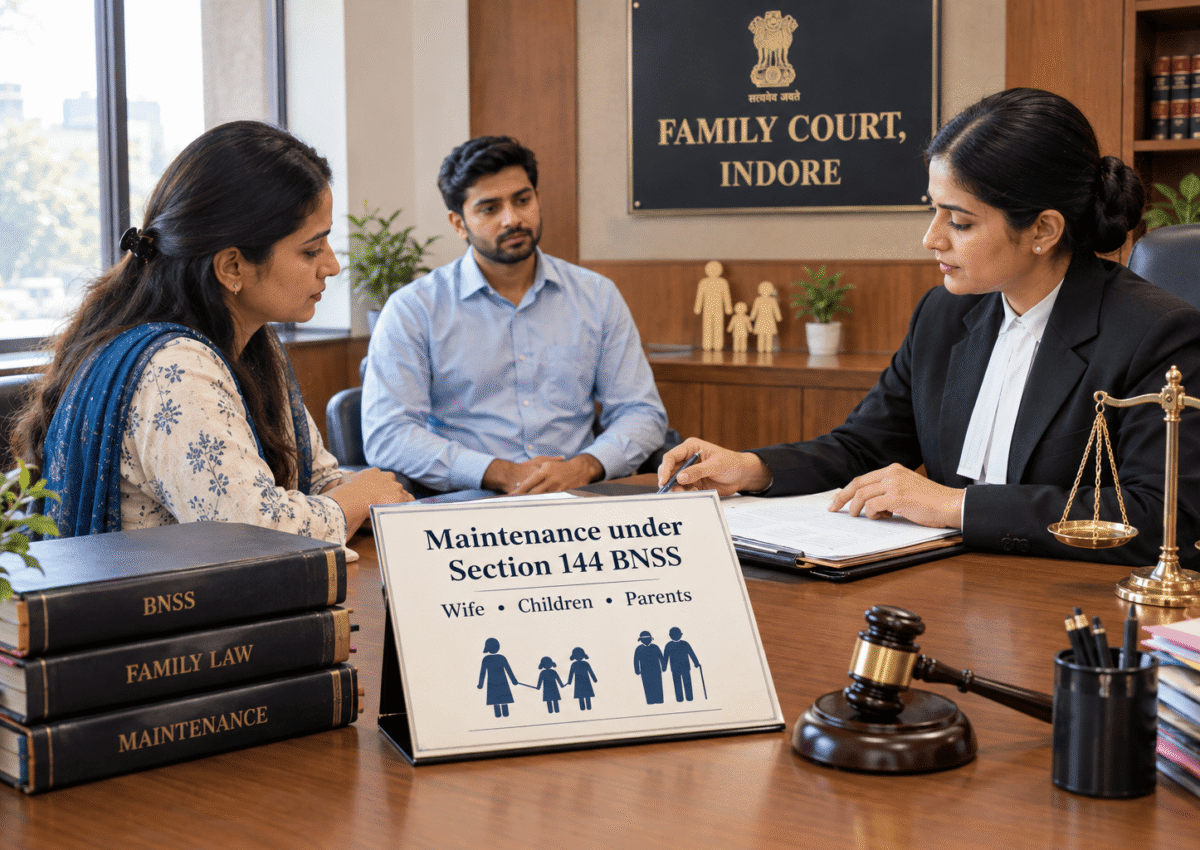
Can a Maintenance Case Pending in Another District Be Transferred to Family Court Indore?
A maintenance case does not necessarily have to remain permanently in the district where it was originally filed.
In appropriate circumstances, a maintenance proceeding pending before a Family Court or other competent court in another district may be transferred to a competent court at Indore.
This can become particularly important where:
- the wife has shifted to Indore;
- the wife is permanently residing with her parents in Indore;
- the children are residing and studying in Indore;
- the husband and wife last resided together in Indore;
- connected matrimonial proceedings are pending in Indore;
- important witnesses are located in Indore;
- the original forum has become substantially inconvenient;
- the parties have subsequently shifted their residence; or
- transfer to Indore would better serve the interests of justice.
However, there is no automatic right to transfer merely because one party now lives in Indore.
The court considering transfer will examine the statutory jurisdiction, the circumstances of both parties, the stage of the case, convenience of parties and witnesses, connected proceedings and the overall interests of justice.
1. What does Section 144 BNSS provide?
Section 144 of the Bharatiya Nagarik Suraksha Sanhita, 2023 provides for maintenance of wives, children and parents in cases where the statutory requirements are satisfied.
Section 145 then deals with the procedure and territorial jurisdiction of proceedings under Section 144.
Section 145(1) provides that a proceeding under Section 144 may be taken in a district:
- where the husband is;
- where the husband or his wife resides;
- where the husband last resided with his wife; or
- where the husband’s father or mother resides.
These are important because they determine whether Family Court, Indore can be the appropriate destination for a transferred maintenance proceeding.
2. Can a case pending in another district be transferred to Indore?
Yes, in an appropriate case.
For example, suppose a maintenance case is pending in:
- Family Court, Bhopal;
- Family Court, Ujjain;
- Family Court, Dewas;
- Family Court, Ratlam;
- Family Court, Gwalior; or
- another competent court,
and subsequently the wife has established genuine residence in Indore.
She may seek transfer to a competent court at Indore, provided the legal requirements for transfer are satisfied.
The important question is not merely:
“Does the applicant now live in Indore?”
The questions are:
Does Family Court, Indore have jurisdiction to entertain the proceeding?
and
Are there sufficient grounds for transferring the pending proceeding from the existing court to Indore?
These two questions should be addressed separately.
3. Why is Section 145 BNSS important in a transfer to Indore?
Section 145(1) is particularly important because it specifies the districts in which a Section 144 proceeding may be taken.
Therefore, if the wife presently resides in Indore, Section 145(1)(b) may provide a statutory basis for the proceeding being heard in Indore.
Similarly, if the husband and wife last resided together in Indore, Section 145(1)(c) may provide another statutory basis.
Thus, where either of these circumstances exists, the applicant can make a much stronger case for transfer to Indore than merely stating that Indore is more convenient.
4. If the wife now resides in Indore, can she seek transfer?
Yes.
Consider this example:
The wife originally filed the maintenance proceeding in Bhopal because she was residing there at that time.
During the pendency of the case, matrimonial circumstances changed and she permanently shifted to her parental home in Indore.
She may seek transfer of the maintenance proceeding to Family Court, Indore.
Her application can explain:
- her present residence in Indore;
- why she shifted to Indore;
- whether minor children reside with her;
- the financial and practical difficulty of travelling to Bhopal;
- whether she has dependent parents or other family responsibilities;
- whether other matrimonial proceedings are pending in Indore;
- whether material witnesses are located in Indore; and
- why transfer would serve the interests of justice.
The court will consider these circumstances along with the respondent’s objections.
5. Is the wife’s present residence in Indore enough by itself?
Not necessarily.
This is an important distinction.
Section 145(1)(b) expressly recognises the district where the wife resides as a permissible district for proceedings under Section 144.
But in an already pending proceeding, the applicant is asking a superior court to transfer an existing case.
Therefore, two separate matters may have to be established:
First: Indore is a legally competent forum.
Second: the circumstances justify transferring the existing proceeding to Indore.
The fact that the wife has genuinely moved to Indore can satisfy the first aspect, while her hardship, children’s residence, connected proceedings and other circumstances may support the second.
6. What if the wife has returned to her parental home in Indore?
This is one of the most practically significant situations.
Suppose:
- husband and wife were living in another district;
- matrimonial disputes arose;
- wife returned to her parental home in Indore;
- she is now genuinely residing there;
- maintenance proceedings remain pending in the original district.
The wife can consider seeking transfer to Family Court, Indore.
Her residence may be relevant under Section 145(1)(b).
If the parties had also previously lived together in Indore, Section 145(1)(c) may provide an additional jurisdictional connection.
The transfer petition should clearly plead these facts rather than simply stating:
“The petitioner is presently residing in Indore.”
7. What if the children are living in Indore?
The presence of minor children can be an important practical consideration.
For example, if:
- the wife resides in Indore;
- minor children reside with her;
- children attend school in Indore;
- the wife has to travel with them to another district for repeated hearings;
she can explain the resulting hardship.
The Supreme Court has in transfer matters considered the practical difficulty faced by a wife who has responsibility for a minor child and is dependent on her parents. In one 2025 transfer order, the Supreme Court transferred a matrimonial proceeding to the Family Court, Bhopal after considering the wife’s dependence on her parents, responsibility for her nine-year-old son and the substantial distance involved.
This illustrates an important principle: transfer applications are decided on the actual circumstances of the parties rather than by applying a mechanical rule.
8. Can a maintenance case be transferred to Indore because other matrimonial cases are pending there?
Yes, this can be a significant consideration.
Suppose:
- maintenance case is pending in District A;
- divorce case is pending in Indore;
- custody case is pending in Indore;
- domestic violence proceedings are pending in Indore; and
- the wife and children are also residing in Indore.
The party seeking transfer can argue that having the connected proceedings at one place would:
- reduce repeated travel;
- reduce litigation expenses;
- avoid inconvenience to witnesses;
- facilitate coordinated litigation;
- prevent inconsistent factual findings; and
- serve the interests of justice.
The existence of another case in Indore does not automatically require transfer, but it can strengthen the application.
The Supreme Court has dealt with matrimonial transfer requests where maintenance and other connected proceedings were pending at the proposed transferee location.
9. What if the maintenance case is pending before a Magistrate rather than a Family Court?
This requires careful drafting.
Section 144 BNSS creates the maintenance jurisdiction, while Section 145 provides the territorial framework.
Where a Family Court has been established, the Family Courts Act gives the Family Court jurisdiction over proceedings for maintenance and also confers the jurisdiction exercisable by a Magistrate of the First Class under the maintenance chapter of the earlier CrPC framework.
Therefore, if the proposed destination is Family Court, Indore, the advocate should examine:
- the nature of the original proceeding;
- the court presently hearing it;
- whether the proceeding is under Section 144 BNSS;
- the Family Courts Act;
- the jurisdiction of Family Court, Indore; and
- the applicable transfer provision.
The transfer provision should not be selected merely because the proposed destination is called a “Family Court.”
10. Which court can order transfer to Family Court, Indore?
This depends upon the nature of the proceeding and the courts involved.
This is one of the most important practical points.
Where the proceeding is a Section 144 BNSS maintenance proceeding
The BNSS contains specific provisions concerning transfer of criminal cases.
Section 447 BNSS gives the High Court power to transfer criminal cases between competent subordinate criminal courts in appropriate circumstances, including where transfer is required for the general convenience of parties or witnesses or is expedient in the interests of justice.
Section 446 gives the Supreme Court power to transfer specified criminal cases between High Courts or subordinate criminal courts under different High Courts.
However, where the proposed transfer is between courts in the same Sessions Division, Section 447 contains a proviso requiring an application first to the Sessions Judge, if the proceeding falls within the relevant criminal-transfer framework.
Because Family Courts are special statutory courts, the exact forum for a transfer application should be determined from the character of the proceeding and the relevant local jurisdiction.
11. Can a case from another district in Madhya Pradesh be transferred to Family Court, Indore?
Potentially, yes.
Suppose a Section 144 BNSS maintenance proceeding is pending in another district of Madhya Pradesh and the applicant wants it transferred to Indore.
The advocate should first determine:
- Whether Indore is a competent forum under Section 145 BNSS.
- Whether the existing court and proposed Family Court fall within the same Sessions Division or different Sessions Divisions.
- Whether the applicable transfer provision requires an application to the Sessions Judge first.
- Whether the special jurisdiction of the Family Court affects the transfer route.
- Whether the High Court of Madhya Pradesh has to be approached.
- Whether any connected matrimonial proceedings justify transfer.
This analysis should be completed before filing.
12. What if the case is pending in a different State?
If the maintenance case is pending in another State and transfer to Family Court, Indore is sought, the matter becomes more significant.
For criminal proceedings falling within Section 446 BNSS, the Supreme Court has power to transfer a case from a criminal court subordinate to one High Court to a competent criminal court subordinate to another High Court when such transfer is expedient for the ends of justice.
Therefore, an inter-State transfer of a Section 144 BNSS proceeding may require approaching the Supreme Court, depending upon the exact nature of the proceeding and courts involved.
This is materially different from an intra-State transfer.
13. Can Section 24 CPC be used for transferring a maintenance proceeding to Indore?
This question requires caution.
Section 24 CPC is commonly used for transfer of civil and matrimonial proceedings between competent civil courts.
But a Section 144 BNSS maintenance proceeding is not simply an ordinary civil suit merely because it is being heard by a Family Court.
Therefore, Section 24 CPC should not be mechanically invoked for every Section 144 BNSS maintenance transfer.
The advocate must first identify the statutory nature of the proceeding.
For example, the transfer analysis for:
- a Hindu Marriage Act divorce petition,
may be different from the analysis for:
- a Section 144 BNSS maintenance proceeding.
This distinction is particularly important when drafting a transfer petition for Family Court, Indore.
14. What are the strongest grounds for transferring a maintenance case to Indore?
The following grounds may be relevant, depending upon the facts.
Genuine residence in Indore
The applicant has permanently shifted to Indore and genuinely resides there.
Minor children residing in Indore
The children live with the applicant and are studying in Indore.
Financial hardship
Repeated travel to the existing district causes substantial financial hardship.
Medical hardship
The applicant has a medical condition that makes long-distance travel difficult.
Safety concerns
There are genuine and supported safety concerns connected with the existing forum.
Connected proceedings
Other matrimonial proceedings between the parties are pending in Indore.
Witness convenience
Important witnesses are located in Indore.
Last shared residence
The parties last resided together in Indore.
Overall interests of justice
The totality of circumstances demonstrates that the case can be more fairly and effectively dealt with at Indore.
15. Is a mere change of address enough?
Not necessarily.
Suppose a wife was residing in Ujjain when she filed the case and later moved to Indore.
If the transfer petition simply states:
“I have changed my address to Indore.”
the court may require more.
The applicant should explain:
- whether the move is permanent;
- why the move occurred;
- where the children are;
- what hardship is caused by the existing forum;
- whether Indore has statutory jurisdiction;
- whether connected cases are pending there; and
- why transfer is necessary in the interests of justice.
The stronger the factual foundation, the stronger the transfer application.
16. What if the husband opposes transfer to Indore?
The husband may contend that:
- the original court already has jurisdiction;
- the wife deliberately changed residence;
- the change of residence was made only to obtain transfer;
- the case is already at an advanced stage;
- witnesses are located in the original district;
- he would suffer greater hardship in Indore;
- the wife has no genuine difficulty travelling; or
- transfer would unnecessarily delay the proceeding.
These objections should be answered factually.
The wife should not merely argue:
“I am the wife, therefore the case must be transferred to Indore.”
Although the convenience and hardship of the wife can be important factors, the court considers the circumstances of both parties and the interests of justice.
17. Is the wife’s convenience given importance in matrimonial transfer cases?
Yes, the Supreme Court has frequently considered the practical difficulties faced by wives in matrimonial transfer matters.
But it would be incorrect to describe this as an absolute rule that every matrimonial or maintenance proceeding must be transferred to the wife’s present place of residence.
The Supreme Court has also refused transfers where, considering the peculiar circumstances, the requested transfer was not found to be bona fide, just or reasonable.
Therefore, the correct proposition is:
The wife’s convenience is an important consideration, but it is not an automatic entitlement to transfer.
18. Can the husband himself request transfer to Indore?
Yes, if there are circumstances supporting it.
For example, suppose:
- the husband is now permanently residing in Indore;
- he has shifted his employment and family to Indore;
- material witnesses are in Indore;
- the wife has no continuing connection with the original district;
- connected proceedings are in Indore; and
- substantial hardship is caused by continuing the case elsewhere.
He may seek transfer.
The law does not reserve transfer applications exclusively for wives.
The court will examine the facts of the particular case.
19. Can the fact that the husband lives in Indore establish jurisdiction?
It can.
Section 145(1)(a) permits proceedings under Section 144 in the district where the husband is.
Therefore, if the husband is residing in Indore and the proceeding is otherwise one falling within Section 144, Indore can have a statutory territorial connection.
This can be a particularly useful ground where the maintenance case was originally filed in a district with which neither party now has a meaningful connection.
20. Can the last shared residence be in Indore?
Yes.
Section 145(1)(c) expressly recognises the district where the husband last resided with his wife.
Therefore, if the parties last actually lived together in Indore, that fact can provide an independent jurisdictional basis for a Section 144 proceeding in Indore.
This is different from saying:
“The marriage took place in Indore.”
The place of marriage and last shared residence are different concepts.
The transfer petition should plead the actual facts.
21. What if the marriage took place in Indore but the parties never lived there?
The place of marriage alone should not be treated as an automatic Section 145 jurisdictional ground.
For Section 144 proceedings, Section 145(1) specifically identifies the relevant territorial connections.
Therefore, if:
- marriage occurred in Indore;
- husband resides in Bhopal;
- wife resides in Bhopal;
- parties last lived together in Bhopal;
the mere fact that the marriage ceremony occurred in Indore is not, by itself, the same as establishing jurisdiction under Section 145(1).
This distinction can be very important when seeking transfer to Family Court, Indore.
22. What if the wife has been residing in Indore for several years?
This is a stronger factual situation.
If the wife has:
- permanent residence in Indore;
- an established household there;
- children studying there;
- employment or business there;
- medical records there;
- bank and official correspondence there; and
- other evidence demonstrating actual residence,
her case for an Indore forum becomes stronger.
Section 145(1)(b) specifically recognises the district where the wife resides.
23. What documents should support a transfer to Indore?
Depending upon the grounds, useful documents may include:
- Aadhaar or other address documents;
- rent agreement;
- electricity or utility bills;
- school records of children;
- medical records;
- employment documents;
- bank correspondence;
- voter registration documents;
- residential proof;
- documents relating to connected proceedings;
- copies of orders in other matrimonial cases;
- travel records;
- medical certificates;
- documents showing financial hardship;
- documents relating to dependent children; and
- any other material supporting the factual grounds for transfer.
The documents should be selected according to the actual grounds pleaded.
24. What if the transfer application is filed after the case has substantially progressed?
The stage of the case can become important.
Suppose the maintenance case has already reached:
- evidence;
- cross-examination;
- final arguments; or
- an advanced stage.
The respondent may argue that transfer would cause duplication and delay.
The applicant can still seek transfer, but should explain why the circumstances requiring transfer arose later or why transfer remains necessary despite the advanced stage.
A transfer application filed very late without explanation may face greater resistance.
25. Can the transfer application be filed after an interim maintenance order?
Yes.
An interim maintenance order does not necessarily prevent a party from seeking transfer.
But the applicant must distinguish between:
transfer of the proceeding
and
challenge to the interim maintenance order.
A transfer petition does not automatically set aside or suspend an existing maintenance order.
If a stay is required, a specific prayer and appropriate legal basis should be considered.
26. Does filing a transfer petition automatically stay the maintenance case?
No.
This is an important practical point.
The mere filing of a transfer petition does not automatically mean that the proceedings before the original court have stopped.
A party should carefully examine whether the superior court has actually passed an order staying further proceedings.
The Supreme Court, when entertaining transfer petitions, has in appropriate cases specifically passed interim orders staying proceedings. For example, Supreme Court records show stay orders being passed in matrimonial transfer proceedings after transfer petitions were instituted.
Therefore:
Transfer petition ≠ automatic stay.
The actual order passed by the competent court must be examined.
27. Can transfer be sought to consolidate connected cases in Indore?
Yes, where legally permissible and factually justified.
Suppose the following proceedings are pending:
- maintenance proceeding in District A;
- divorce proceeding in Indore;
- custody proceeding in Indore;
- domestic violence proceeding in Indore.
A party may seek transfer of the maintenance proceeding to Indore so that related disputes are dealt with at one place.
The court may consider:
- common parties;
- overlapping evidence;
- common witnesses;
- possibility of conflicting findings;
- convenience;
- stage of proceedings; and
- interests of justice.
The Supreme Court has, in appropriate cases, ordered connected proceedings to be transferred and clubbed with a maintenance proceeding.
28. What should be pleaded regarding the existing court?
A transfer petition should not make vague allegations against the existing court.
The applicant should ordinarily focus on objective circumstances such as:
“The petitioner is presently residing at Indore.”
“The minor children are residing with the petitioner at Indore.”
“The children are studying at Indore.”
“The petitioner is financially dependent upon her parents residing at Indore.”
“The connected matrimonial proceeding between the parties is pending before the Family Court, Indore.”
“The parties last resided together at Indore.”
“Repeated travel to the existing district is causing substantial hardship.”
These are more useful than making unsupported allegations about the existing judge or court.
29. What if the applicant alleges bias or apprehension of unfairness?
Such allegations should be handled very carefully.
A transfer petition can raise concerns about a fair and impartial hearing where the facts genuinely support such a contention. Section 447 BNSS expressly recognises circumstances in which a fair and impartial inquiry or trial cannot be had as a ground for transfer of criminal cases.
However, a mere allegation that:
“I do not expect justice from that court”
is not enough.
Serious allegations concerning judicial bias should be supported by specific facts and should be pleaded responsibly.
30. What happens after transfer to Family Court, Indore?
If the competent superior court allows transfer, the transfer order will generally specify the court to which the matter is to be sent and directions concerning transmission of the record.
The Supreme Court has in transfer matters directed that records be sent promptly to the transferee court.
After transfer, the case proceeds before the transferee court in accordance with the transfer order.
The applicant does not normally have to file an entirely fresh maintenance claim merely because the pending proceeding has been transferred.
31. Does transfer cancel the previous proceedings?
No.
Transfer changes the forum.
It does not ordinarily wipe out the proceedings already taken.
Orders already passed must be examined in light of the transfer order.
For example, if the original court has already passed an interim maintenance order, transfer itself does not automatically mean that the order has vanished.
32. What happens to evidence already recorded?
This depends upon the transfer order and the procedural stage.
The transfer petition should, where relevant, disclose:
- whether evidence has commenced;
- whether witnesses have been examined;
- whether cross-examination is complete;
- whether documents have been exhibited; and
- whether the case is at an advanced stage.
The superior court may issue appropriate directions concerning the existing record and further proceedings.
Therefore, an advocate should not simply request:
“Transfer the case to Indore.”
The prayer should also seek appropriate consequential directions concerning the record and continuation of the proceedings.
33. What if the wife is financially dependent on her parents in Indore?
This can be a significant fact.
The Supreme Court has considered circumstances where a wife was dependent on her parents and responsible for a minor child while deciding matrimonial transfer requests.
Accordingly, where a wife seeking transfer to Indore is:
- living with her parents;
- financially dependent upon them;
- caring for minor children;
- unable to travel independently; and
- required to attend repeated hearings,
these facts should be specifically pleaded and supported where possible.
34. What if the husband says he will bear the wife’s travel expenses?
That can be raised as an objection to transfer.
The court may consider whether the proposed arrangement genuinely eliminates the hardship.
However, the applicant can explain that hardship is not always limited to the cost of travel.
It may include:
- time;
- childcare;
- school disruption;
- medical difficulties;
- safety;
- repeated travel;
- accommodation;
- loss of wages;
- dependence upon family members; and
- other practical difficulties.
The court will balance the competing circumstances.
35. Can the case be transferred to Indore merely because the lawyer is in Indore?
Ordinarily, this would be a weak ground by itself.
A party’s choice of advocate is generally not enough to establish that the entire proceeding should be transferred.
The transfer application should focus on:
- statutory jurisdiction;
- genuine residence;
- convenience of parties;
- convenience of witnesses;
- connected proceedings;
- hardship; and
- interests of justice.
36. Can the transfer request be made by the husband after the wife has shifted to Indore?
Yes.
The husband can oppose the transfer or seek transfer based on his own circumstances.
For example, if the wife wants the matter transferred from Bhopal to Indore merely because she has temporarily moved there, the husband can contest:
- the genuineness of the residence;
- the permanence of the move;
- the existence of Indore jurisdiction;
- the timing of the move;
- the stage of the case;
- the hardship to him; and
- the reasons for the transfer.
The court will decide on the totality of circumstances.
37. Can transfer to Indore be sought when the husband is outside Madhya Pradesh?
Yes, potentially.
Suppose the husband resides in Rajasthan, Gujarat, Maharashtra or another State, while the wife and children reside in Indore.
The wife may seek transfer of the pending maintenance proceeding to Indore if the statutory and transfer requirements are satisfied.
Section 145(1)(b) specifically recognises the district where the wife resides as a permissible district for Section 144 proceedings.
The husband being outside Madhya Pradesh does not by itself prevent Indore from being a competent forum.
38. What if the existing case is in another State because the husband resides there?
That does not necessarily prevent transfer.
For example:
Husband: Maharashtra
Wife: Indore
Maintenance case: Maharashtra
Proposed forum: Family Court, Indore
The wife can seek transfer, but the transfer court will examine the statutory jurisdiction and the appropriate transfer mechanism.
If the proceeding falls within the criminal transfer provisions and the transfer crosses High Court jurisdictions, Section 446 BNSS may become relevant, because it gives the Supreme Court power to transfer specified criminal cases between High Courts or subordinate courts under different High Courts.
39. Is Family Court, Indore required to have jurisdiction before transfer can be ordered?
As a practical matter, the proposed transferee court must be legally competent to entertain the proceeding.
A superior court ordinarily does not transfer a case to a court that lacks jurisdiction to decide it.
Therefore, the transfer petition should clearly establish the Indore connection.
For a Section 144 BNSS proceeding, the most obvious grounds may be:
- husband is in Indore;
- wife resides in Indore;
- parties last resided together in Indore; or
- another statutory ground under Section 145(1) applies.
40. What is the best way to draft the jurisdiction paragraph?
For example, where the wife resides in Indore, the transfer petition may plead in substance:
“The petitioner is presently residing at Indore and has been ordinarily and genuinely residing there. In terms of Section 145(1)(b) of the Bharatiya Nagarik Suraksha Sanhita, 2023, a proceeding under Section 144 may be taken in the district where the husband or his wife resides. Family Court, Indore is therefore a competent forum for the maintenance proceeding. The petitioner is seeking transfer of the pending proceeding to Indore because of the circumstances and hardship specifically set out herein.”
If the parties last resided together in Indore, an additional paragraph may rely upon Section 145(1)(c).
The precise pleading should, of course, be adapted to the facts of the particular case.
41. What documents should an advocate collect before filing?
A proper transfer brief should contain:
Existing maintenance case
- complete maintenance petition;
- interim maintenance application;
- written reply;
- orders passed;
- order sheets;
- evidence, if recorded;
- notices/summons;
- details of next date.
Indore connection
- address proof;
- residence documents;
- children’s school documents;
- employment records;
- medical records;
- documents showing permanent residence.
Connected proceedings
- divorce petition;
- domestic violence case;
- custody proceedings;
- restitution proceedings;
- other maintenance cases;
- relevant orders.
Hardship
- medical documents;
- travel details;
- financial documents;
- children’s records;
- evidence concerning dependent parents.
42. What should the transfer petition specifically ask for?
The prayer may seek, depending upon the applicable statutory route:
- transfer of the pending maintenance proceeding from the present court;
- transfer to the competent Family Court at Indore;
- transmission of the complete record;
- appropriate directions concerning proceedings during transfer;
- stay of further proceedings in the existing court, if legally justified and specifically required;
- protection of any interim order already passed; and
- any other appropriate relief in the interests of justice.
The prayer should be drafted according to the particular transfer provision invoked.
43. What if the transfer application is dismissed?
If the competent court rejects the transfer request, the original proceeding normally continues in the existing court, subject to whatever further remedy is legally available.
The dismissal of transfer does not decide whether the claimant is entitled to maintenance.
It only means that the proceeding is not being moved on the grounds presented.
44. What if the transfer application is allowed?
The maintenance case will proceed before Family Court, Indore in accordance with the transfer order.
The transfer order may contain directions regarding:
- transmission of records;
- appearance;
- continuation from the existing stage;
- interim orders;
- further proceedings; and
- other procedural matters.
The advocate should obtain a certified copy of the transfer order and place it before both the original and transferee courts as required.
45. Important distinction between transfer and fresh filing
A party should generally not assume that because Indore is now a convenient forum, the proper course is simply to abandon the pending proceeding and file a fresh Section 144 proceeding at Indore.
A fresh proceeding can create issues concerning:
- duplication;
- parallel proceedings;
- overlapping claims;
- limitation/recovery issues;
- previous orders;
- disclosure of earlier litigation; and
- abuse of process objections.
Where the objective is to move the existing case, transfer of the existing proceeding should be examined first.
46. Practical examples
Example 1: Wife shifts from Bhopal to Indore
Maintenance case is pending in Bhopal.
The wife permanently returns to her parental home in Indore and lives there with her minor child.
She may have grounds to seek transfer to Family Court, Indore, particularly if the child is studying in Indore and the wife is financially dependent upon her parents.
Example 2: Husband shifts to Indore
Maintenance case is pending in Ujjain.
The husband permanently shifts to Indore for employment and the wife also resides in Indore.
The husband may seek transfer, particularly if the circumstances show that Indore is now the more appropriate forum.
Example 3: Parties last lived together in Indore
Maintenance case is pending elsewhere, but the parties’ last matrimonial residence was Indore.
Section 145(1)(c) may provide an important statutory connection to Indore.
Example 4: Connected proceedings in Indore
Maintenance case is pending in another district while divorce, custody and domestic violence proceedings are pending in Indore.
The party seeking transfer can argue that transfer would reduce duplication and facilitate efficient adjudication.
Example 5: Marriage took place in Indore
The parties married in Indore but never lived there.
Neither spouse presently resides in Indore and their last shared residence was elsewhere.
In such circumstances, the place of marriage alone is not a sufficient Section 145 jurisdictional ground.
47. Checklist for transfer of a maintenance case to Family Court, Indore
Before filing a transfer petition, ask:
Jurisdiction
- Does the wife reside in Indore?
- Does the husband reside in Indore?
- Did the parties last reside together in Indore?
- Does another Section 145 ground apply?
- Is Family Court, Indore competent to entertain the proceeding?
Hardship
- Who will suffer greater inconvenience?
- Are minor children involved?
- Is the wife dependent on her parents?
- Are there medical problems?
- Is there substantial travel involved?
Connected litigation
- Is a divorce case pending in Indore?
- Is a custody case pending in Indore?
- Is a domestic violence case pending in Indore?
- Are witnesses located in Indore?
Stage
- Has evidence started?
- Has cross-examination begun?
- Is the case at final arguments?
- Is interim maintenance pending?
Transfer forum
- Is the proceeding within the criminal-transfer framework?
- Is the existing and proposed court within the same Sessions Division?
- Is an application to the Sessions Judge required?
- Does the matter require the High Court?
- If it crosses State High Court jurisdictions, is Supreme Court transfer jurisdiction involved?
48. Final legal position
Yes, a maintenance case pending in another district can, in an appropriate case, be transferred to Family Court, Indore.
For a Section 144 BNSS proceeding, the first important question is whether Indore is a legally competent territorial forum under Section 145 BNSS. Section 145(1) permits proceedings in a district where the husband is, where the husband or wife resides, where the husband last resided with his wife, or where the husband’s father or mother resides.
Therefore, a wife who is genuinely residing in Indore, or spouses who last resided together in Indore, may have a particularly strong jurisdictional connection with Indore.
But jurisdiction and transfer are not the same thing. Even where Indore is competent, the applicant should establish why the pending case should actually be moved from the existing district. Relevant considerations may include the wife’s or husband’s genuine residence, minor children, financial and medical hardship, connected matrimonial proceedings, witness convenience, the stage of the case and the overall interests of justice.
The Supreme Court’s transfer jurisprudence demonstrates that transfer applications are decided on the totality of circumstances, and that the convenience and genuine difficulties of the parties can be important considerations, but transfer is not an automatic entitlement.
Most importantly, an advocate dealing with a Section 144 BNSS maintenance case seeking transfer to Family Court, Indore should first identify the exact statutory character of the proceeding and then select the correct transfer forum and provision. For criminal-procedure maintenance proceedings, Section 447 BNSS provides the High Court’s transfer power in specified circumstances, including convenience and interests of justice, while Section 446 deals with inter-State transfers falling within its scope.
Thus, the practical answer is:
A maintenance case pending in another district can be transferred to Family Court, Indore when Indore is a competent forum and the applicant establishes sufficient grounds showing that transfer is justified in the interests of justice. Mere residence in Indore, by itself, does not guarantee transfer, but genuine residence, minor children, substantial hardship, connected proceedings and the statutory jurisdictional connection with Indore can make the case for transfer considerably stronger.
Disclaimer: This information is intended for general guidance only and does not constitute legal advice. Please consult with a qualified lawyer for personalized advice specific to your situation.
Advocate J.S. Rohilla (Civil & Criminal Lawyer in Indore)
Contact: 88271 22304
