
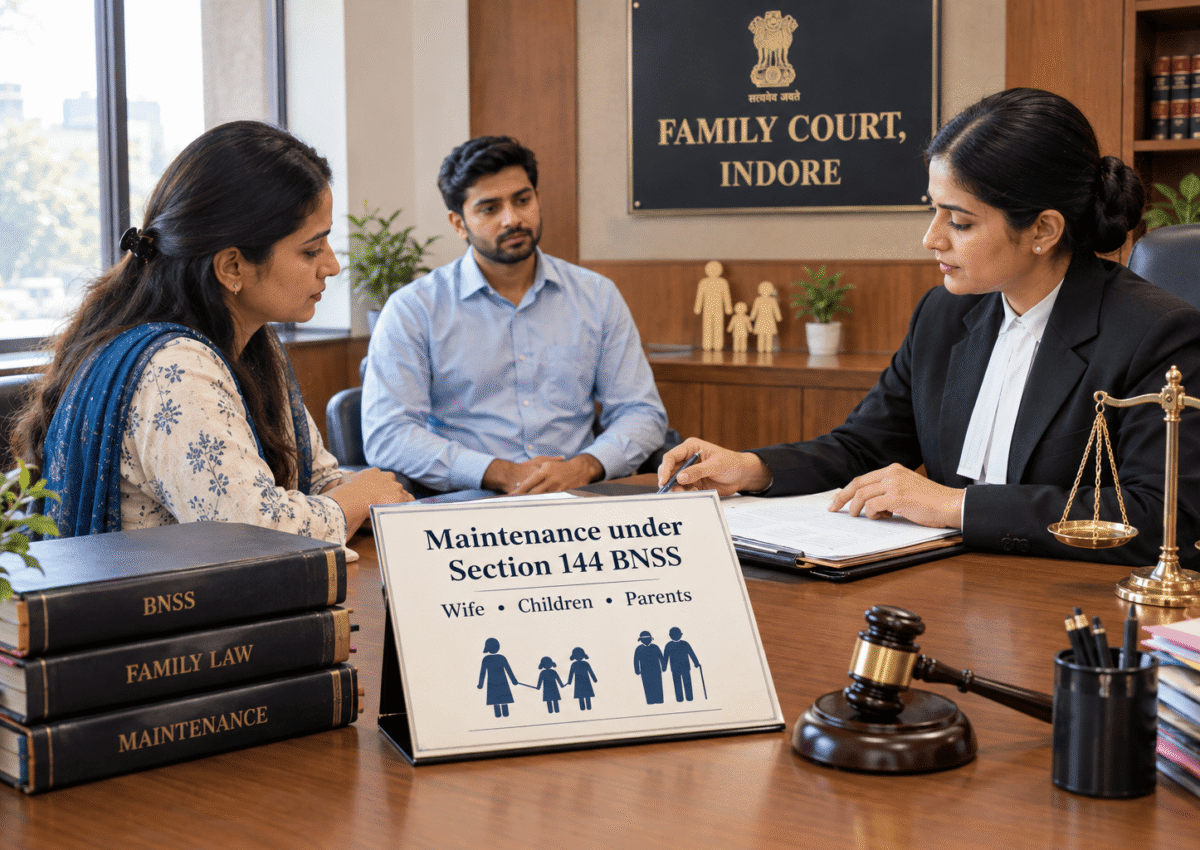
Can a Wife Living in Indore File a Maintenance Case Against Her Husband Before Family Court Indore?
Yes. A wife residing in Indore can file a maintenance proceeding against her husband before the Family Court, Indore under Section 144 of the Bharatiya Nagarik Suraksha Sanhita, 2023 (BNSS), provided the statutory requirements and territorial jurisdiction are satisfied.
This is an important question for wives who have separated from their husbands and are presently residing in Indore, particularly where the husband is living in another city, another district or even another State.
Section 144 BNSS provides a statutory remedy for maintenance to a wife who is unable to maintain herself where her husband, having sufficient means, neglects or refuses to maintain her. Section 145 BNSS specifically provides that proceedings may be instituted in a district where the husband or his wife resides, or where the husband last resided with his wife, among the other places specified by the statute.
Therefore, the mere fact that the husband does not presently reside in Indore does not, by itself, prevent a wife residing in Indore from approaching the Family Court, Indore.
What is Section 144 BNSS?
Section 144 of the Bharatiya Nagarik Suraksha Sanhita, 2023 deals with orders for maintenance of wives, children and parents.
Broadly, where a person having sufficient means neglects or refuses to maintain:
- his wife who is unable to maintain herself;
- his legitimate or illegitimate child who is unable to maintain itself;
- a qualifying major child suffering from physical or mental abnormality or injury; or
- his father or mother who is unable to maintain himself or herself,
the Magistrate of the First Class may, upon proof of the statutory requirements, order payment of a monthly allowance.
In areas where a Family Court has jurisdiction, the Family Court exercises the relevant maintenance jurisdiction under the Family Courts Act.
Why can a wife file the case before Family Court, Indore?
There are two important legal provisions to understand.
Section 144 BNSS
Section 144 creates the substantive maintenance remedy.
Section 145 BNSS
Section 145 deals with the procedure and territorial jurisdiction for proceedings under Section 144.
Section 145(1) provides that proceedings may be taken in any district:
- where the husband is;
- where the husband or his wife resides;
- where the husband last resided with his wife; or
- where his father or mother resides.
Thus, if a wife is genuinely residing within the territorial jurisdiction of Indore, that residence can provide a statutory jurisdictional basis for instituting the Section 144 proceeding in Indore.
The Family Courts Act, 1984 separately provides that a Family Court has jurisdiction over a suit or proceeding for maintenance and also exercises the jurisdiction that was exercisable by a Magistrate of the First Class in maintenance proceedings covered by the Act.
Does the husband also have to live in Indore?
No, not necessarily.
This is one of the most frequently asked questions by wives.
Suppose:
- the wife is residing in Indore;
- the husband is residing in Bhopal;
- the parties are separated; and
- the wife is unable to maintain herself.
The husband cannot automatically argue that the Family Court, Indore has no jurisdiction merely because he is residing in Bhopal.
Section 145(1)(b) expressly recognizes the district where the wife resides as one of the places where proceedings may be instituted.
Therefore, a wife residing in Indore may have a jurisdictional basis to institute the proceeding here.
However, the facts of residence should be genuine and capable of being established if jurisdiction is disputed.
What does “wife resides” mean in practical terms?
This is an important practical issue.
A wife should not assume that merely giving an Indore address in the petition automatically establishes territorial jurisdiction.
The Court may examine the factual circumstances concerning residence.
For example, relevant material may include:
- present residential address;
- rent agreement;
- electricity bill;
- Aadhaar or other address documents;
- bank records;
- correspondence;
- employment records;
- children’s school records;
- medical records;
- other documents showing residence; and
- the circumstances in which she came to reside in Indore.
The exact evidentiary requirements will depend upon the facts and the nature of the objection raised by the husband.
What if the wife has recently shifted to Indore?
This situation requires careful legal analysis.
If a wife has recently shifted to Indore, the question is not simply whether she has an Indore address.
The Court may have to examine whether she is actually residing in Indore and whether Section 145 jurisdiction is attracted on the facts.
Therefore, if the husband challenges jurisdiction on the ground that the wife has merely created a temporary address in Indore for filing the case, the wife should be prepared to establish her actual residence.
An advocate should therefore examine the factual residence before filing the case rather than relying solely upon a nominal address.
What if the wife is living with her parents in Indore?
A wife can live with her parents in Indore and still potentially invoke the jurisdiction contemplated by Section 145 BNSS.
The provision does not say that a wife must have an independent house in her own name.
What matters is whether she resides in the relevant district.
Therefore, a wife who has returned to her parental home in Indore after matrimonial separation may, subject to the facts, institute proceedings based upon her residence in Indore.
What if the husband lives outside Madhya Pradesh?
The answer can still be yes.
For example, suppose the wife is residing in Indore and her husband is living in:
- Mumbai;
- Delhi;
- Pune;
- Bengaluru;
- Ahmedabad;
- Jaipur;
- Bhopal; or
- another State.
Section 145(1)(b) recognizes the place where the wife resides as a possible forum for the proceeding.
The fact that the husband lives outside Madhya Pradesh therefore does not automatically prevent a wife residing in Indore from filing the maintenance proceeding in Indore.
Of course, appropriate service of notice and subsequent procedural steps have to be dealt with according to law.
What if the husband says, “Come to my city and file the case there”?
That is not necessarily correct.
Section 145 does not restrict the wife exclusively to the husband’s present place of residence.
The statutory language expressly includes the district where the wife resides.
Therefore, a wife who legitimately resides in Indore does not ordinarily have to travel to another city merely because her husband resides there.
The jurisdictional issue should, however, be decided from the actual facts and applicable law.
What if the parties last lived together in Indore?
This provides another potentially relevant jurisdictional basis.
Section 145(1)(c) permits proceedings in the district where the husband last resided with his wife.
Therefore, if the matrimonial home or the place where the parties last lived together was in Indore, that fact can independently become relevant to territorial jurisdiction.
For example:
Marriage: Bhopal
Matrimonial residence: Indore
Wife presently residing: Indore
Husband presently residing: Delhi
In such a situation, there may be more than one jurisdictional factor supporting proceedings in Indore.
Does the wife have to be divorced to file a Section 144 case?
No.
A wife does not have to obtain a divorce before claiming maintenance under Section 144.
A legally existing marriage is sufficient to consider a wife’s claim, subject to the other statutory requirements.
In fact, Section 144 is commonly invoked by wives whose matrimonial relationship continues but who are living separately from their husbands.
Can a separated wife claim maintenance?
Yes, subject to the statutory requirements.
The fact that the husband and wife are living separately does not by itself extinguish the wife’s right.
However, the Court may examine the circumstances of separate residence.
Section 144 specifically provides that a wife is not entitled to maintenance in certain circumstances, including where:
- she is living in adultery;
- without sufficient reason she refuses to live with her husband; or
- the parties are living separately by mutual consent.
Therefore, the question is often not simply:
“Is the wife living separately?”
but:
“Why is the wife living separately?”
What if the husband himself drove the wife out of the matrimonial home?
If the wife alleges that she was compelled to live separately because of cruelty, domestic violence, harassment, husband’s relationship with another woman, or other circumstances, those facts may become relevant to the maintenance claim.
Section 144 expressly provides that if the husband has contracted marriage with another woman or keeps a mistress, this is to be considered a just ground for the wife’s refusal to live with him.
The wife should therefore clearly plead the factual circumstances rather than merely stating that the husband refused to maintain her.
Can a wife file the case if she has no independent income?
Yes.
In fact, Section 144 expressly contemplates a wife who is unable to maintain herself.
The wife should place her financial circumstances before the Court.
This may include:
- employment status;
- salary;
- business income;
- rental income;
- investments;
- bank accounts;
- assets;
- monthly expenditure;
- medical expenses;
- children’s expenses; and
- other relevant financial information.
The absence of independent income can be an important factual circumstance, but entitlement must still be determined according to the statutory requirements.
Can a working wife living in Indore claim maintenance?
Yes, the fact that the wife is employed does not automatically prevent her from filing a maintenance case.
The Court can examine her actual income and financial circumstances while considering entitlement and quantum.
For example, a wife may be earning ₹20,000 per month while her husband earns substantially more. The mere existence of the wife’s employment does not answer the entire maintenance question.
Similarly, if the wife has substantial independent income sufficient for her own maintenance, that fact can be relevant to the husband’s defence.
The actual financial position should therefore be disclosed accurately by both parties.
Does the husband have to be a resident of Indore?
No.
As explained above, Section 145(1)(b) expressly includes the district where the wife resides.
Therefore, a husband living outside Indore may still be proceeded against before the Family Court, Indore where the statutory territorial jurisdiction is properly attracted.
Can a wife claim maintenance for children along with her own claim?
Yes, where the statutory requirements are satisfied.
A maintenance application may involve:
- maintenance for the wife;
- maintenance for minor children;
- interim maintenance for the wife;
- interim maintenance for children; and
- expenses of proceedings.
Section 144 expressly covers children in addition to wives.
The financial requirements of the wife and children should nevertheless be clearly set out rather than combining everything into one unexplained amount.
Can a divorced woman residing in Indore file a Section 144 case?
Yes, in appropriate circumstances.
The Explanation to Section 144 provides that “wife” includes a woman who has been divorced by, or has obtained a divorce from, her husband and has not remarried.
Therefore, a divorced woman residing in Indore may have a remedy under Section 144, subject to the statutory requirements and the effect of any previous settlement, alimony order or other proceedings.
Can a wife claim interim maintenance in Family Court, Indore?
Yes.
Section 144 expressly empowers the Court, during the pendency of the maintenance proceeding, to order interim maintenance and reasonable expenses of the proceeding.
This is particularly important because a wife may have no adequate financial resources while the main maintenance case is pending.
The statute provides that an application for interim maintenance and proceedings expenses should, as far as possible, be disposed of within sixty days from the date of service of notice of that application.
The phrase “as far as possible” is important. It should not be understood as an automatic guarantee that every interim-maintenance application will be decided within exactly 60 days.
From what date can maintenance be awarded?
Section 144(2) provides that maintenance or interim maintenance and expenses of proceedings are payable from the date of the order, or, if so directed, from the date of the application.
This can make a significant financial difference.
For example, if a wife files a maintenance application in January and an order is passed in September, the Court may have to determine the appropriate effective date in accordance with the provision and the facts.
Therefore, the question of the effective date should be specifically addressed in the proceedings.
What if the husband says that he has no income?
The husband’s assertion of “no income” does not necessarily end the matter.
The Court may examine his overall financial circumstances and resources.
Relevant matters may include:
- employment;
- business;
- profession;
- property;
- rental income;
- investments;
- bank accounts;
- previous employment;
- qualifications;
- earning capacity;
- lifestyle; and
- other financial resources.
A wife who has reliable evidence concerning the husband’s actual financial position should place it before the Court through legally appropriate means.
What if the husband claims that he is unemployed?
Unemployment may be relevant, but it is not necessarily conclusive.
The Court can examine the circumstances surrounding the alleged unemployment and the husband’s overall financial position.
Similarly, a husband should provide truthful financial disclosure rather than merely making a bald assertion that he has no income.
What if the husband says the wife left the matrimonial home voluntarily?
This can become an important defence, but it is not necessarily sufficient by itself.
The husband may have to establish that the wife refused to live with him without sufficient reason, if he relies upon that statutory ground.
The wife may, in turn, explain why she left.
Therefore, the Court may examine:
- cruelty;
- domestic violence;
- harassment;
- husband’s conduct;
- separate residence;
- second marriage;
- alleged extra-marital relationship;
- safety concerns;
- prior complaints;
- mediation;
- communications between the parties; and
- other relevant circumstances.
What documents should a wife living in Indore keep ready?
Before filing a maintenance case, a wife should ordinarily discuss with her lawyer the availability of:
Marriage documents
- marriage certificate;
- marriage photographs;
- invitation card;
- other proof of marriage.
Residence documents
- Aadhaar/address proof;
- rent agreement;
- electricity bill;
- bank correspondence;
- employment records;
- children’s school records;
- other documents demonstrating residence in Indore.
Financial documents
- wife’s bank statements;
- salary slips;
- income-tax records, if applicable;
- monthly expenditure details;
- medical expenditure;
- children’s educational expenses.
Husband’s financial information
Where legally available:
- employment details;
- business information;
- property information;
- professional information;
- vehicle ownership;
- investment information;
- other reliable evidence of financial capacity.
Matrimonial documents
- relevant messages;
- emails;
- complaints;
- medical documents;
- police records;
- domestic violence proceedings;
- previous court orders;
- mediation records.
The precise documents required depend upon the facts.
Can the husband challenge the territorial jurisdiction of Family Court, Indore?
Yes, a husband can raise a genuine jurisdictional objection where the statutory requirements for filing in Indore are not satisfied.
However, such an objection should be carefully examined before being raised.
Section 145 expressly permits proceedings in the district where the wife resides.
Therefore, a husband cannot successfully challenge Indore jurisdiction merely by saying:
“I do not live in Indore.”
The wife’s residence is itself recognized by the statute as a relevant jurisdictional connecting factor.
The real issue may be whether she genuinely resides within the relevant district and whether the Family Court, Indore has jurisdiction over the particular proceeding.
What if the wife has only temporarily come to Indore?
This should be examined carefully.
If the husband alleges that the wife has merely come to Indore temporarily for the purpose of filing the case, the Court may have to examine the factual question of residence.
The wife should therefore be prepared, where necessary, to establish that Indore is genuinely her place of residence.
This is one reason why a lawyer should collect residence-related documents before filing.
Can a wife living in Indore file against a husband living abroad?
The husband’s foreign residence does not automatically eliminate the wife’s statutory remedy.
Where the statutory jurisdictional requirements are satisfied, the proceeding may be instituted in India, and the procedural requirements concerning service upon a person outside India would then have to be addressed.
Such cases require additional procedural care because service, appearance, enforcement and the husband’s foreign assets or income can raise issues beyond an ordinary domestic maintenance case.
A wife should obtain case-specific advice before filing where the husband is permanently residing outside India.
What happens after filing the maintenance case?
Broadly, the proceeding may involve:
- Filing of the maintenance application.
- Scrutiny/registration by the Court.
- Issuance and service of notice.
- Appearance of the husband.
- Filing of reply.
- Consideration of interim maintenance, if claimed.
- Financial disclosure by the parties.
- Evidence and documents.
- Cross-examination where applicable.
- Final arguments.
- Final order.
- Enforcement, if maintenance is awarded and not paid.
The exact procedural sequence can vary according to the case and orders passed by the Family Court, Indore.
Does the Family Court try to settle matrimonial disputes?
Yes.
Section 9 of the Family Courts Act places a duty upon the Family Court to make efforts, where possible and consistent with the nature and circumstances of the case, to assist and persuade the parties to arrive at a settlement.
Therefore, a maintenance proceeding in Family Court, Indore may involve counselling or settlement/mediation efforts at an appropriate stage.
However, settlement should be voluntary and carefully documented.
What if the husband does not appear?
A husband should never ignore the summons.
Section 145 BNSS contains provisions concerning proceedings where the respondent wilfully avoids service or wilfully neglects to attend. In appropriate circumstances, the Court may proceed ex parte, subject to the statutory safeguards for seeking setting aside of an ex parte order.
Therefore, once notice from Family Court, Indore is received, the husband should immediately consult his advocate.
What if the husband does not pay the maintenance after an order?
Section 147 BNSS provides for enforcement of maintenance orders.
Therefore, if maintenance has been ordered and the husband does not comply, the wife can take appropriate steps for enforcement in accordance with the statutory procedure.
The wife should maintain a clear record of:
- monthly amount ordered;
- date from which it is payable;
- payments received;
- unpaid months; and
- total arrears.
Can the maintenance amount later be increased?
Potentially, yes.
Section 146 BNSS permits alteration of the maintenance allowance upon proof of a change in circumstances.
For example, circumstances may change because:
- the husband’s income increases;
- the child’s educational expenses increase;
- medical expenses increase;
- the wife’s circumstances change;
- the cost of necessary living expenses materially changes; or
- another relevant financial circumstance changes.
An appropriate application can be considered on the basis of the changed circumstances.
What if the husband’s financial condition becomes worse?
The same principle applies in the opposite direction.
If there is a genuine and material change in circumstances, Section 146 can become relevant to an application for alteration of the maintenance allowance.
Therefore, maintenance orders are not necessarily incapable of modification for the entire future.
What is the most important point for a wife residing in Indore?
The most important point is that residence in Indore can itself be a statutory jurisdictional basis under Section 145(1)(b) BNSS.
A wife does not necessarily have to file the case where her husband currently resides.
Section 145 specifically recognizes the district where “he or his wife resides.”
Therefore, if a wife genuinely resides within the jurisdiction of the Family Court, Indore, she may have a legal basis to institute her Section 144 maintenance proceeding there.
Practical checklist for a wife planning to file a maintenance case in Indore
Before filing, discuss the following with your advocate:
Jurisdiction
- Where do I presently reside?
- Where does my husband reside?
- Where did we last live together?
- Can my residence in Indore be established?
Marriage
- Do I have proof of marriage?
- Is the marriage disputed?
- Is there a divorce decree?
- Has either party remarried?
Financial position
- What is my income?
- What is my monthly expenditure?
- What do I know about my husband’s income?
- Does he own a business or property?
- Does he have other financial resources?
Children
- How many children are there?
- What are their ages?
- What are their school and medical expenses?
- Who presently bears those expenses?
Matrimonial dispute
- Why are we living separately?
- What happened before separation?
- Are there allegations of cruelty or domestic violence?
- Are there police complaints?
- Are there other pending cases?
Existing proceedings
- Has any maintenance already been awarded?
- Is there a domestic violence proceeding?
- Is there a divorce or matrimonial case?
- Are there previous settlement terms or court orders?
Interim relief
- Do I require interim maintenance?
- Do I require expenses of the proceedings?
- From what date should maintenance be sought?
Conclusion
Yes, a wife genuinely residing in Indore can, subject to the facts and applicable jurisdiction, file a maintenance proceeding against her husband before the Family Court, Indore under Section 144 BNSS.
The crucial statutory provision on territorial jurisdiction is Section 145(1)(b) BNSS, which expressly permits proceedings under Section 144 in a district where the husband or his wife resides. Section 145 also recognizes the district where the husband last resided with his wife as another possible forum.
The Family Courts Act, 1984 provides the Family Court with jurisdiction over proceedings for maintenance and the relevant maintenance jurisdiction that was formerly exercisable by a Magistrate.
Therefore, a wife living in Indore does not ordinarily have to travel to the husband’s city merely because the husband lives elsewhere.
At the same time, territorial jurisdiction should not be treated as a formality. The wife’s actual residence, the parties’ matrimonial history, the place where they last resided together and the other facts relevant under Section 145 BNSS should be properly examined before filing.
For a wife approaching the Family Court, Indore, the case should also be prepared beyond the question of jurisdiction. The petition should properly address her inability to maintain herself, the husband’s sufficient means, his alleged neglect or refusal to maintain her, the circumstances of separate residence, her financial needs, the husband’s financial capacity, children’s expenses where applicable, previous proceedings and the requirement of interim maintenance.
A well-prepared maintenance case is therefore not merely a claim for a particular monthly amount. It is a case requiring proper jurisdictional foundation, accurate financial disclosure, documentary evidence and a clear presentation of the circumstances of the matrimonial relationship.
Disclaimer: This information is intended for general guidance only and does not constitute legal advice. Please consult with a qualified lawyer for personalized advice specific to your situation.
Advocate J.S. Rohilla (Civil & Criminal Lawyer in Indore)
Contact: 88271 22304
