
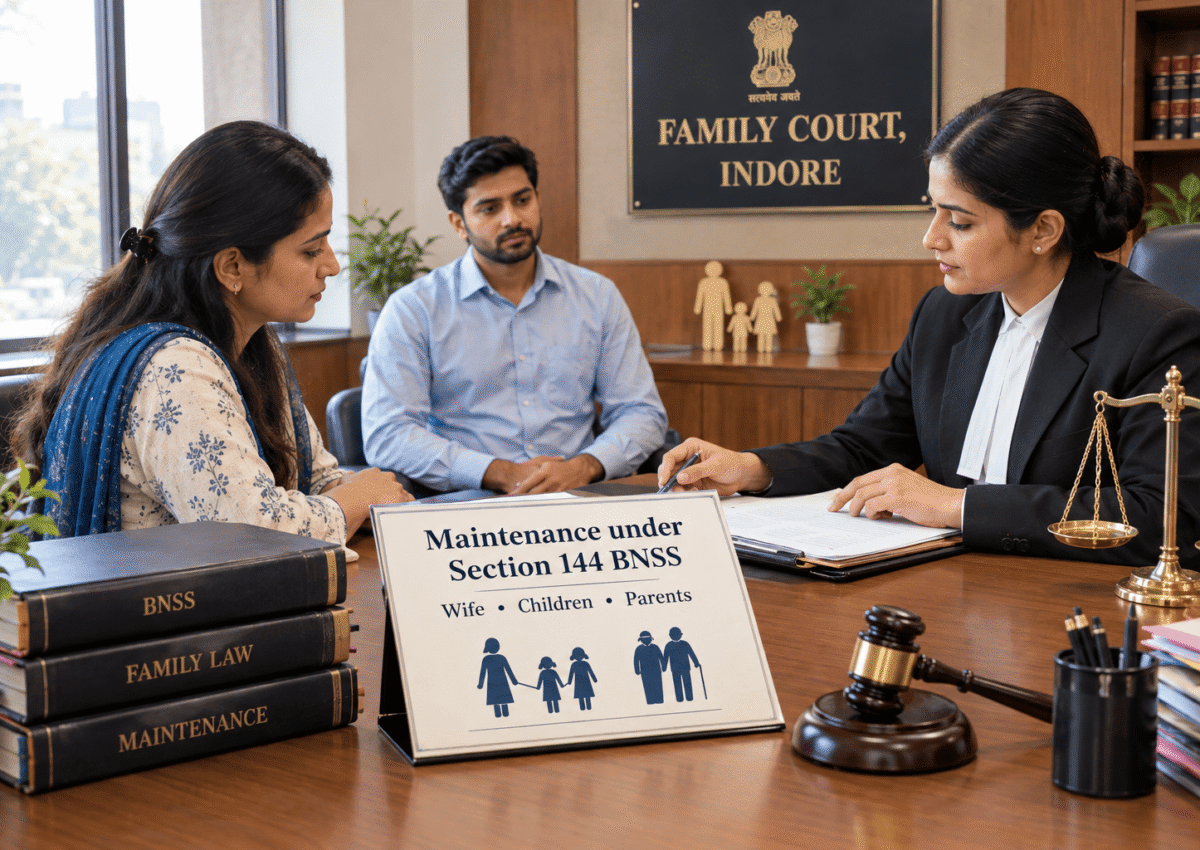
Can I File a Maintenance Case in Indore if My Husband and I Last Lived Together in Indore?
Yes. If you and your husband last resided together in Indore, you can, subject to the other requirements of law, file a maintenance proceeding before the Family Court, Indore under Section 144 of the Bharatiya Nagarik Suraksha Sanhita, 2023 (BNSS).
This is not merely because your marriage may have taken place in Indore or because you have some connection with the city. The important point is that Section 145(1)(c) BNSS specifically recognizes the district where the husband last resided with his wife as a permissible place for instituting proceedings under Section 144.
This provision can be particularly important where the husband has subsequently moved to another city or State after separation.
For example:
Wife: Presently residing in Indore
Husband: Presently residing in Mumbai
Last matrimonial residence: Indore
In such a situation, the wife may have a clear statutory basis for approaching the Family Court, Indore.
1. What is the short answer?
The short answer is:
Yes. If the husband and wife last resided together in Indore, Section 145(1)(c) BNSS provides a statutory territorial basis for instituting a Section 144 maintenance proceeding in Indore.
The husband’s present residence outside Indore does not, by itself, destroy this jurisdictional connection.
Section 145(1) provides several alternative places where a Section 144 proceeding may be instituted:
- where the husband is;
- where the husband or his wife resides;
- where the husband last resided with his wife; or
- where his father or mother resides.
Therefore, the wife is not necessarily required to travel to the husband’s present city merely because he has shifted away from Indore.
2. What does Section 144 BNSS provide?
Section 144 BNSS is the statutory provision dealing with maintenance of wives, children and parents.
In relation to a wife, where a person having sufficient means neglects or refuses to maintain his wife who is unable to maintain herself, the Court may order him to pay a monthly allowance for her maintenance.
The provision also permits the Court to grant:
- interim maintenance; and
- reasonable expenses of the proceedings.
The law further provides that an application for interim maintenance and proceedings expenses should, as far as possible, be disposed of within 60 days from the date of service of notice.
However, Section 144 tells us what maintenance remedy is available, while Section 145 tells us where the proceeding can be instituted.
For a wife who last lived with her husband in Indore, Section 145 is therefore particularly important.
3. What does Section 145(1)(c) BNSS say?
Section 145(1)(c) provides that proceedings under Section 144 may be taken in any district:
“where he last resided with his wife”
The word “he” in this provision refers to the person against whom the maintenance proceeding is sought, ordinarily the husband in a wife’s maintenance claim.
Thus, if the husband and wife last resided together in Indore, Indore can be a statutory territorial forum for the maintenance proceeding.
This is particularly useful where the husband has subsequently moved away.
4. Does the husband have to presently live in Indore?
No.
This is one of the most important practical points.
Suppose the parties:
- lived together in Indore after marriage;
- separated in Indore;
- the husband subsequently shifted to Delhi; and
- the wife continued to reside in or returned to Indore.
The husband cannot simply argue:
“I now live in Delhi, so the Family Court, Indore has no jurisdiction.”
His present residence is not the only territorial consideration.
Section 145(1)(c) specifically recognizes the district where he last resided with his wife.
Therefore, the wife’s case may continue to have a jurisdictional connection with Indore even after the husband has moved away.
5. What exactly does “last resided with his wife” mean?
This phrase is extremely important.
The provision is concerned with the last place where the husband and wife resided together.
It is not enough that:
- the husband once lived in Indore;
- the wife once lived in Indore;
- the marriage took place in Indore; or
- the husband’s parents live in Indore.
The relevant question under Section 145(1)(c) is:
Where did the husband and wife last reside together as husband and wife?
If the answer is Indore, that fact can support jurisdiction under Section 145(1)(c).
6. What is meant by “resided together”?
The parties should have actually lived together as spouses at the relevant place.
For example:
Example 1
The parties married in Indore and established their matrimonial home in Vijay Nagar, Indore.
They lived together there for three years.
After matrimonial disputes, the husband left Indore and moved to Mumbai.
This is a strong factual situation for invoking Section 145(1)(c), because Indore was the place where the husband last resided with his wife.
Example 2
The parties married in Indore but immediately moved to Bhopal and never lived together in Indore.
In that situation, the place of marriage alone would not establish jurisdiction under Section 145(1)(c).
The relevant place would be where they last actually resided together.
7. What if the wife is presently living in Indore too?
Then the wife’s position may be even stronger.
She may potentially rely upon two separate jurisdictional grounds:
- Section 145(1)(b) — the wife resides in Indore; and
- Section 145(1)(c) — the husband last resided with her in Indore.
Section 145(1)(b) permits proceedings in the district where the husband or his wife resides, while Section 145(1)(c) separately covers the district where the husband last resided with his wife.
Therefore, the petition should clearly state the relevant jurisdictional facts rather than merely mentioning Indore as the place of filing.
8. What if the wife has returned to her parental home in Indore?
That is a common situation.
For example:
- husband and wife lived together in Indore;
- serious matrimonial disputes arose;
- husband left the matrimonial home;
- wife returned to her parents’ home in Indore;
- husband subsequently shifted to another State.
The wife may potentially rely upon:
Section 145(1)(c): Indore was the place where the husband last resided with her.
If she is also genuinely residing in Indore, she may additionally rely upon:
Section 145(1)(b): Indore is the district where she resides.
Therefore, returning to the parental home does not by itself remove the Indore jurisdiction.
9. What if the husband says, “We lived together in Indore only for a short time”?
The duration of residence may become a factual issue, but the statutory language focuses on where the husband last resided with his wife.
The husband may dispute whether the parties actually established a matrimonial residence in Indore.
The wife should therefore be prepared to demonstrate the factual circumstances of the shared residence.
Relevant material may include:
- rental agreement;
- residential address;
- electricity or utility records;
- bank correspondence;
- employment records;
- school records of children;
- medical records;
- photographs;
- correspondence;
- delivery records;
- other documents showing that the parties actually lived together in Indore.
The precise evidentiary value of each document will depend upon the circumstances.
10. Does the place where the marriage took place matter?
It may be relevant as background, but it is important not to confuse it with the statutory jurisdictional ground under Section 145.
For Section 144 maintenance proceedings, Section 145 specifically lists:
- husband’s location;
- husband’s or wife’s residence;
- last shared residence of husband and wife; and
- residence of husband’s father or mother.
Place of marriage is not separately listed in Section 145(1).
Therefore, if your case is:
Marriage in Indore + last matrimonial residence in Indore
then the stronger jurisdictional basis is the last shared residence, not merely the place of marriage.
11. What if the husband now lives outside Madhya Pradesh?
That does not necessarily prevent the case from being filed in Indore.
For example:
Last shared residence: Indore
Present husband: Ahmedabad
Present wife: Indore
The wife may rely upon Section 145(1)(c) and, depending upon the facts, Section 145(1)(b).
Similarly, the husband could presently be residing in:
- Mumbai;
- Delhi;
- Pune;
- Bengaluru;
- Ahmedabad;
- Jaipur;
- Hyderabad;
- Bhopal; or
- another State.
The last shared residence in Indore remains a separate statutory connecting factor.
12. What if the husband is living abroad?
The husband’s foreign residence does not automatically eliminate the Indore jurisdiction if Section 145 otherwise applies.
For example:
Last matrimonial residence: Indore
Wife: residing in Indore
Husband: working in Dubai
The wife can examine Section 145(1)(c), along with any other applicable jurisdictional ground.
However, a foreign-resident husband may create additional procedural issues relating to:
- service of notice;
- appearance;
- representation;
- disclosure of foreign income;
- foreign assets;
- exchange rates;
- enforcement of the order.
These issues should be addressed at the beginning of the case.
13. What if the husband says the wife must file the case where he presently lives?
That is not an accurate statement of the statutory position.
Section 145 does not restrict the proceeding exclusively to the husband’s present place of residence.
It expressly provides alternative forums, including the district where the husband last resided with his wife.
Therefore, where Indore was the last shared matrimonial residence, the wife may have a statutory basis for filing there even though the husband has subsequently moved away.
14. What if the husband challenges territorial jurisdiction?
He is entitled to raise a genuine jurisdictional objection.
For example, he may contend:
- the parties never actually resided together in Indore;
- their last shared residence was another city;
- the alleged Indore residence was only temporary;
- the wife has incorrectly stated the matrimonial address;
- the parties had already separated before the alleged Indore residence.
The Court may then examine the evidence.
The wife should therefore plead the jurisdictional facts accurately and be prepared to support them.
15. What documents can establish that the parties last lived together in Indore?
There is no single document that is necessarily decisive in every case.
Depending upon the circumstances, evidence may include:
Residential documents
- rent agreement;
- lease deed;
- electricity bill;
- water bill;
- gas connection;
- broadband records;
- society records.
Government/address records
- Aadhaar;
- voter identification;
- passport;
- driving licence;
- other address records.
Employment records
- office records;
- employer records;
- transfer records;
- salary documents showing the Indore posting.
Children’s records
- school admission;
- school fee receipts;
- school correspondence;
- medical records.
Financial records
- bank statements;
- credit-card statements;
- delivery records;
- insurance documents.
Matrimonial evidence
- correspondence;
- photographs;
- messages;
- invitations;
- other documents showing the parties’ common household.
The appropriate evidence will depend upon the facts of the case.
16. What if the parties lived in a hotel or temporary accommodation in Indore?
This can become a factual question.
A short stay in a hotel during a visit to Indore should not automatically be treated as the parties’ last shared residence.
On the other hand, if the parties actually established their matrimonial residence in temporary accommodation in Indore for a period and lived there together as husband and wife, the circumstances may be relevant.
The key question is whether the parties actually resided together there.
17. What if the husband lived in Indore for work but the wife lived elsewhere?
This is different.
Suppose:
- husband was employed in Indore;
- wife remained in Bhopal;
- husband occasionally visited her;
- the parties never established a common household in Indore.
The wife should not automatically plead that Indore was the place where the husband last resided with her.
The statutory phrase requires examination of whether the husband actually resided with his wife at the relevant place.
18. What if the husband and wife lived in Indore but separated while the husband was away on business?
This may require factual analysis.
For example, if the parties had an established matrimonial home in Indore and the husband temporarily travelled elsewhere for employment, that temporary absence would not necessarily mean that the last shared residence ceased to be Indore.
The precise facts matter.
A maintenance petition should therefore accurately explain the matrimonial residence and the circumstances of separation.
19. Does Family Court, Indore have jurisdiction over maintenance proceedings?
The Family Courts Act, 1984 gives Family Courts jurisdiction over proceedings of the nature specified in Section 7, including proceedings concerning maintenance.
Section 7 provides that a Family Court exercises jurisdiction over suits and proceedings of the specified nature and includes maintenance-related jurisdiction within the statutory framework.
Therefore, where territorial jurisdiction is established under Section 145 BNSS, the Family Court, Indore can be the appropriate forum for the maintenance proceeding.
The exact allocation of jurisdiction should always be considered in light of the local Family Court notification and the facts of the case.
20. Is filing the maintenance case in Indore the same as proving entitlement to maintenance?
No.
This is an extremely important distinction.
There are two separate questions:
First question: Jurisdiction
Can the maintenance proceeding legally be instituted in Indore?
If the parties last resided together in Indore, Section 145(1)(c) may answer this question.
Second question: Entitlement
Is the wife legally entitled to maintenance under Section 144?
That requires examination of the substantive facts.
The wife generally has to establish the relevant statutory circumstances, including the husband’s sufficient means, neglect or refusal to maintain, and her inability to maintain herself, subject to the statutory conditions.
Therefore:
Territorial jurisdiction does not automatically establish entitlement to maintenance.
21. What if the husband says he was maintaining his wife when they lived in Indore?
This is a substantive defence, not necessarily a jurisdictional defence.
The husband may produce evidence showing:
- monthly payments;
- bank transfers;
- payment of rent;
- household expenses;
- school fees;
- medical expenses;
- insurance;
- other financial support.
The wife may contend that such support was insufficient or discontinued.
The Court can examine the actual evidence.
The existence of a valid Indore jurisdiction does not prevent the husband from contesting the merits of the maintenance claim.
22. What if the wife is earning?
A wife who is earning can still institute a maintenance proceeding if she otherwise satisfies the statutory requirements.
Her actual income and financial resources may, however, be relevant to entitlement and quantum.
The Court may examine:
- wife’s salary;
- husband’s income;
- standard of living;
- reasonable needs;
- liabilities;
- children’s expenses;
- assets;
- other financial circumstances.
Therefore, neither party should reduce the case to the simple proposition:
“She works, so she gets nothing.”
or
“He earns well, so she automatically gets whatever she claims.”
The Court considers the facts and evidence.
23. Can the wife seek interim maintenance in Family Court, Indore?
Yes.
Section 144 expressly permits interim maintenance and reasonable expenses of the proceedings during the pendency of the maintenance case.
The statute further provides that an application for interim maintenance and proceedings expenses should, as far as possible, be disposed of within 60 days from service of notice.
Therefore, if the wife requires immediate financial support, she should consider seeking interim relief at the appropriate stage.
24. Can maintenance be awarded from the date of filing?
Yes.
Section 144(2) provides that maintenance or interim maintenance is payable from the date of the order or, if so directed, from the date of the application.
Consequently, the date on which the maintenance application is filed can have significant financial implications.
A wife should therefore carefully formulate:
- the amount claimed;
- the date from which maintenance is sought;
- interim expenses; and
- supporting financial material.
25. What if the wife has children who lived with both parties in Indore?
The fact that the family lived together in Indore can be particularly relevant.
For example:
- husband and wife lived in Indore;
- their children attended school in Indore;
- the matrimonial household was in Indore;
- the husband later left Indore;
- wife and children remained in or returned to Indore.
The wife can explain the family residence and the circumstances of separation in the maintenance petition.
The maintenance claim may also include the children’s statutory entitlement where the requirements of Section 144 are satisfied.
26. What if the husband has shifted his entire business from Indore to another State?
That does not necessarily defeat jurisdiction.
The relevant question under Section 145(1)(c) is where the husband last resided with his wife.
A later change of:
- employment;
- business;
- residence;
- State;
- city
does not automatically erase the historical jurisdictional connection recognized by Section 145.
27. Can the husband seek transfer of the case?
A husband may seek appropriate transfer relief where legally available and where there are sufficient grounds.
However, the existence of jurisdiction in Indore does not automatically mean that the case must be transferred simply because the husband now lives elsewhere.
A transfer request and a jurisdictional objection are separate legal questions.
The wife should therefore not assume that filing in Indore is invalid merely because the husband subsequently moved.
28. What if the husband has remarried after moving out of Indore?
The remarriage itself does not eliminate the territorial jurisdiction based upon the last shared residence.
Moreover, Section 144 specifically recognizes that where a husband has contracted another marriage or keeps a mistress, this can constitute a just ground for the wife’s refusal to live with him.
Therefore, if the husband argues:
“I am willing to maintain my wife only if she comes back to live with me,”
the Court may examine the circumstances surrounding such an offer.
29. What if the wife has left Indore and is now living elsewhere?
The fact that the parties last resided together in Indore can still be relevant under Section 145(1)(c).
For example:
Last shared residence: Indore
Wife’s present residence: Delhi
Husband’s present residence: Mumbai
The wife should examine whether Section 145(1)(c) provides the necessary territorial basis.
However, if she is no longer residing in Indore, she should not rely upon Section 145(1)(b) merely because she formerly lived there.
The jurisdictional basis should be stated accurately.
30. What if the parties last lived together in Indore ten years ago?
The passage of time does not, by itself, rewrite the statutory language.
If Indore was genuinely the place where the husband last resided with his wife, that fact may remain relevant under Section 145(1)(c).
However, the overall facts should be carefully examined, particularly where there have been multiple periods of separation, reconciliation, relocation or subsequent cohabitation.
The petition should identify the last actual shared residence, not simply an earlier matrimonial residence.
31. What does “last resided together” mean where there were multiple matrimonial homes?
This is an important drafting issue.
Suppose the parties lived:
- Indore — 2018 to 2020
- Bhopal — 2020 to 2022
- Indore — 2022 to 2025
- Husband shifted to Mumbai — 2025
The relevant place under Section 145(1)(c) would ordinarily be the place where the husband last resided with his wife, which on these facts would be Indore.
Therefore, a maintenance petition should provide a clear chronology of matrimonial residences.
32. How should the wife plead territorial jurisdiction in her petition?
The jurisdiction paragraph should be factual and precise.
For example:
“That the petitioner and respondent last resided together as husband and wife at Indore, Madhya Pradesh, and therefore this Hon’ble Court has territorial jurisdiction to entertain and adjudicate the present proceedings under Section 145(1)(c) of the Bharatiya Nagarik Suraksha Sanhita, 2023.”
If the wife also resides in Indore, the petition can separately plead the additional jurisdictional fact:
“That the petitioner is presently residing at Indore, Madhya Pradesh, and the present proceedings are also maintainable at Indore under Section 145(1)(b) of the Bharatiya Nagarik Suraksha Sanhita, 2023.”
The exact pleading should, of course, correspond to the actual facts.
33. What documents should be kept ready to prove last shared residence?
A wife should preserve documents showing the common matrimonial household.
Useful documents may include:
- rent agreement in the names of the parties;
- electricity bills;
- gas connection;
- society maintenance records;
- house purchase documents;
- employer records;
- children’s school records;
- medical records;
- bank correspondence;
- insurance documents;
- courier/delivery records;
- photographs;
- messages;
- correspondence;
- other credible evidence.
It is preferable to collect evidence contemporaneously rather than attempting to reconstruct the entire residence history years later.
34. What if there is no document showing both names?
The absence of a joint document does not necessarily mean that the fact of shared residence cannot be established.
Other evidence may be relevant.
For example:
- landlord’s records;
- neighbours’ evidence, where appropriate;
- school records;
- employment records;
- correspondence;
- photographs;
- electronic communications;
- other surrounding circumstances.
The Court will assess the evidence as a whole.
35. What if the husband denies ever living with the wife in Indore?
The wife should respond with specific facts rather than general allegations.
For example:
- exact address;
- approximate period of residence;
- nature of accommodation;
- employment location;
- children’s school;
- landlord;
- utility connections;
- relevant correspondence;
- photographs;
- other supporting evidence.
The more specific the factual pleading, the easier it is for the Court to examine the jurisdictional objection.
36. Can the wife also rely upon the husband’s parents living in Indore?
Yes, where the statutory conditions are satisfied.
Section 145(1)(d) provides jurisdiction in the district where the husband’s father or mother resides.
Therefore, in some cases there may be several independent jurisdictional grounds connecting the proceeding with Indore.
For example:
- wife resides in Indore;
- parties last resided together in Indore; and
- husband’s parents reside in Indore.
The petition should identify the grounds that genuinely apply rather than pleading every possible ground without factual basis.
37. What if the husband is living separately but maintains a house in Indore?
The mere existence of property in Indore should not automatically be equated with the statutory ground of last shared residence.
The relevant question under Section 145(1)(c) remains where the husband last resided with his wife.
If the Indore property was actually the matrimonial home where the parties last lived together, that is different from merely owning an unused house in Indore.
38. Can the husband avoid the case because attending Indore is inconvenient?
Not merely on that ground.
If Family Court, Indore has territorial jurisdiction, the husband’s inconvenience does not automatically extinguish the jurisdiction.
However, procedural arrangements concerning personal appearance may be considered by the Court.
Section 145(2) expressly contemplates proceedings where the respondent’s personal attendance is dispensed with and evidence may be taken in the presence of his advocate.
Therefore, an outstation husband may seek appropriate procedural relief rather than simply ignoring the proceeding.
39. What happens if the husband does not appear?
Section 145(2) permits the Court to proceed ex parte where it is satisfied that the respondent is wilfully avoiding service or wilfully neglecting to attend.
The provision also contains a mechanism for setting aside an ex parte order for good cause within the statutory period and subject to appropriate terms.
Therefore, a husband receiving notice from Family Court, Indore should respond promptly even if he lives in another city.
40. Can the wife settle the matter in Family Court, Indore?
Yes.
The Family Courts Act emphasizes settlement and requires the Family Court, where possible and consistent with the nature and circumstances of the case, to make efforts to assist the parties in reaching a settlement.
Depending upon the circumstances, a settlement may address:
- monthly maintenance;
- interim maintenance;
- arrears;
- children’s expenses;
- education expenses;
- medical expenses;
- one-time settlement;
- withdrawal or settlement of connected litigation;
- matrimonial proceedings; and
- other agreed obligations.
A settlement should be properly drafted and placed before the competent Court.
41. What if the wife has also filed a Domestic Violence case?
The wife should disclose the existence of connected proceedings.
If she has filed proceedings under the Protection of Women from Domestic Violence Act, 2005, she should maintain a clear record of:
- relief claimed;
- interim orders;
- maintenance/monetary relief claimed;
- amounts received;
- pending applications.
Similarly, the husband should disclose any previous or parallel maintenance orders.
This helps prevent inconsistent pleadings and unnecessary disputes concerning overlapping monetary relief.
42. What if the husband says the wife is not entitled to maintenance because she left the matrimonial home?
The question of why she left becomes important.
Section 144 contains statutory provisions concerning a wife’s refusal to live with her husband.
The wife may have legally sufficient grounds for living separately.
The statute specifically recognizes, for example, that where the husband has contracted another marriage or keeps a mistress, that is a just ground for the wife’s refusal to live with him. It also addresses situations involving adultery, refusal without sufficient reason and separation by mutual consent.
Therefore, simply proving that the wife left Indore or left the matrimonial home does not automatically dispose of her maintenance claim.
The circumstances must be examined.
43. What if the husband claims that the parties separated by mutual consent?
That may be relevant under Section 144.
Section 144(4) provides that a wife is not entitled to maintenance under that provision if the parties are living separately by mutual consent, subject to the statutory framework.
The husband would need to establish the factual basis for such a contention.
The wife may dispute that the separation was voluntary or mutually agreed.
Therefore, the circumstances of separation should be pleaded carefully.
44. Can the wife file maintenance even if she is already living separately for a long time?
A long period of separation does not automatically answer the question.
The Court will examine:
- the statutory requirements;
- circumstances of separation;
- financial condition of the wife;
- husband’s financial capacity;
- previous payments;
- previous court orders;
- other relevant facts.
The wife should therefore provide a clear chronology explaining when and why the parties separated.
45. What if the husband has sufficient income but claims large liabilities?
Liabilities can be relevant, but they should be genuine and supported by documents.
The husband should disclose:
- loan statements;
- EMI obligations;
- dependent-parent expenses;
- medical expenses;
- other genuine financial commitments.
Similarly, the wife should provide accurate information concerning her own income and expenses.
The Court can then determine the appropriate amount based on the overall financial circumstances.
46. What if the wife has no independent income?
The wife should clearly disclose that fact and provide appropriate financial information.
She should prepare a realistic statement of monthly requirements, including:
- food;
- accommodation;
- clothing;
- medical expenses;
- transportation;
- communication;
- personal necessities;
- children’s expenses, where applicable.
The claim should be based upon reasonable and supportable figures rather than an arbitrary amount.
47. What if the wife is receiving financial support from her parents?
Temporary support from parents does not automatically decide the maintenance claim against the husband.
The Court may consider the wife’s own financial position and the husband’s statutory obligations.
The wife should nevertheless disclose relevant facts honestly.
48. What is the most important point in an Indore maintenance case based on last shared residence?
The most important point is:
The petition should clearly establish that Indore was actually the place where the husband last resided with the wife.
Do not rely merely on:
- place of marriage;
- wife’s parental home;
- husband’s old address;
- husband’s property;
- occasional visits.
The factual basis should be:
“The husband and wife last resided together as husband and wife at Indore.”
That is the statutory connection recognized by Section 145(1)(c).
49. A practical example
Suppose:
Marriage: 2019
Matrimonial home: Indore
Period of cohabitation: 2019–2025
Separation: 2025
Husband: shifted to Bengaluru
Wife: residing in Indore
The wife wants to file a Section 144 BNSS maintenance case.
She can potentially rely upon:
Section 145(1)(b): she resides in Indore.
She can also rely upon:
Section 145(1)(c): the husband last resided with her in Indore.
The fact that the husband now lives in Bengaluru does not automatically deprive the Family Court, Indore of territorial jurisdiction.
50. Another example: last shared residence was not Indore
Suppose:
Marriage: Indore
Matrimonial home: Bhopal
Last shared residence: Bhopal
Husband: Delhi
Wife: Bhopal
The wife should not automatically file in Indore merely because the marriage was solemnized there.
The more obvious Section 145 jurisdictional connection is Bhopal, because that is where the husband last resided with his wife and where the wife presently resides.
This illustrates why place of marriage and last shared residence should not be confused.
51. How should a wife prepare before filing in Family Court, Indore?
A practical checklist is:
Establish the last matrimonial residence
Write down:
- complete address;
- period of residence;
- when the parties moved there;
- when the husband left;
- when the wife left;
- circumstances of separation.
Collect supporting documents
Keep:
- rent agreement;
- utility bills;
- employment documents;
- children’s records;
- correspondence;
- photographs;
- other residence evidence.
Prepare financial information
Collect information concerning:
- husband’s salary;
- business;
- property;
- vehicles;
- investments;
- other sources of income.
Prepare the maintenance calculation
List realistic monthly expenses.
Identify parallel proceedings
Prepare details of:
- divorce;
- domestic violence;
- criminal cases;
- custody;
- previous maintenance cases;
- other relevant proceedings.
Preserve evidence
Do not delete relevant messages, emails, documents or financial records.
52. How should a lawyer draft the jurisdiction paragraph?
Where the facts genuinely support it, a maintenance petition can contain a jurisdiction paragraph along these lines:
“That the petitioner and respondent last resided together as husband and wife at Indore, Madhya Pradesh, and therefore the present proceedings under Section 144 of the Bharatiya Nagarik Suraksha Sanhita, 2023 are maintainable within the territorial jurisdiction of this Hon’ble Court in terms of Section 145(1)(c) thereof.”
If the wife also presently resides in Indore, an additional factual basis may be pleaded:
“That the petitioner is presently residing at Indore, Madhya Pradesh, and the present proceedings are also maintainable within the territorial jurisdiction of this Hon’ble Court under Section 145(1)(b) of the Bharatiya Nagarik Suraksha Sanhita, 2023.”
The pleading should only contain facts that are true and capable of being supported by evidence.
53. What if the husband raises a preliminary objection?
The wife should respond to the specific objection rather than merely repeating that she was married in Indore.
For example, if the husband says:
“I have been living in Mumbai for the last two years.”
the wife can explain:
“The respondent’s present residence in Mumbai is not determinative because the parties last resided together as husband and wife at Indore, attracting Section 145(1)(c) BNSS.”
If she also resides in Indore:
“The petitioner additionally resides in Indore, attracting Section 145(1)(b) BNSS.”
The response should be based upon the actual facts and documentary evidence.
54. Conclusion
Yes. If you and your husband last lived together in Indore, you can have a statutory basis for filing a maintenance proceeding before the Family Court, Indore under Section 144 BNSS.
The key provision is Section 145(1)(c) BNSS, which expressly provides that proceedings under Section 144 may be taken in the district “where he last resided with his wife.”
This means that the husband’s subsequent relocation to another city or State does not, by itself, remove the territorial connection with Indore.
If you also presently reside in Indore, there may be an additional jurisdictional basis under Section 145(1)(b), which permits proceedings where the husband or his wife resides.
However, the wife should distinguish carefully between:
place of marriage,
present residence, and
last shared matrimonial residence.
For a Section 144 BNSS maintenance proceeding, the last shared residence is expressly recognized by Section 145(1)(c). Thus, where the parties genuinely last lived together as husband and wife in Indore, this fact should be specifically and accurately pleaded in the maintenance petition.
Finally, territorial jurisdiction and entitlement to maintenance are two different questions. Establishing Indore jurisdiction does not automatically establish the wife’s entitlement or the amount of maintenance. The Court will still examine the statutory requirements, the circumstances of separation, the financial position of both parties, the wife’s needs, the husband’s means, and other relevant facts.
For a woman seeking maintenance in Indore, the practical question is therefore not merely:
“Where does my husband live today?”
It is also:
“Where did my husband and I last actually reside together as husband and wife?”
If the answer is Indore, Section 145(1)(c) BNSS provides an important statutory basis for approaching the Family Court, Indore.
Disclaimer: This information is intended for general guidance only and does not constitute legal advice. Please consult with a qualified lawyer for personalized advice specific to your situation.
Advocate J.S. Rohilla (Civil & Criminal Lawyer in Indore)
Contact: 88271 22304
