
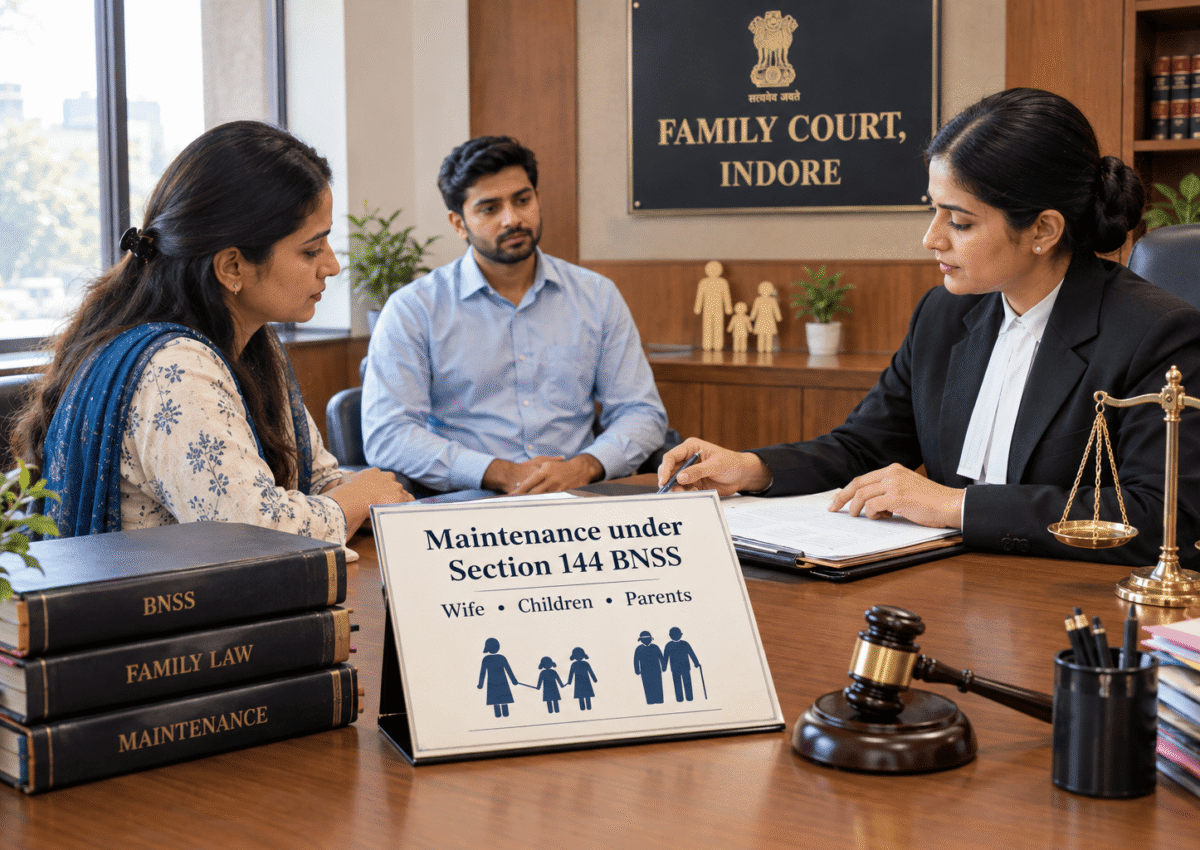
Can a Wife Residing in Indore File a Maintenance Case in Family Court if Her Husband Is Living Abroad?
Yes. A wife who is genuinely residing in Indore can, subject to the facts of her case, institute a maintenance proceeding in Indore even when her husband is living and working abroad.
The husband’s foreign residence does not, by itself, require the wife to travel to the country where he is living and pursue her maintenance claim there.
Section 144 of the Bharatiya Nagarik Suraksha Sanhita, 2023 (BNSS) provides the statutory remedy for maintenance of a wife, children and parents. More importantly for the question of jurisdiction, Section 145(1)(b) BNSS expressly permits proceedings under Section 144 to be taken in a district where the husband or his wife resides. Section 145(1)(c) also permits proceedings in the district where the husband last resided with his wife.
Therefore, where a wife presently and genuinely resides in Indore, the fact that her husband has shifted abroad for employment or permanent residence does not automatically take the matter outside the jurisdiction of Indore.
1. Can a wife living in Indore claim maintenance from a husband living abroad?
Yes.
Suppose the following situation exists:
- the parties are legally married;
- the wife is presently residing in Indore;
- the husband is residing and working in another country;
- the husband is financially capable of maintaining his wife;
- the husband is neglecting or refusing to provide adequate maintenance; and
- the wife is unable to maintain herself in the manner contemplated by Section 144 BNSS.
In such circumstances, the wife can consider initiating appropriate maintenance proceedings in Indore, provided the statutory territorial and substantive requirements are satisfied.
The husband’s foreign residence is therefore not an automatic bar to a maintenance claim in Indore.
2. Why can the case be filed in Indore when the husband lives abroad?
The answer lies principally in Section 145 BNSS.
Section 145(1) provides that proceedings under Section 144 may be taken in a district:
(a) where the husband is;
(b) where he or his wife resides;
(c) where he last resided with his wife; or
(d) where his father or mother resides.
These are alternative statutory territorial grounds.
Therefore, the wife does not necessarily have to file the proceeding at the husband’s present place of residence.
If the wife resides in Indore, Section 145(1)(b) is particularly important because it expressly recognises the wife’s place of residence as a permissible forum.
3. Does the husband’s foreign residence defeat Family Court, Indore jurisdiction?
No, not merely because he is abroad.
For example, if the husband is living in:
- Dubai;
- Abu Dhabi;
- Singapore;
- London;
- Canada;
- Australia;
- the United States;
- Saudi Arabia;
- Qatar; or
- any other foreign country,
his foreign residence does not by itself mean that the wife cannot approach the competent court in India.
The question is whether the Indian Court has jurisdiction under the applicable law.
Where the wife genuinely resides in Indore, Section 145(1)(b) BNSS provides an important jurisdictional basis.
4. What role does Family Court, Indore play?
The Family Courts Act, 1984 provides Family Courts with jurisdiction over specified family and matrimonial proceedings, including proceedings relating to maintenance within the statutory framework. Section 7 sets out the jurisdiction of a Family Court.
Therefore, where the maintenance proceeding falls within the jurisdiction of the Family Court, the wife may approach the Family Court, Indore, rather than being required to institute the proceeding in the country where the husband presently resides.
The exact forum should always be determined from the particular facts and the territorial jurisdiction applicable to the Family Court.
5. Does the wife have to prove that she actually resides in Indore?
Yes, if residence in Indore is being relied upon as the jurisdictional basis.
The word “resides” should not be treated as meaning that a person can simply mention any Indore address in the petition.
If the husband challenges jurisdiction, the Court may examine whether the wife actually resides in Indore.
Useful evidence may include:
- Aadhaar or other address proof;
- rent agreement;
- electricity or other utility bills;
- bank records;
- government correspondence;
- employment records;
- children’s school records;
- medical records;
- residential documents of parents where she is living with them;
- documents filed in other proceedings; and
- other material demonstrating actual residence.
The evidence required will depend upon the facts of the individual case.
6. Can a wife living with her parents in Indore file the case?
Yes.
This is particularly relevant in matrimonial disputes.
A wife may have returned to her parental home in Indore because of:
- matrimonial disputes;
- cruelty;
- domestic violence;
- financial neglect;
- abandonment;
- disputes with in-laws;
- husband’s second marriage or relationship;
- husband’s decision to live separately; or
- other circumstances affecting matrimonial life.
Living with her parents does not, by itself, prevent the wife from relying upon her residence in Indore for territorial jurisdiction.
What matters is whether she is genuinely residing there.
7. What if the husband has been living abroad for several years?
That fact does not automatically defeat the proceeding.
In fact, where the husband has been abroad for several years, the wife should carefully distinguish between:
territorial jurisdiction, and
service and enforcement difficulties.
The first question is whether Indore is a permissible place to institute the maintenance proceeding.
The second question is how notice will be served upon the husband abroad, how he will participate in the case, how his financial information will be placed before the Court, and how an eventual order may be enforced.
These are important practical issues, but they do not necessarily eliminate the wife’s right to approach an Indian court having jurisdiction.
8. What if the husband says, “I live abroad, so Indian courts cannot order me to pay maintenance”?
That is too broad a proposition.
A husband does not automatically become immune from proceedings in India merely because he resides outside India.
If an Indian court has jurisdiction over the proceeding and the statutory requirements are satisfied, the husband can be called upon to respond to the proceedings.
However, the practical enforceability of an order against a person residing abroad may depend upon the circumstances, the location of his assets and income, the nature of the order, and applicable Indian and foreign law.
Therefore, jurisdiction and enforcement should not be confused.
9. What if the husband is an NRI?
The fact that the husband is an NRI does not automatically extinguish the wife’s right to seek maintenance.
An NRI husband may have:
- salary earned abroad;
- Indian property;
- foreign bank accounts;
- investments;
- business interests;
- pension or retirement benefits;
- shares or securities;
- rental income in India; or
- other financial resources.
The Court may require appropriate disclosure and evidence concerning the parties’ financial circumstances.
The wife should therefore collect as much reliable information as she can about the husband’s employment and financial position.
10. Can the wife’s maintenance claim take into account the husband’s foreign salary?
The husband’s income and financial capacity are relevant to the determination of maintenance.
If the husband is employed abroad, his foreign employment may be an important part of the financial picture.
The wife should provide reliable information, where available, concerning:
- employer;
- designation;
- country of employment;
- salary;
- employment benefits;
- accommodation provided by employer;
- bonuses;
- business interests;
- Indian properties;
- investments; and
- other financial resources.
However, the wife should avoid making inflated or speculative claims regarding the husband’s income.
The Court will determine the amount of maintenance on the basis of the evidence and circumstances placed before it.
11. What if the wife does not know the exact foreign salary?
That is not necessarily fatal to the maintenance proceeding.
In many matrimonial cases, the wife may know that the husband is working abroad but may not know his exact salary.
For example, she may know:
“My husband is working in Dubai with a particular company.”
but not know whether his monthly income is AED 15,000, AED 20,000 or AED 30,000.
The wife should state the information that she genuinely possesses and avoid presenting assumptions as established facts.
The husband’s financial disclosure and supporting evidence can become important during the proceeding.
12. What if the husband deliberately conceals his foreign income?
If the wife has credible material suggesting that the husband is concealing his actual income, that issue should be specifically brought to the attention of the Court.
The wife may place before the Court whatever reliable material she possesses, such as:
- employment details;
- social or professional profiles;
- company information;
- salary documents;
- communications;
- property records;
- bank-related information lawfully available to her;
- photographs or documents showing employment or business activity; or
- other relevant evidence.
The Court can then consider the financial disclosures and evidence in accordance with law.
The wife should not, however, rely on fabricated documents or illegally obtained material.
13. Can the wife claim interim maintenance from a husband living abroad?
Yes, where she satisfies the requirements for interim relief.
Section 144 BNSS expressly provides for interim maintenance and reasonable expenses of proceedings during the pendency of the maintenance proceeding. It further provides that an application for interim maintenance and proceedings expenses should, as far as possible, be disposed of within sixty days from service of notice of the application.
Therefore, a wife should not assume that she has to wait until the final disposal of the entire maintenance case before seeking interim financial relief.
14. From what date can maintenance be awarded?
Section 144(2) BNSS provides that maintenance or interim maintenance is payable from the date of the order or, if so directed, from the date of the application.
Accordingly, the wife should carefully consider the date of filing and the relief being claimed.
The Court will determine the appropriate effective date in accordance with the statute and facts of the case.
15. What if the husband says he has no responsibility because the wife is in India and he is abroad?
The place where the spouses are physically living does not by itself determine whether the husband has a maintenance obligation.
The Court will examine the statutory requirements.
Section 144 applies where a person having sufficient means neglects or refuses to maintain a wife who is unable to maintain herself.
Thus, the central questions include:
- Is there a valid marital relationship?
- Is the wife unable to maintain herself as contemplated by the provision?
- Does the husband have sufficient means?
- Has he neglected or refused to maintain her?
- Are there any statutory defences or circumstances affecting entitlement?
The fact that the husband happens to be abroad is only one factual circumstance.
16. Can the husband challenge the jurisdiction of Family Court, Indore?
Yes.
A husband living abroad can raise a territorial-jurisdiction objection if he believes that the statutory requirements for filing in Indore are not satisfied.
For example, he may contend:
- the wife does not actually reside in Indore;
- she is only temporarily staying in Indore;
- the Indore address is nominal;
- the parties last resided together somewhere else;
- another court has jurisdiction on the facts; or
- the statutory requirements have otherwise not been fulfilled.
But the mere statement:
“I live abroad, therefore Indore Court has no jurisdiction”
does not by itself answer Section 145(1)(b).
Section 145 expressly permits proceedings where the wife resides.
17. What if the wife returned to her parental home in Indore after the husband went abroad?
This is a common factual situation.
For example:
The husband went to Dubai for employment after marriage. The wife initially lived with him or with his family in another city. Due to matrimonial differences, she returned to her parental home in Indore and has continued to live there.
If the wife genuinely resides in Indore, she may rely upon Section 145(1)(b).
The precise facts concerning the parties’ last shared residence should also be examined because Section 145(1)(c) separately recognises the district where the husband last resided with his wife.
18. What if the parties last lived together in Indore before the husband moved abroad?
This provides an additional potentially important jurisdictional ground.
Section 145(1)(c) permits proceedings in the district where the husband last resided with his wife.
Therefore, suppose:
- husband and wife lived together in Indore;
- husband subsequently obtained employment abroad;
- the marriage broke down;
- wife continued to reside in or returned to Indore.
In such circumstances, the wife’s residence and the parties’ last shared residence may both be relevant.
The petition should accurately plead the factual circumstances rather than relying upon a general statement that the parties have some connection with Indore.
19. Does the place of marriage in Indore automatically give jurisdiction?
Not necessarily.
The place where the marriage was solemnised is not separately listed as a territorial ground in Section 145(1) BNSS.
Therefore, merely saying:
“Our marriage took place in Indore”
does not, by itself, establish every aspect of territorial jurisdiction for a Section 144 proceeding.
The stronger statutory grounds may arise from:
- the wife’s present residence in Indore; and/or
- the parties’ last shared residence in Indore,
depending upon the facts.
20. How will notice be served on a husband living abroad?
Service upon a husband living outside India requires careful attention to the applicable procedural requirements.
The wife should provide the Court with the husband’s correct and complete foreign address, wherever known, including:
- flat/house number;
- street;
- city;
- country;
- postal code;
- employer details, where relevant;
- email or other contact details, where legally appropriate.
The Court will determine the legally permissible mode of service.
The wife should not provide an incomplete or deliberately incorrect address merely to obtain an ex parte order.
Proper service becomes particularly important where the husband is residing outside India.
21. Can the husband contest the case without personally coming to every hearing in Indore?
Potentially, yes, depending upon the stage and orders of the Court.
Section 145(2) BNSS contemplates evidence being taken in the presence of the person against whom maintenance is sought or, when personal attendance is dispensed with, in the presence of his advocate. It also permits an ex parte proceeding where the Court is satisfied that the person is wilfully avoiding service or wilfully neglecting to attend.
Therefore, a husband living abroad should not simply ignore the proceeding.
He should appear through appropriate legal representation and seek suitable directions regarding personal attendance where necessary.
The exact procedure will depend upon the Court’s orders and the circumstances of the case.
22. Can an ex parte maintenance order be passed against a husband living abroad?
Yes, in appropriate circumstances.
Living abroad is not a licence to disregard court proceedings.
If the Court is satisfied that the husband is wilfully avoiding service or wilfully neglecting to attend, Section 145(2) permits the Court to proceed ex parte. The provision also contains a mechanism for seeking setting aside of an ex parte order for good cause within the statutory period and subject to such terms as the Court considers appropriate.
Consequently, a husband who receives proper notice should take the proceeding seriously even if he cannot personally travel to India on every date.
23. What if the husband says, “I have a foreign job and cannot attend Indian courts”?
His employment circumstances may be relevant when considering personal attendance, but they do not automatically terminate the proceeding.
A husband living abroad should obtain appropriate legal advice and place his difficulty before the Court through proper procedural means.
Depending upon the circumstances, the Court may consider whether personal attendance can be dispensed with and whether representation through counsel is sufficient for a particular stage.
24. Can the wife seek maintenance for children living with her in Indore?
Yes, where the statutory conditions are satisfied.
Section 144 also covers maintenance of legitimate or illegitimate children who are unable to maintain themselves. It contains a separate provision concerning certain major children suffering from physical or mental abnormality or injury.
If children are living with the wife in Indore, the petition should clearly state:
- their names and ages;
- educational expenses;
- medical expenses;
- daily expenses;
- special needs, if any; and
- the husband’s financial capacity.
The claim for children should be separately and clearly quantified where appropriate.
25. What if the husband says the wife is earning?
A wife’s employment does not automatically dispose of a maintenance claim.
The Court may consider the wife’s actual income and financial circumstances while deciding entitlement and quantum.
Relevant factors can include:
- actual income;
- stability of employment;
- reasonable expenses;
- husband’s income;
- standard of living during marriage;
- dependent children;
- liabilities;
- assets; and
- other circumstances relevant to the parties’ financial position.
Therefore, neither “the wife is working” nor “the husband is abroad” is, by itself, a complete answer to the maintenance claim.
26. What if the husband claims that the wife voluntarily left him?
That is generally a question of entitlement and merits rather than automatically a question of territorial jurisdiction.
Section 144(4) BNSS contains statutory circumstances affecting a wife’s entitlement, including living in adultery, refusal without sufficient reason to live with the husband, or separation by mutual consent. The provision also recognises circumstances that may justify the wife’s refusal to live with the husband.
Therefore, if the husband alleges that the wife left without sufficient reason, the wife should be prepared to explain the circumstances leading to separation.
For example, depending upon the facts, issues may include:
- cruelty;
- domestic violence;
- husband’s second marriage;
- relationship with another woman;
- financial neglect;
- unsafe matrimonial circumstances;
- abandonment;
- serious matrimonial disputes; or
- other circumstances making separate residence justified.
27. What documents should a wife prepare before filing in Indore?
A well-prepared maintenance case should ideally contain documentary material relating to both jurisdiction and financial entitlement.
Documents showing residence in Indore
- Aadhaar/address proof;
- rent agreement;
- electricity bill;
- bank correspondence;
- government documents;
- employment records;
- children’s school documents;
- medical records;
- documents showing residence with parents.
Marriage documents
- marriage certificate;
- wedding photographs;
- invitation card;
- other evidence of marriage.
Husband’s foreign employment
Where available:
- employer name;
- employment contract;
- salary information;
- designation;
- foreign address;
- work permit-related information;
- business information;
- property details;
- social/professional profiles;
- other reliable documents showing employment.
Wife’s financial documents
The wife should also maintain accurate information concerning:
- her own income;
- bank accounts;
- employment;
- assets;
- rent;
- medical expenses;
- children’s education;
- household expenses;
- other liabilities.
Full and accurate disclosure is preferable to exaggerated claims.
28. What if the husband owns property in India?
This may be relevant.
A husband may live abroad while owning:
- a house in India;
- agricultural land;
- commercial property;
- residential property;
- vehicles;
- investments;
- shares;
- business interests; or
- other assets.
Such assets may be relevant to understanding his overall financial position.
The wife should provide reliable particulars where available.
29. What if the husband has no property in India?
That does not necessarily mean that a maintenance claim cannot be made.
A person may have substantial foreign employment income without owning property in India.
The wife’s claim should therefore not depend solely upon the existence of Indian assets.
The husband’s foreign employment, salary and other financial resources may be relevant to the assessment of his means.
30. What if the husband stops paying after the wife files the case?
The wife should maintain a proper record of financial support received from the husband.
For example, she should preserve:
- bank transfer records;
- remittance details;
- payment receipts;
- messages concerning financial support;
- email correspondence; and
- other reliable evidence.
This can help establish the actual level of financial support being provided.
The Court can then consider the evidence while determining interim or final maintenance.
31. Can the maintenance amount later be changed?
Yes.
Section 146 BNSS permits alteration of a maintenance allowance where there is proof of a change in circumstances.
For example:
- husband’s foreign salary may substantially increase;
- husband may lose employment;
- wife may obtain employment;
- wife’s financial circumstances may change;
- children’s educational expenses may increase;
- medical expenses may arise; or
- other material circumstances may change.
The appropriate party may seek alteration in accordance with law.
32. What happens if the husband does not pay the maintenance ordered by the Court?
Section 144(3) BNSS contains statutory mechanisms for enforcement of a maintenance order where the person ordered to pay fails without sufficient cause to comply. It includes provisions concerning recovery of amounts due and other consequences specified by the statute.
Where the husband is abroad, however, enforcement can involve additional practical and legal considerations.
For this reason, at the time of filing the case, the wife should provide as much accurate information as possible regarding:
- the husband’s Indian assets;
- foreign employment;
- Indian bank accounts;
- Indian properties;
- business interests;
- correct foreign address; and
- other information relevant to enforcement.
33. What is the difference between filing the case and enforcing the order abroad?
This distinction is extremely important.
Filing the case
The question is whether Family Court, Indore has jurisdiction to entertain the proceeding.
If the wife resides in Indore, Section 145(1)(b) may provide the territorial basis.
Enforcing the order
The question is how the maintenance order will actually be recovered if the husband continues to live abroad and does not voluntarily comply.
Enforcement may require consideration of the husband’s Indian assets, income, bank accounts and, where relevant, applicable mechanisms involving the foreign jurisdiction.
Therefore:
A husband’s foreign residence may create practical enforcement issues, but it does not automatically prevent the wife from instituting a maintainable proceeding in Indore.
34. What if the husband is a foreign citizen?
The answer requires greater factual and legal care.
If the marriage is valid under applicable Indian law and the wife has a statutory entitlement to maintenance, the husband’s citizenship alone should not be treated as automatically defeating the claim.
However, questions concerning:
- jurisdiction;
- applicable personal law;
- service;
- foreign residence;
- foreign proceedings;
- enforcement; and
- recognition of orders
may become more complicated.
Such cases should therefore be examined on their specific facts rather than merely on the basis of the husband’s nationality.
35. What if the husband has already filed a case abroad?
This situation requires special attention.
If matrimonial or maintenance proceedings are already pending in another country, the wife should disclose the complete details to her Indian lawyer.
Important questions may include:
- what relief has been claimed abroad;
- whether an order has already been passed;
- whether the foreign proceeding concerns the same parties and same relief;
- whether there is any settlement;
- whether maintenance is already being paid; and
- whether any issue of parallel proceedings arises.
The existence of a foreign proceeding should not be concealed from the Indian Court.
36. Practical example: husband living in Dubai
Consider this example:
A husband and wife were married in India. After marriage, the husband moved to Dubai for employment. The wife presently resides with her parents in Indore. The husband earns a regular foreign salary but has stopped providing adequate financial support.
The wife may consider filing an appropriate maintenance proceeding before the competent Family Court at Indore.
Her case would ordinarily need to address:
- the marriage;
- her genuine residence in Indore;
- the husband’s means;
- her inability to maintain herself, as required by Section 144;
- the husband’s neglect or refusal to maintain her;
- the husband’s foreign employment;
- the appropriate amount of maintenance;
- interim maintenance and proceedings expenses, if required; and
- proper service of notice upon the husband abroad.
The husband’s Dubai residence does not, by itself, require the wife to file the maintenance proceeding in Dubai.
37. Practical example: husband living in the United States
Suppose a husband is employed in the United States and the wife has returned to Indore.
If she genuinely resides in Indore, Section 145(1)(b) can be relevant because the wife’s residence is expressly recognised as a territorial basis.
If the parties had previously lived together in Indore, Section 145(1)(c) may also become relevant.
The petition should plead the facts supporting whichever statutory grounds actually apply.
38. What should a wife specifically mention in her petition?
A carefully drafted petition should generally address:
Marriage
When and where the marriage took place and the applicable law.
Matrimonial life
Where the parties lived together after marriage.
Separation
When and why the parties started living separately.
Present residence
The fact that the wife presently and genuinely resides in Indore.
Husband’s foreign residence
The husband’s country, city and employment, to the extent known.
Husband’s means
His employment, salary and other financial resources, based upon reliable information.
Neglect/refusal
How and when the husband stopped maintaining or inadequately maintained the wife.
Wife’s financial position
Her income, if any, expenses, liabilities and inability to adequately maintain herself.
Jurisdiction
The specific statutory facts supporting Indore jurisdiction under Section 145 BNSS.
Interim maintenance
The amount and reasons for seeking interim maintenance and proceedings expenses.
Other proceedings
Details of any related litigation already pending or decided.
39. A model jurisdiction paragraph
Where the facts support it, the petition may contain a jurisdiction paragraph along the following lines:
“That the Petitioner is presently residing at Indore, Madhya Pradesh, and is ordinarily and genuinely residing within the territorial jurisdiction of this Hon’ble Court. The Petitioner is therefore entitled to institute the present proceedings at Indore in terms of Section 145(1)(b) of the Bharatiya Nagarik Suraksha Sanhita, 2023. The Respondent is presently residing and working outside India; however, the Respondent’s residence outside India does not take away the statutory jurisdiction conferred by Section 145(1)(b) upon the district where the wife resides. The parties had also last resided together at Indore, if applicable, and hence Section 145(1)(c) is additionally attracted.”
The last sentence should be included only if it is factually correct.
40. Important precautions for a wife filing against an overseas husband
A wife should avoid:
- giving a false Indore address;
- exaggerating the husband’s foreign salary;
- concealing her own income;
- concealing other maintenance orders;
- concealing foreign proceedings;
- providing an incorrect foreign address;
- relying upon fabricated employment documents; or
- making allegations that cannot reasonably be supported.
A maintenance proceeding is ultimately decided on pleadings, evidence and the circumstances of the parties.
41. Final legal position
Yes, a wife genuinely residing in Indore can file a maintenance proceeding before the competent Family Court at Indore even if her husband is living and working abroad.
The strongest statutory point concerning territorial jurisdiction is Section 145(1)(b) BNSS, which permits proceedings under Section 144 in the district where the husband or his wife resides. Section 145(1)(c) separately recognises the district where the husband last resided with his wife.
Section 144 BNSS provides the substantive maintenance remedy and also permits interim maintenance and reasonable expenses of proceedings during the pendency of the case.
Therefore, the fact that the husband is:
- an NRI;
- employed abroad;
- permanently residing abroad;
- receiving a foreign salary; or
- maintaining a foreign residence
does not, by itself, prevent the wife from approaching the competent Family Court in Indore where the statutory territorial requirements are satisfied.
The practical issues become more significant when the husband is abroad, particularly regarding service of notice, his appearance, disclosure of foreign income, evidence of his financial resources, and enforcement of a maintenance order. These issues should be anticipated while drafting and conducting the case.
In simple terms
If the wife is genuinely residing in Indore, and the requirements of Section 144 BNSS are otherwise satisfied, she need not ordinarily be told that she must travel to the foreign country where her husband lives merely because he is abroad.
The wife’s residence in Indore can itself provide the statutory territorial basis for the proceeding under Section 145(1)(b) BNSS. If the parties also last resided together in Indore, that may provide an additional statutory basis under Section 145(1)(c).
Accordingly, a husband living abroad does not automatically take a maintenance case out of the jurisdiction of Family Court, Indore.
Disclaimer: This information is intended for general guidance only and does not constitute legal advice. Please consult with a qualified lawyer for personalized advice specific to your situation.
Advocate J.S. Rohilla (Civil & Criminal Lawyer in Indore)
Contact: 88271 22304
