
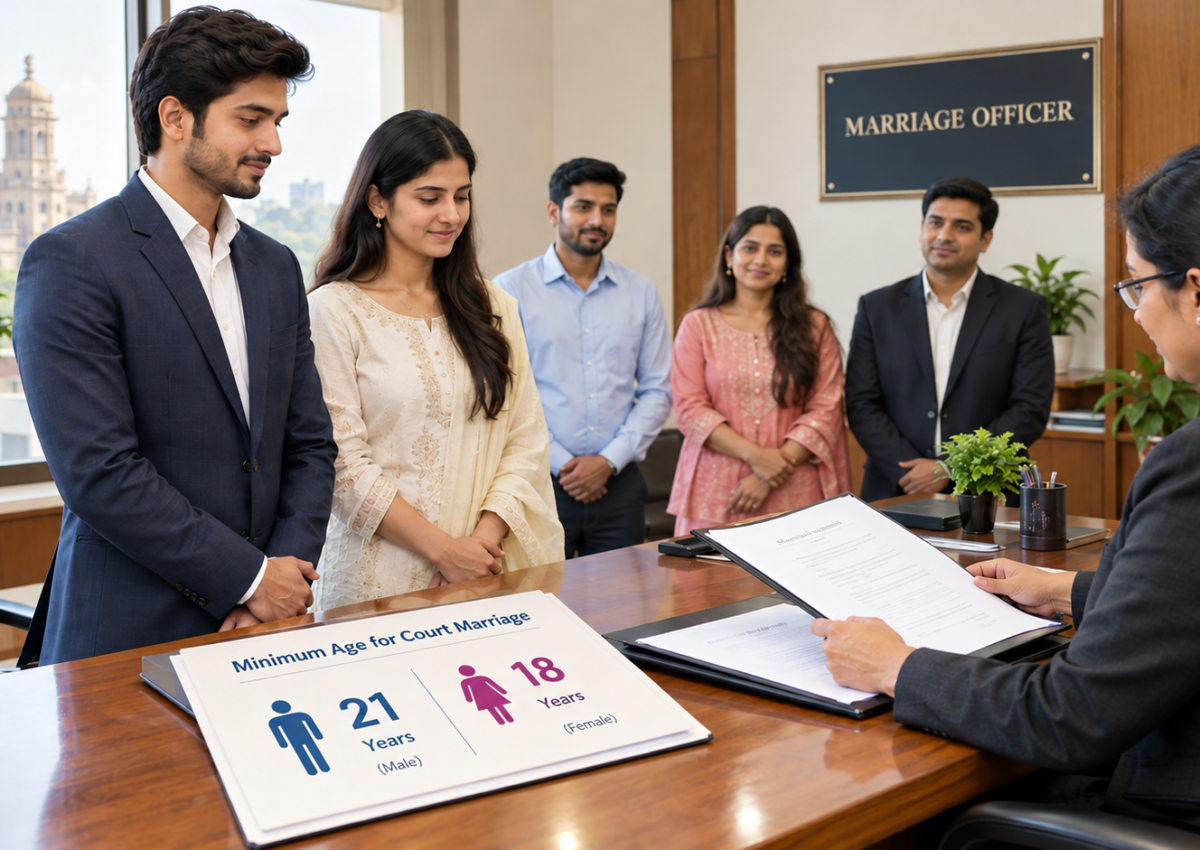
Can an Inter-Caste Couple Have Court Marriage in Indore?
Yes, an inter-caste couple can have a court marriage in Indore. There is no general legal prohibition against an inter-caste marriage, and caste difference between two adults does not by itself prevent them from marrying under the Special Marriage Act, 1954, provided the statutory conditions for marriage are fulfilled.
Inter-caste marriage is legally recognized in India. A man and woman belonging to different castes can marry each other through the procedure prescribed by law. If they want to solemnize their marriage without following the marriage ceremony of a particular religion, they can consider marriage under the Special Marriage Act, 1954.
This is particularly relevant in Indore, where couples sometimes approach a Family Lawyer or marriage lawyer because their families oppose their relationship on the ground of caste.
Common questions include:
- Can an inter-caste couple get court marriage in Indore?
- Is inter-caste marriage legal in Madhya Pradesh?
- Can parents object to an inter-caste court marriage?
- Is caste certificate required for court marriage?
- Can a Brahmin marry a Rajput through court marriage?
- Can an OBC person marry an SC person?
- Can a general-category person marry an SC or ST person?
- Can two persons from different castes marry under the Special Marriage Act?
- Can family members stop an inter-caste marriage?
- Is police protection available to an inter-caste couple?
- Is parental consent required for inter-caste court marriage?
- Is there a 30-day notice period for inter-caste court marriage?
- Can an inter-caste couple marry without informing their parents?
The answer to these questions requires understanding the difference between caste, religion, statutory eligibility, parental consent, and the procedure under the Special Marriage Act.
Can an Inter-Caste Couple Have Court Marriage in Indore?
Yes. An inter-caste couple can have a court marriage in Indore. Caste difference is not a statutory bar to marriage under the Special Marriage Act, 1954. If both parties satisfy the legal conditions relating to age, marital status, mental capacity, prohibited relationship and the applicable residence and procedural requirements, they can proceed with marriage before the competent Marriage Officer.
The fact that the parents or relatives oppose the marriage because the parties belong to different castes does not, by itself, make the marriage legally impermissible.
The Supreme Court has specifically recognized that there is no legal bar to inter-caste marriage and has directed authorities to protect couples facing threats or violence because of their choice to marry outside their caste. In Lata Singh v. State of U.P., the Supreme Court stated that there is no bar to inter-caste marriage under the Hindu Marriage Act or other law. This principle was subsequently considered and reinforced in Shakti Vahini v. Union of India.
What Is an Inter-Caste Marriage?
An inter-caste marriage is generally understood as a marriage between two persons belonging to different castes.
For example, a marriage between persons belonging to:
- General and OBC categories;
- General and SC categories;
- General and ST categories;
- OBC and SC categories;
- OBC and ST categories;
- two different caste groups within the broader Hindu community;
may commonly be described as an inter-caste marriage.
The exact classification can matter for certain government schemes or benefits, but caste difference itself does not prevent two legally eligible adults from marrying.
It is important to distinguish an inter-caste marriage from an interfaith marriage.
An inter-caste marriage concerns caste differences.
An interfaith marriage concerns differences in religion.
For example, if both parties are Hindu but belong to different castes, it is ordinarily an inter-caste marriage rather than an interfaith marriage.
If the parties belong to different religions, the legal route and personal-law considerations may be different, although the Special Marriage Act provides a statutory mechanism for marriage irrespective of religion, subject to its conditions.
Is Inter-Caste Marriage Legal in India?
Yes.
There is no general prohibition against inter-caste marriage in Indian law.
The Supreme Court has repeatedly recognized the right of adults to choose their life partner and has specifically addressed the problem of social and family interference with inter-caste marriages.
In Lata Singh v. State of U.P., the Supreme Court dealt with an adult woman who had married outside her caste and faced threats from her family. The Court made it clear that there is no legal bar to inter-caste marriage and criticized unlawful harassment of couples who exercise their choice to marry.
Later, in Shakti Vahini v. Union of India, the Supreme Court considered honour-based interference with marriages and directed State authorities to take preventive and protective measures where inter-caste or inter-religious couples face threats.
The Court recognized that the choice of a partner is an important aspect of individual liberty and dignity.
Can an Inter-Caste Couple Marry Under the Special Marriage Act?
Yes.
The Special Marriage Act, 1954 provides a statutory framework for solemnization of marriage before a Marriage Officer.
Importantly, Section 4 of the Act does not make belonging to the same caste a condition for marriage.
The statutory conditions focus on matters such as:
- existing marriage;
- age;
- capacity to give valid consent;
- prohibited relationship; and
- other statutory requirements.
Caste similarity is not prescribed as a general condition.
Therefore, two persons belonging to different castes can approach the Marriage Officer and follow the procedure prescribed by the Act.
Is Caste Certificate Required for Court Marriage?
A caste certificate is generally not a basic eligibility document for proving that two adults can marry under the Special Marriage Act.
The purpose of the Special Marriage Act is not to determine whether the parties belong to the same caste.
The Marriage Officer is primarily concerned with whether the statutory requirements for marriage are satisfied and whether the prescribed documents and procedure are complied with.
However, particular documents required by the local Marriage Officer may vary according to the administrative process and the circumstances of the applicants.
If a couple is applying for an inter-caste marriage incentive scheme, caste certificates may become relevant for determining eligibility for that separate government benefit.
Therefore, it is important to distinguish:
Documents required for marriage
from
Documents required for claiming an inter-caste marriage benefit.
They are not necessarily the same.
Is Parental Consent Required for Inter-Caste Court Marriage?
No, parental consent is not a general statutory requirement for an adult couple marrying under the Special Marriage Act.
If both parties are adults and satisfy the statutory conditions, their parents do not acquire a general legal veto merely because they disagree with the proposed marriage.
A parent may personally oppose the marriage.
A parent may attempt to persuade the adult son or daughter not to marry.
A parent may even communicate an objection to the Marriage Officer.
However, the legal significance of such an objection depends upon whether it identifies a genuine statutory impediment.
Simply saying:
“We do not want our daughter to marry outside our caste”
does not, by itself, establish that the proposed marriage violates Section 4 of the Special Marriage Act.
Can Parents Object to an Inter-Caste Court Marriage?
Parents can submit an objection during the statutory objection period, but the objection must have a legally relevant basis.
Section 7 of the Special Marriage Act permits any person to object to a proposed marriage before the expiry of the prescribed period after publication of the notice.
However, the statutory scheme connects the objection to the conditions contained in Section 4.
This distinction is extremely important.
A parent does not have an automatic right to prevent a marriage simply by filing an objection.
For example, if the objection is:
“The couple belongs to different castes.”
that alone does not establish a Section 4 disqualification.
But if a parent alleges and can substantiate that one proposed spouse already has a living spouse, that may raise a genuine statutory issue.
The Marriage Officer has to deal with the objection according to the Act.
Can Parents Stop an Inter-Caste Marriage Because of Family Honour?
No.
The concept of family honour does not give a parent, relative, community organization or panchayat a legal power to prevent two eligible adults from exercising their choice of partner.
The Supreme Court in Shakti Vahini v. Union of India dealt specifically with interference in marriages in the name of honour.
The Court emphasized that family or community consent is not a substitute for the decision of two competent adults to enter into marriage.
The Court also issued directions concerning preventive and protective measures for couples facing threats because of inter-caste or inter-religious marriages.
What Did the Supreme Court Say About Inter-Caste Marriage?
The Supreme Court’s decisions provide important guidance.
Lata Singh v. State of U.P.
In Lata Singh v. State of U.P., the Supreme Court dealt with a woman who had married outside her caste and faced threats from her brothers.
The Court observed that there is no bar to inter-caste marriage under the Hindu Marriage Act or any other law.
The judgment remains an important authority concerning the legality of inter-caste marriage and the protection of adults exercising their choice.
Shakti Vahini v. Union of India
In Shakti Vahini v. Union of India, the Supreme Court considered honour crimes and unlawful interference with the choice of adults.
The Court recognized that an adult’s choice to marry is connected with liberty and dignity.
The Court also directed authorities to protect couples facing threats or harassment because of inter-caste or inter-religious marriages.
The judgment is particularly important for couples who fear opposition from parents, relatives, community groups or other persons.
Shafin Jahan v. Asokan K.M.
The Supreme Court in Shafin Jahan v. Asokan K.M. dealt with the autonomy of an adult woman concerning her choice of spouse.
The judgment is important for the broader principle that an adult’s personal choice in intimate matters receives constitutional protection.
Supriyo @ Supriya Chakraborty v. Union of India
The 2023 Constitution Bench decision in Supriyo is also relevant for accurately understanding the constitutional position.
The Supreme Court discussed the autonomy of individuals in choosing a life partner and observed that choices concerning marriage fall within an area where individual autonomy has constitutional significance.
At the same time, the judgment should not be oversimplified into saying that there is an unlimited constitutional right to marry in every circumstance. Marriage remains subject to the conditions and procedures prescribed by law.
Can a Brahmin and Rajput Have Court Marriage in Indore?
Yes.
If both parties satisfy the legal requirements, there is no general prohibition against their marriage merely because they belong to different caste groups.
Their parents’ approval is not a general condition under the Special Marriage Act.
The same principle applies to other caste combinations.
Can an SC and General Category Person Have Court Marriage?
Yes.
A person belonging to a Scheduled Caste and a person belonging to the General category can legally marry if the statutory requirements are satisfied.
The caste difference does not itself prevent the marriage.
If the couple intends to claim a government incentive available for eligible inter-caste marriages, however, the eligibility conditions of the particular scheme must be separately examined.
Can an OBC and SC Person Have Court Marriage?
Yes.
A person belonging to the Other Backward Classes category and a person belonging to the Scheduled Caste category can marry.
Their caste difference does not itself make the marriage invalid.
The requirements of the applicable marriage law must still be fulfilled.
Can an SC and ST Person Have Court Marriage?
Yes.
There is no general prohibition against marriage between persons belonging to different caste or community classifications merely because their social categories are different.
The ordinary statutory conditions applicable to the marriage must be satisfied.
Is Inter-Caste Marriage Possible Without Parents’ Permission?
Yes, where both parties are adults and otherwise legally eligible.
Parental permission is not generally required under the Special Marriage Act.
The legal position becomes particularly important where parents threaten to prevent the couple from marrying.
A lawyer should distinguish between:
- parental disagreement;
- statutory objection;
- criminal allegation;
- threat to personal safety;
- unlawful confinement;
- and actual legal incapacity.
These are different legal issues and should not be mixed together.
Can Parents Call the Police to Stop an Inter-Caste Marriage?
Parents can approach the police with an allegation of an offence.
However, the police cannot simply treat parental disapproval as proof that an adult’s marriage is illegal.
If the parties are adults and voluntarily choose to marry, their statements and circumstances become legally relevant.
A genuine allegation of kidnapping, coercion, fraud or another offence must be examined on its own facts.
The mere fact that parents oppose an inter-caste marriage does not automatically establish a criminal offence by the couple.
Can Parents File a Missing Person Complaint?
Parents may approach the police if an adult family member leaves home and they do not know where that person is.
However, the legal consequences are different when the person is an adult and voluntarily chooses to leave.
If the adult tells the police that he or she left voluntarily and is living with the chosen partner of their own free will, that statement is important.
The precise legal position will depend on the facts and on whether any independent allegation of an offence exists.
Can the Family Force the Girl to Return Home?
An adult woman has her own legal personality and personal liberty.
Family members cannot simply assume that they have the legal authority to control an adult woman’s choice of residence or spouse.
If an adult woman voluntarily chooses to live with her partner, family disagreement alone does not justify unlawful confinement, threats or violence.
The Supreme Court has repeatedly emphasized individual autonomy in matters concerning choice of partner.
What If the Family Threatens the Couple?
This is a more serious situation.
An inter-caste couple facing threats should not treat the issue merely as a family disagreement.
If there are threats of:
- physical assault;
- kidnapping;
- forced separation;
- confinement;
- honour-based violence;
- intimidation;
- stalking;
- or other criminal conduct,
the couple should consider approaching the appropriate police authorities or court for protection.
The Supreme Court in Shakti Vahini directed authorities to take preventive and protective measures in cases involving threats to couples whose marriages are opposed by families or communities.
The judgment contemplated special cells at district level and protective mechanisms for couples facing such threats.
Can Police Protection Be Sought by an Inter-Caste Couple in Indore?
Depending upon the facts, an inter-caste couple facing a genuine threat can seek appropriate protection from the competent authorities.
The Supreme Court’s directions in Shakti Vahini are particularly relevant where threats arise because of an inter-caste marriage.
A lawyer should assess the actual threat before deciding the appropriate remedy.
The relevant material may include:
- threatening messages;
- call recordings where legally obtained;
- screenshots;
- prior complaints;
- names of persons issuing threats;
- previous incidents of violence;
- medical records;
- witness information;
- and other evidence.
A protection application should be based on genuine facts and should not contain exaggerated or unsupported allegations.
Can a Panchayat Stop an Inter-Caste Marriage?
No.
A community body, panchayat or informal organization does not acquire a legal veto over the marriage of two consenting adults.
The Supreme Court has specifically addressed the problem of extra-legal interference by community bodies.
In Shakti Vahini, the Court held that informal institutions cannot assume the role of adjudicating the personal choices and rights of adults.
Therefore, an inter-caste couple cannot be legally prevented from marrying merely because a community organization has passed a social resolution against the relationship.
Is a 30-Day Notice Required for Inter-Caste Court Marriage?
Where the couple is solemnizing the marriage under the Special Marriage Act, the statutory notice procedure under Section 5 is relevant.
Section 5 deals with the notice of intended marriage.
Section 6 deals with the publication of the notice.
Section 7 provides for objections.
The statutory scheme therefore involves a notice and objection period before solemnization.
This is one of the most important differences between the commonly used expression “court marriage” and an ordinary religious marriage ceremony followed by registration.
A couple planning a Special Marriage Act marriage in Indore should understand this procedure before deciding the date of marriage.
Why Is the 30-Day Notice Important?
The notice period provides a statutory opportunity for objections to the proposed marriage.
It does not mean that parents receive an automatic veto.
It also does not mean that every objection must be accepted.
The objection must be considered within the framework of the Special Marriage Act.
For an inter-caste couple, the important point is that caste difference itself is not a statutory ground for refusing the marriage.
Does the Court Marriage Notice Mention the Caste of the Parties?
The Special Marriage Act procedure is not based upon establishing that the parties belong to the same caste.
The application and supporting documents concern the identity and statutory eligibility of the parties.
The precise documents and forms required by the Marriage Officer should be checked before submission because administrative requirements can vary.
Is Caste Certificate Required to Give Notice?
Caste certificate is not generally the document that establishes eligibility for marriage under the Special Marriage Act.
The statutory conditions relate to matters such as age, existing marital status, prohibited relationship and capacity to consent.
However, if the couple wants to apply for a government incentive relating to inter-caste marriage, caste documentation may become relevant.
Can an Inter-Caste Couple Get Marriage Certificate in Indore?
Yes.
After the marriage is solemnized in accordance with the Special Marriage Act and the prescribed requirements are completed, the Marriage Officer enters the required certificate in the Marriage Certificate Book.
The marriage certificate is important documentary evidence of the marriage.
Couples should preserve the original certificate and obtain appropriate copies where required.
How Many Witnesses Are Required?
The Special Marriage Act requires the parties and three witnesses for the declaration and solemnization process.
The witnesses must satisfy the requirements prescribed by the Marriage Officer and should carry appropriate identity documents.
The witnesses do not have to belong to the same caste as either party.
Friends can generally act as witnesses, subject to the applicable administrative requirements.
Can Friends Be Witnesses in an Inter-Caste Court Marriage?
Yes, friends can generally act as witnesses.
There is no general rule that the witnesses must be parents or close relatives.
This can be particularly useful where the couple’s families oppose the marriage.
The couple should nevertheless confirm the identity-document requirements and any local procedural requirements applicable before appearing before the Marriage Officer.
What Documents Should an Inter-Caste Couple Keep Ready?
The exact document list should be confirmed with the concerned Marriage Officer, but couples commonly need documents relating to:
- identity;
- age or date of birth;
- residence;
- photographs;
- marital status where relevant;
- divorce, if previously married;
- death certificate of a previous spouse, where applicable;
- and witness identity.
The documents should contain consistent names, dates of birth and other particulars.
Any discrepancy should be addressed before filing the notice wherever possible.
Can a Divorced Person Have an Inter-Caste Court Marriage?
Yes.
A divorced person can marry again if the previous marriage has legally ended and the person satisfies the applicable statutory requirements.
The relevant divorce decree should be preserved and produced wherever required.
Being divorced does not itself prevent a person from entering into a subsequent marriage.
Can a Widow or Widower Have an Inter-Caste Court Marriage?
Yes.
Widowhood or widower status does not itself prevent a person from marrying again.
The death certificate or other appropriate document concerning the previous spouse may be required to establish the person’s marital status.
Can an Inter-Caste Couple Marry If They Come From Different States?
Yes.
The fact that the parties belong to different States does not itself prevent an inter-caste marriage.
The couple must, however, comply with the applicable jurisdiction and residence requirements under the Special Marriage Act.
For a couple planning marriage in Indore, residence documentation and the jurisdiction of the concerned Marriage Officer should therefore be checked carefully before filing the notice.
Is Police Verification Required for an Inter-Caste Court Marriage?
The statutory procedure under the Special Marriage Act should not be confused with a general requirement that every inter-caste couple must undergo police verification merely because they belong to different castes.
Administrative verification may arise in particular circumstances or according to local procedure.
The important point is that inter-caste status by itself does not make a couple legally suspect or disqualified from marriage.
Can an Inter-Caste Couple Have a Court Marriage Without Informing Parents?
The legal question is different from the family question.
For two adults who satisfy the statutory conditions, parental consent is not a general requirement under the Special Marriage Act.
However, the couple should understand the notice and publication procedure and should not assume that the statutory process guarantees complete confidentiality.
A couple concerned about family opposition should obtain legal advice before submitting the notice so that they understand the applicable procedure and possible consequences.
What If Parents File a False Objection?
If a parent submits an objection, the couple should not panic.
The first step is to identify the exact ground of objection.
The Marriage Officer must deal with objections under the statutory framework.
If the objection merely says:
“The marriage is inter-caste.”
the couple should understand that caste difference itself is not a statutory disqualification.
If the objection alleges:
- existing marriage;
- lack of statutory age;
- prohibited relationship;
- lack of legal capacity;
the matter should be examined carefully because these can involve statutory requirements.
What If the Parents Say the Marriage Will Bring Disgrace to the Family?
Family reputation is not a statutory condition for a valid Special Marriage Act marriage.
A family may disagree with an adult child’s decision, but personal disagreement cannot replace the statutory requirements of the Act.
If the disagreement escalates into threats or violence, the couple should seek appropriate protection rather than attempting to resolve a serious safety issue through confrontation.
Can Parents Stop an Inter-Caste Marriage Through a Court Case?
Parents can approach a court only where they have a legally recognizable cause and remedy.
They cannot acquire a general legal right to cancel an adult’s matrimonial choice merely by filing a case.
If proceedings are filed alleging an actual legal impediment or criminal offence, the couple should respond through the appropriate legal process.
Where the dispute concerns unlawful interference with the couple’s liberty, constitutional remedies may also become relevant depending on the facts.
Does the Government Encourage Inter-Caste Marriage?
Government schemes concerning inter-caste marriage may exist, but eligibility should be checked separately from the legality of the marriage.
The Government of Madhya Pradesh currently publishes information concerning an inter-caste marriage incentive scheme under the Scheduled Caste Welfare Department. The published scheme information states that, subject to its conditions, an eligible couple may receive an incentive of ₹2 lakh, and specifies conditions including that one spouse must belong to a Scheduled Caste recognized by Madhya Pradesh, be a native of Madhya Pradesh, and that the marriage registration requirement is under the Hindu Marriage Act, 1955.
This is an important distinction for couples in Indore.
The legal validity of an inter-caste marriage and eligibility for an inter-caste marriage incentive are two different questions.
A couple should not assume that because its marriage is legally valid, it automatically qualifies for every government scheme.
The latest scheme conditions should be checked before making an application.
Does the Inter-Caste Marriage Incentive Apply to Every Court Marriage?
Not necessarily.
The eligibility conditions of the relevant government scheme must be examined separately.
For example, the Madhya Pradesh government information currently available for the relevant scheme includes specific requirements concerning Scheduled Caste status, Madhya Pradesh domicile and registration under the Hindu Marriage Act.
Therefore, an inter-caste couple who solemnizes a marriage under the Special Marriage Act should not automatically assume that the same government incentive is available.
The couple should check the current scheme rules with the concerned department before relying upon any financial benefit.
What Should an Inter-Caste Couple Do Before Court Marriage in Indore?
A couple should ideally complete a preliminary legal check before filing the marriage notice.
Check the age of both parties
The statutory age requirements should be satisfied.
Check marital status
Neither party should have a subsisting marriage where the Special Marriage Act prohibits such marriage.
Check previous marriage documents
If either person was previously married, obtain the final divorce decree or appropriate death certificate, as applicable.
Check prohibited relationship
The parties should ensure that they do not fall within the prohibited relationship restrictions applicable under the Act, subject to statutory exceptions.
Check residence
The residence requirement under Section 5 should be examined carefully before filing the notice.
Check identity documents
Names and dates of birth should be consistent.
Prepare witnesses
Three witnesses are required for solemnization under the Special Marriage Act.
Understand the notice procedure
The couple should understand the publication and objection procedure before filing.
Assess family opposition
If parents are opposed, the couple should consider whether the opposition is merely verbal or whether there are genuine threats.
Preserve evidence of threats
If threats are being received, preserve relevant evidence and obtain appropriate legal advice.
What If There Is a Threat of Honour Violence?
The issue should be taken seriously.
The Supreme Court’s decision in Shakti Vahini is particularly significant for couples facing threats because of inter-caste marriage.
The Court directed authorities to adopt preventive measures and to respond to threats against couples.
The judgment contemplated special cells at the district level and protective arrangements where necessary.
Therefore, an inter-caste couple in Indore facing a genuine threat should not assume that it has no legal remedy.
Depending upon the facts, appropriate representations may be made to the police authorities and other competent authorities, and appropriate judicial remedies may be considered.
What Is the Difference Between Social Opposition and Legal Objection?
This distinction is essential.
Social opposition
Examples include:
- “Our family does not approve.”
- “The caste difference is unacceptable.”
- “Our relatives will boycott us.”
- “We do not like the family.”
- “We wanted an arranged marriage.”
- “This will affect our social status.”
These are generally matters of family or social disagreement.
Legal objection
Examples may include an allegation that:
- one party has a living spouse;
- a statutory age requirement is not satisfied;
- the parties fall within a prohibited relationship;
- a required legal condition has not been fulfilled.
These are matters that can fall within the statutory framework.
A Marriage Officer is required to apply the law, not decide the marriage according to the preferences of the parents or community.
Can a Community Prevent the Couple From Entering the Marriage Office?
No lawful community authority has a general right to physically prevent eligible adults from appearing before the Marriage Officer.
If persons use force, intimidation or threats to prevent the couple from proceeding, the issue may become one of personal liberty and criminal law.
The couple should seek appropriate assistance rather than confront a threatening group.
Is Inter-Caste Marriage Valid if Parents Do Not Attend?
Yes.
The presence or absence of parents does not determine the validity of an otherwise legally solemnized marriage under the Special Marriage Act.
The statutory declaration, solemnization and required witnesses are what matter under the Act.
Parents do not have to attend merely because they are parents.
Can Parents Refuse to Give Documents?
A parent generally cannot create a statutory requirement simply by withholding personal documents belonging to the adult child.
An adult should ordinarily maintain control over their own identity and age documentation.
If essential documents are unavailable, alternative documents or appropriate administrative remedies may need to be considered.
The exact solution depends upon the document involved.
Why Should an Inter-Caste Couple Consult a Lawyer in Indore?
Although the legal principle is straightforward, the practical procedure can become complicated when family opposition exists.
A lawyer can help examine:
- whether the Special Marriage Act is the appropriate route;
- jurisdiction;
- residence requirements;
- documents;
- previous marital status;
- notice procedure;
- possible objections;
- witness requirements;
- family threats;
- police complaints;
- and protection remedies.
This is especially relevant where one or both parties fear that the family may attempt to interfere with the marriage.
Frequently Asked Questions
Can an inter-caste couple have court marriage in Indore?
Yes. An inter-caste couple can have a court marriage in Indore if both parties satisfy the statutory requirements of the applicable marriage law. Caste difference by itself is not a legal bar under the Special Marriage Act.
Is inter-caste marriage legal in Madhya Pradesh?
Yes. There is no general prohibition against inter-caste marriage in Madhya Pradesh.
Is parental consent required for an inter-caste court marriage?
No, parental consent is not generally required for an adult couple under the Special Marriage Act.
Can parents object to an inter-caste marriage?
They may submit an objection under the statutory procedure, but the objection must have a legally relevant basis.
Can parents object only because the marriage is inter-caste?
Caste difference alone does not constitute a statutory disqualification under Section 4 of the Special Marriage Act.
Can a Brahmin and Rajput marry through court marriage?
Yes, provided the applicable statutory conditions are satisfied.
Can an SC and General category person marry?
Yes.
Can an OBC and SC person marry?
Yes.
Can an SC and ST person marry?
Yes.
Is caste certificate required for court marriage?
A caste certificate is not generally required to establish that the parties are legally entitled to marry under the Special Marriage Act. It may, however, be relevant for certain government schemes.
Is parental permission required?
No, not as a general statutory condition for an adult Special Marriage Act marriage.
Can a panchayat stop an inter-caste marriage?
No. A panchayat or community organization does not have a general legal veto over the matrimonial choice of consenting adults.
Can the police stop an inter-caste couple from marrying?
The police may investigate genuine allegations of criminal offences, but parental or community disapproval alone does not make an otherwise lawful adult marriage illegal.
Can an inter-caste couple seek police protection?
Yes, where there is a genuine threat to life, liberty or safety, appropriate protection may be sought from the competent authorities.
Can friends be witnesses?
Yes, friends can generally act as witnesses, subject to the requirements of the Marriage Officer.
How many witnesses are required?
Three witnesses are required for solemnization under the Special Marriage Act.
Is there a 30-day notice procedure?
Yes, the Special Marriage Act contains a notice and objection procedure before solemnization.
Does the 30-day notice mean that parents can stop the marriage?
No. The notice period gives a statutory opportunity to raise objections; it does not give parents a general veto.
Can an inter-caste couple marry without their parents attending?
Yes, parents do not have to attend merely because they are parents, provided the statutory requirements are fulfilled.
Can a divorced person enter into an inter-caste marriage?
Yes, if the previous marriage has legally ended and the person otherwise satisfies the applicable requirements.
Can a widow or widower enter into an inter-caste marriage?
Yes.
Can an inter-caste couple from different States marry in Indore?
Potentially yes, subject to the residence and jurisdiction requirements under the Special Marriage Act.
Can family honour prevent an inter-caste marriage?
No. Family honour does not create a statutory veto over the lawful matrimonial choice of adults.
What if parents threaten the couple?
The couple should consider approaching the appropriate police authorities or court for protection depending upon the nature and immediacy of the threat.
Important Legal Points for Inter-Caste Couples in Indore
Before proceeding with a court marriage, an inter-caste couple should remember the following:
1. Caste difference is not a general legal bar to marriage.
2. Parental consent is not generally required for an adult marriage under the Special Marriage Act.
3. Parents may raise a statutory objection, but an objection is not automatically a veto.
4. The Marriage Officer must apply the conditions prescribed by law.
5. Three witnesses are required for solemnization under the Special Marriage Act.
6. The notice and objection procedure should be understood before filing.
7. Residence and jurisdiction requirements should be checked carefully.
8. A caste certificate is different from an eligibility document for marriage and may become relevant for a separate government incentive scheme.
9. Threats, violence or unlawful confinement are separate legal issues and may justify seeking protection.
10. Supreme Court decisions recognize the importance of an adult’s choice of life partner and protection from unlawful family or community interference.
Conclusion
An inter-caste couple can legally have a court marriage in Indore. The fact that the two persons belong to different castes does not, by itself, prevent them from marrying under the Special Marriage Act, 1954.
The law does not make same-caste status a general condition for marriage. The relevant statutory questions concern the legal eligibility of the parties and compliance with the prescribed procedure.
For a couple planning court marriage in Indore, the most important issues are therefore not whether the parties belong to the same caste, but whether they satisfy the applicable legal conditions, including age, marital status, prohibited relationship, capacity to consent, residence and procedural requirements.
Family opposition is a separate issue.
Parents may disagree with an inter-caste marriage. They may express their concerns or, where the statute permits, submit an objection. But parental opposition based solely on caste difference does not give the parents a general legal power to veto the marriage.
The Supreme Court’s decisions are particularly important in this area. In Lata Singh v. State of U.P., the Court recognized that there is no legal bar to inter-caste marriage. In Shakti Vahini v. Union of India, the Supreme Court went further and addressed the problem of threats, harassment and honour-based violence against couples who choose to marry contrary to family or community wishes.
The constitutional principle is fundamentally one of individual autonomy. Adults are entitled to make important personal choices, including the choice of their life partner, subject to the requirements of law. The Supreme Court has repeatedly emphasized this principle while also making clear that marriages remain subject to statutory conditions.
For an inter-caste couple in Indore, the practical approach should therefore be to verify eligibility, prepare the required documents, understand the Special Marriage Act notice procedure, arrange the required witnesses and assess any potential family opposition before commencing the process.
If there is only disagreement from the family, the couple should understand that such disagreement does not itself make the proposed marriage illegal. If, however, the disagreement has escalated into threats, violence, confinement or intimidation, the couple should treat the matter as a potential personal-safety and legal-protection issue and seek appropriate assistance.
It is also important not to confuse the validity of an inter-caste marriage with eligibility for an inter-caste marriage incentive scheme. Government schemes may have additional conditions relating to caste category, domicile, registration under a particular marriage law and the time within which an application must be made. Those conditions should be checked separately before relying upon any financial benefit.
Thus, for couples searching for inter-caste court marriage in Indore, the central legal position is clear: different caste identities do not prevent two legally eligible adults from marrying each other, and parental or community opposition based solely on caste does not create a general legal bar to the marriage.
Disclaimer: This information is intended for general guidance only and does not constitute legal advice. Please consult with a qualified lawyer for personalized advice specific to your situation.
Advocate J.S. Rohilla (Civil & Criminal Lawyer in Indore)
Contact: 88271 22304
