
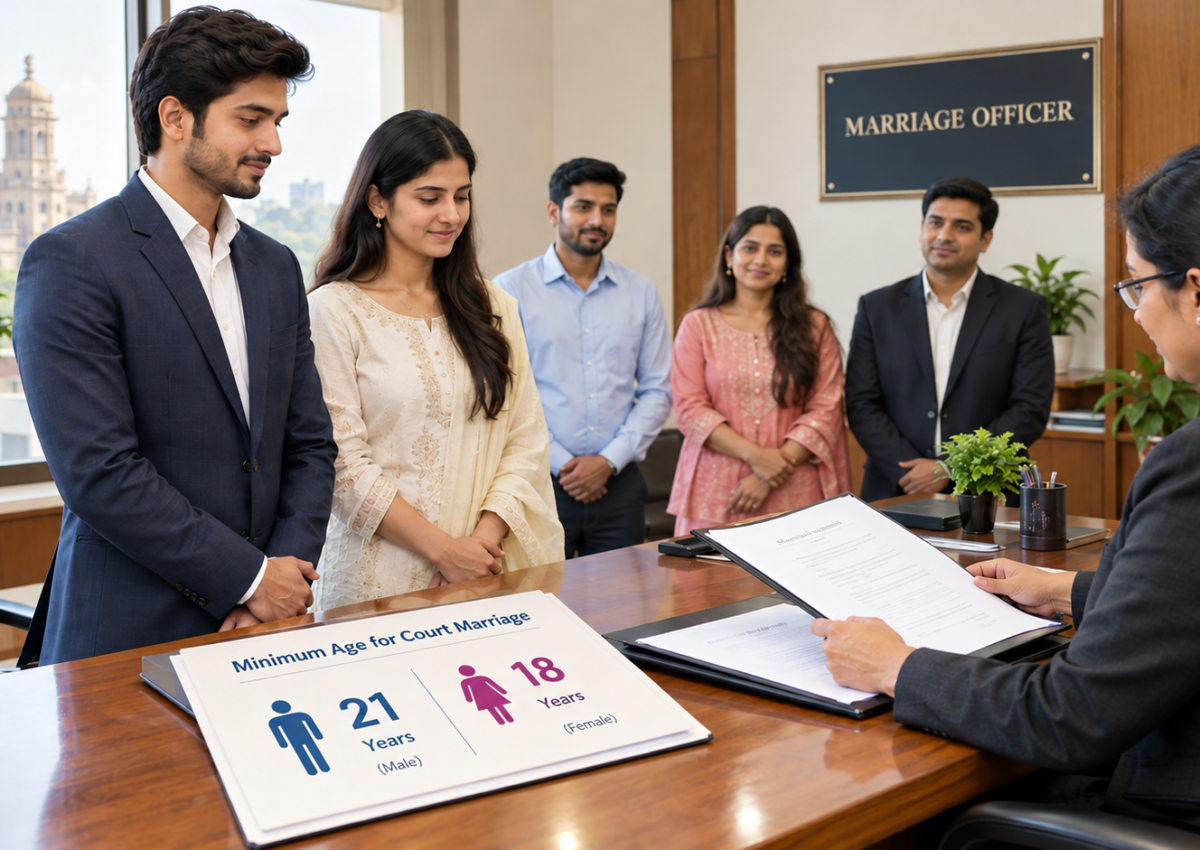
Can a Person from Another City Get Court Marriage in Indore?
Yes, a person from another city can get court marriage in Indore, but merely coming to Indore for the marriage is not sufficient. Under the Special Marriage Act, 1954, the Marriage Officer of Indore can receive the notice only when at least one of the parties has resided in the district for at least 30 days immediately before giving the notice of intended marriage.
This is an important distinction. A person living in Bhopal, Ujjain, Dewas, Delhi, Mumbai, Jaipur or another city may marry a person in Indore under the Special Marriage Act, but the couple cannot ordinarily select Indore merely because they prefer to have the marriage ceremony there. The jurisdiction of the Marriage Officer is connected with the statutory residence requirement under Section 5 of the Special Marriage Act, 1954.
The District Indore administration currently provides an application form for marriage under the Special Marriage Act, 1954 and identifies the relevant office at the Collector Office, New Administrative Sankul, Indore.
What Is the Short Answer?
If your question is:
“I live in another city. Can I come to Indore and have a court marriage here?”
The answer is:
Yes, but only if the jurisdictional requirements of the Special Marriage Act are satisfied. At least one of the parties must have resided in the district of the Marriage Officer for at least 30 days immediately before the notice of intended marriage is given.
Therefore, there are two different situations:
Situation 1: One party has already been residing in Indore for at least 30 days → the couple can ordinarily give notice to the Marriage Officer having jurisdiction in Indore, subject to the other statutory requirements.
Situation 2: Neither party has resided in Indore for the required period and both merely travel to Indore for the marriage → simply coming to Indore does not satisfy Section 5.
This distinction is extremely important for couples searching for court marriage in Indore.
What Does Section 5 of the Special Marriage Act Say?
Section 5 of the Special Marriage Act, 1954 deals with the notice of intended marriage.
It provides that when a marriage is intended to be solemnized under the Act, the parties must give notice in writing to the Marriage Officer of the district in which at least one of the parties has resided for a period of not less than 30 days immediately preceding the date on which the notice is given.
This provision is the principal legal basis for determining whether an out-of-city person can have a Special Marriage Act court marriage in Indore.
The important words are:
“at least one of the parties”
and
“resided for a period of not less than thirty days”
Therefore, both parties do not necessarily have to be residents of Indore for 30 days.
The law requires the relevant residence condition to be satisfied by at least one party.
Does Both Bride and Groom Have to Live in Indore?
No. Both parties do not have to live in Indore for 30 days.
Section 5 uses the expression “at least one of the parties”.
Consequently, if the bride has been residing in Indore for the required period, while the groom lives in another city, the statutory jurisdiction requirement may be satisfied.
Similarly, if the groom has been residing in Indore for the required period while the bride lives in another city, the requirement may be satisfied.
For example:
Example 1: Bride lives in Indore
The bride has been living in Indore for more than 30 days.
The groom permanently lives in Bhopal.
They want to marry under the Special Marriage Act in Indore.
The bride’s residence may provide the necessary jurisdiction for giving notice to the Indore Marriage Officer, subject to the other requirements of the Act.
Example 2: Groom lives in Indore
The groom has been residing in Indore for more than 30 days.
The bride lives in Ujjain.
The couple wants a Special Marriage Act marriage in Indore.
The groom’s qualifying residence may establish jurisdiction.
Example 3: Neither party lives in Indore
The bride lives in Delhi.
The groom lives in Mumbai.
Neither has resided in Indore for the statutory period.
They simply travel to Indore and ask for court marriage.
In this situation, they cannot ordinarily establish Indore jurisdiction merely by arriving in the city for the marriage.
The residence requirement under Section 5 must be satisfied.
Is 30 Days’ Residence Required in Indore?
Yes, where Indore is being selected as the district of the Marriage Officer for giving the notice under Section 5, at least one party must have resided in that district for not less than 30 days immediately preceding the date on which the notice is given.
This is different from saying that the couple must wait 30 days after arriving in Indore and then immediately get married.
There are actually two different 30-day concepts that people frequently confuse.
First 30-Day Requirement: Residence Before Notice
At least one party must have resided in the relevant district for at least 30 days immediately before giving the notice.
Second 30-Day Period: Notice Before Solemnization
After the notice is published, Section 7 provides a 30-day period during which objections may be made on the grounds specified in Section 4. After that period expires, the marriage may be solemnized unless an objection has been made and remains to be dealt with.
Therefore, the 30-day residence requirement and the 30-day notice period are not the same thing.
This is one of the most important points for couples planning court marriage in Indore.
Can a Person from Bhopal Get Court Marriage in Indore?
Yes, but the answer depends upon the residence of at least one party.
Suppose the groom lives in Bhopal and the bride lives in Indore.
If the bride has satisfied the Section 5 residence requirement, the couple may be able to give notice to the Indore Marriage Officer.
But suppose both parties live in Bhopal.
They cannot simply travel to Indore for one day and expect the Indore Marriage Officer to have jurisdiction merely because they want the marriage to take place there.
The relevant question is not:
“Where do you want to get married?”
The legal question is:
“In which district has at least one of the parties resided for the required period immediately before giving notice?”
Can a Person from Ujjain Get Court Marriage in Indore?
Yes, if the statutory jurisdiction requirements are satisfied.
For example, if one party lives in Ujjain and the other party has been residing in Indore for the required period, the Indore Marriage Officer may have jurisdiction to receive the notice.
However, if both parties live in Ujjain and neither has resided in Indore for the required period, simply travelling from Ujjain to Indore does not ordinarily create jurisdiction.
Can a Person from Dewas Get Court Marriage in Indore?
The same principle applies.
Living in Dewas does not by itself prevent the person from marrying someone in Indore.
The question is whether the Indore Marriage Officer has jurisdiction under Section 5.
If one party has qualifying residence in Indore, the couple can potentially proceed through the Indore Marriage Officer.
If neither party has such residence, the couple should ordinarily approach the Marriage Officer having jurisdiction under Section 5 rather than selecting Indore merely for convenience.
Can a Person from Delhi Get Court Marriage in Indore?
Yes, a Delhi resident can marry in Indore under the Special Marriage Act if the jurisdictional requirements are satisfied.
For example:
- Bride: resident of Delhi
- Groom: resident of Indore
- Groom has qualifying residence in Indore
In such a situation, Indore may have jurisdiction for the notice.
But if:
- Bride: Delhi
- Groom: Mumbai
- Neither has qualifying residence in Indore
then merely flying to Indore for the marriage does not ordinarily satisfy Section 5.
Can a Person from Mumbai Get Court Marriage in Indore?
Yes, an individual living in Mumbai can marry in Indore, provided the statutory requirements are satisfied.
The Special Marriage Act is not restricted to people who were born in Indore or whose permanent homes are in Indore.
The issue is jurisdiction based on residence, not birthplace or permanent ancestral residence.
Does Permanent Address Have to Be Indore?
This is an important distinction.
The Second Schedule to the Special Marriage Act asks for the parties’ dwelling place and, where the present dwelling place is not permanent, their permanent dwelling place. It also contains a column concerning the length of residence.
Therefore, couples should not automatically assume that only a permanent residential address in Indore can ever be relevant.
Section 5 focuses on whether at least one party has resided in the district for the required period.
The statutory form itself distinguishes between present dwelling place and permanent dwelling place where the present dwelling place is not permanent.
The important question is therefore the factual residence of the party and whether it satisfies the statutory requirement.
What Does “Resided” Mean Under Section 5?
The word “resided” is important.
A person should not assume that merely booking a hotel room in Indore for a few days automatically establishes the required statutory residence.
The residence must be genuine and capable of being established if questioned.
A person claiming Indore residence should therefore be able to provide appropriate evidence of residence where required.
The facts of each case matter.
A Family Lawyer in Indore should examine the person’s actual living arrangement rather than simply looking at the permanent address printed on an identity document.
Can a Person Temporarily Living in Indore Give Notice?
A person who is temporarily residing in Indore may potentially satisfy the statutory residence requirement depending upon the facts and the nature of that residence.
The Second Schedule itself contemplates that the present dwelling place may not be permanent and asks for the permanent dwelling place in such circumstances.
Therefore, “temporary” and “permanent” residence should not automatically be treated as identical concepts.
The relevant issue is whether the person has actually resided in the district for the statutory period.
For a specific case, the nature and proof of residence should be examined before filing the notice.
Can a Paying Guest Use Indore Address for Court Marriage?
This depends upon the actual facts.
If a person genuinely lives in Indore as a paying guest and has resided there for the required period, the situation is different from a person who merely obtains an address on paper without actually residing there.
The Marriage Officer may require supporting documentation.
Therefore, couples should not create a fictitious residence arrangement merely to obtain jurisdiction.
The correct approach is to document an actual residence.
Can a Person Living in a Hostel Get Court Marriage in Indore?
Again, the answer depends upon the factual circumstances.
Students and working professionals frequently live in hostels, rented accommodation, paying-guest accommodation or other temporary residences.
The fact that the accommodation is not owned by the person does not automatically answer the question of residence.
The actual period and nature of residence and the documents available to establish it are relevant.
The Second Schedule’s distinction between present and permanent dwelling place is particularly relevant here.
Can a Tenant Get Court Marriage in Indore?
Yes, a tenant can potentially satisfy the residence requirement if the tenant actually resides in Indore for the required period.
Ownership of the house is not the same thing as residence.
For example, a person who owns a house in another city but has genuinely been living in rented accommodation in Indore may need to establish the Indore residence through appropriate documents.
What Documents Can Establish Residence?
The precise documents accepted by the Marriage Officer should be confirmed with the concerned office.
Depending upon the circumstances, documents that may be relevant can include:
- Aadhaar card;
- voter identification;
- passport;
- registered rent agreement;
- electricity bill;
- gas connection document;
- bank correspondence;
- employer records;
- educational institution records;
- hostel documentation;
- other government records;
- other documentary evidence establishing actual residence.
The important point is that the document should accurately reflect the person’s actual circumstances.
A person should not create or submit false documents merely to satisfy the residence requirement.
Does Aadhaar Address Decide Jurisdiction?
Not necessarily in every factual situation.
An Aadhaar address can be useful evidence, but Section 5 speaks of residence, and the Second Schedule distinguishes between present dwelling place and permanent dwelling place.
Therefore, the legal question is broader than simply asking:
“What address is printed on Aadhaar?”
For example, a person may have a permanent address in another city but genuinely reside in Indore for work.
Conversely, a person may have an Indore address on a document but actually live elsewhere.
The factual residence should therefore be stated accurately.
Does the Groom Need to Be From Indore?
No.
There is no general requirement that the groom must be an Indore resident simply because the marriage is being solemnized through the Indore Marriage Officer.
Section 5 expressly requires residence of at least one of the parties in the relevant district for at least 30 days immediately before giving notice.
Therefore, the groom can be from another city.
Does the Bride Need to Be From Indore?
No.
The same principle applies to the bride.
The bride may be from another city, State or location, while the groom may satisfy the Indore residence requirement.
Alternatively, the bride may satisfy the requirement while the groom resides elsewhere.
Can Both Parties Be From Different Cities?
Yes.
In fact, the Special Marriage Act is specifically designed to provide a civil form of marriage without requiring the parties to belong to the same religion or social group.
Two people from different cities can marry under the Act if the statutory conditions and jurisdictional requirements are satisfied.
For example:
Bride — Bhopal
Groom — Indore
This can potentially be dealt with through the Indore Marriage Officer if the groom satisfies the Section 5 residence requirement.
Similarly:
Bride — Indore
Groom — Delhi
can potentially proceed through Indore if the bride satisfies the statutory residence requirement.
Can Two People From Different States Get Court Marriage in Indore?
Yes.
The fact that the parties belong to different States does not itself prevent a Special Marriage Act marriage.
The jurisdiction issue remains important.
For example:
Bride — Rajasthan
Groom — Indore
If the groom has resided in Indore for at least 30 days immediately before notice, the Indore Marriage Officer may have jurisdiction.
The fact that the bride’s permanent residence is Rajasthan does not by itself prevent the marriage.
The Madhya Pradesh High Court has also discussed Section 5 in the context of marriages, specifically recognising the requirement that at least one party must have resided in the Marriage Officer’s district for at least 30 days before notice.
Can a Couple From Outside Indore Come to Indore for Court Marriage?
This question needs a careful answer.
If “come to Indore” means:
“We both live elsewhere and want to come to Indore for one day simply because we prefer Indore.”
then that alone is not enough to establish jurisdiction under Section 5.
But if “come to Indore” means:
“One of us has actually shifted/resided in Indore and has completed the required period of residence before giving notice.”
then the position is different.
The statutory residence requirement must exist before the notice is given.
Can Court Marriage Be Done in One Day in Indore for an Outsider?
Ordinarily, a Special Marriage Act marriage cannot simply be completed in one day by an outsider who has no qualifying residence in Indore.
There are two separate reasons.
First, the Indore Marriage Officer must have jurisdiction under Section 5.
Second, after notice is given, Section 7 provides a 30-day period for objections.
Therefore, the popular concept of:
“Come to Indore in the morning and get court married the same day”
does not accurately describe the ordinary Special Marriage Act procedure.
A lawyer should carefully distinguish a Special Marriage Act solemnization from other forms of marriage or registration.
Does the 30-Day Residence Period Mean the Marriage Happens After 30 Days?
Not exactly.
Suppose the bride has already lived in Indore for 45 days.
The couple files notice today.
The bride has already satisfied the residence requirement.
The couple does not have to wait another 30 days merely to complete the residence requirement.
However, the notice procedure then involves its own statutory period before solemnization.
Section 7 provides that objections may be made before the expiration of 30 days from publication of the notice, and after that period the marriage may be solemnized unless an objection has been made.
This distinction is extremely important.
Example of the Complete Indore Court Marriage Timeline
Consider the following example.
Day 1 to Day 30
The groom genuinely resides in Indore.
Day 31
The couple gives notice to the Marriage Officer.
At this stage, the groom has already satisfied the requirement of at least 30 days’ residence.
Notice publication
The Marriage Officer publishes the notice as required by Section 6.
Next 30 days
The statutory objection period operates under Section 7.
After the statutory period
If there is no valid unresolved objection preventing solemnization, the marriage can proceed in accordance with the Act.
Solemnization
The parties appear with the required witnesses and complete the statutory solemnization procedure.
Thus, 30 days’ residence before notice and 30 days after notice are separate matters.
What Happens if Someone Objects to the Marriage?
Section 7 allows a person to object before the expiry of the 30-day period on the ground that the proposed marriage would contravene one or more of the conditions specified in Section 4.
An objection is therefore not legally valid merely because:
- the parents dislike the relationship;
- the couple belongs to different communities;
- the parties are from different cities;
- the parents do not approve;
- the witnesses are friends.
The objection must relate to the statutory grounds specified in the Act.
If an objection is made, Section 8 provides the procedure for inquiry by the Marriage Officer.
Can Parents Stop an Adult Couple From Getting Court Marriage in Indore?
Parents do not acquire an automatic veto over the marriage merely because they are parents.
If both parties are legally eligible adults and the statutory conditions are satisfied, the parents’ personal opposition is not itself one of the statutory conditions under Section 4.
However, if someone raises an objection, the Marriage Officer must deal with it according to the statutory procedure.
The Madhya Pradesh High Court has specifically considered the statutory notice and objection framework under Sections 5 to 8 in the context of marriage-related guidelines.
Can Friends Be Witnesses if the Couple Is From Another City?
Yes, subject to the requirements of the Marriage Officer.
The Special Marriage Act requires three witnesses for solemnization.
The witnesses do not have to be the parents.
Therefore, a couple from different cities can potentially bring three suitable friends as witnesses.
The friends should have the necessary identification and documents and should be physically present for the solemnization.
Does the Witness Also Need to Live in Indore?
The statutory Section 5 residence requirement applies to at least one of the parties to the marriage, not to all three witnesses.
Therefore, the three witnesses do not automatically acquire a 30-day Indore residence requirement merely because they are witnesses.
However, the Marriage Officer may require identification or other documentation, and the current local requirements should be confirmed.
What About a Person From Another State Who Works in Indore?
This is a common situation.
Suppose a person was born in Rajasthan but has been working and living in Indore.
The person may have:
- Rajasthan permanent address;
- Indore rented accommodation;
- Indore employment;
- Indore bank correspondence;
- Indore utility documents.
The fact that the person’s permanent home is Rajasthan does not automatically mean that the person cannot establish residence in Indore.
The factual circumstances and evidence should be examined.
What If the Person Has Lived in Indore for Only 20 Days?
If the person has only resided in Indore for 20 days immediately before giving notice, the statutory 30-day requirement under Section 5 has not yet been satisfied.
The couple should not simply file a notice by incorrectly stating that the residence requirement has been fulfilled.
The proper approach is to wait until the statutory requirement is met or consider the jurisdiction of the Marriage Officer of the district where the requirement is already satisfied.
What If the Person Has Lived in Indore for 29 Days?
The same principle applies.
The statute says “not less than thirty days.”
Therefore, 29 days is not 30 days.
The exact dates should be calculated carefully before submitting the notice.
What If the Person Has Lived in Indore for 31 Days?
If the person has actually resided in the district for at least 30 days immediately preceding the date of notice, the residence condition may be satisfied, subject to the other requirements and acceptance of the evidence by the Marriage Officer.
Does the Residence Have to Be Continuous?
Section 5 speaks of having resided for a period of not less than thirty days immediately preceding the date on which the notice is given.
The precise application to intermittent stays can depend upon the facts.
Therefore, if a person has repeatedly travelled in and out of Indore, the factual residence history should be carefully examined rather than simply adding together unrelated visits.
A person should not assume that thirty hotel stays or thirty occasional visits necessarily constitute statutory residence.
Can a Hotel Address Be Used?
A hotel stay and genuine residence are not automatically synonymous.
If a person merely books a hotel room for a short period to manufacture jurisdiction, that is legally different from genuinely residing in the district.
A Family Lawyer in Indore should therefore advise clients against artificial arrangements designed solely to satisfy the statutory requirement.
The information supplied to the Marriage Officer should be truthful.
What If Both Parties Are From Outside Indore?
Suppose:
Bride — Jaipur
Groom — Delhi
Neither party has lived in Indore.
They want to get married in Indore because they like the city.
The couple should not assume that they can simply select Indore.
They should determine which Marriage Officer has jurisdiction under Section 5.
If neither party satisfies the Indore residence requirement, Indore would not ordinarily become the appropriate jurisdiction merely because the couple prefers the city as the venue.
Can the Marriage Ceremony Take Place in Indore Even if One Party Lives Elsewhere?
Yes.
This is precisely why the wording of Section 5 is important.
The Act does not require both parties to be residents of the district.
If one party has qualifying residence in Indore, the couple can potentially give notice to the Indore Marriage Officer even though the other party ordinarily lives elsewhere.
What Documents Should an Out-of-City Person Keep Ready?
A person from another city planning court marriage in Indore should generally keep the following documents ready, subject to the current requirements of the Marriage Officer:
Identity proof
For example, an Aadhaar card, passport, voter ID or other accepted government identity document.
Age proof
A document establishing date of birth.
Photographs
Recent photographs as required.
Residence proof
Particularly important where Indore jurisdiction is being claimed through the residence of one party.
Marital-status documents
If previously married, the appropriate divorce decree or death certificate, as applicable.
The District Indore administration currently lists Section 4 affidavits for divorced and widowed applicants under the Special Marriage Act among its forms.
Other prescribed affidavits
The exact requirement depends upon the circumstances and the current local procedure.
Does the District Indore Website Provide a Special Marriage Act Form?
Yes.
The official District Indore website currently lists an Application Form for Special Marriage Act, 1954.
The listed office is:
Collector Helpline, Collector Office, New Administrative Sankul, Indore.
The District Indore forms page also lists several Special Marriage Act-related forms, including affidavits for divorced and widowed applicants.
This official information is useful when preparing an Indore court marriage application.
Can a Person From Another City Marry an Indore Resident?
Yes.
This is perhaps the most common situation.
For example:
Bride: Indore resident
Groom: Bhopal resident
The bride’s qualifying residence in Indore can establish the jurisdiction required for giving notice to the Indore Marriage Officer.
Likewise:
Groom: Indore resident
Bride: Delhi resident
The groom’s qualifying residence may establish jurisdiction.
Can Both Parties Keep Their Permanent Addresses Outside Indore?
Potentially, yes, depending on their actual residence at the relevant time.
The Second Schedule specifically contemplates that the present dwelling place may not be permanent and requires the permanent dwelling place to be stated in that situation.
Therefore, permanent address and current residence are not necessarily identical concepts.
The critical point is that the residence declaration must be truthful and satisfy the statutory requirement.
Does Changing Address on Aadhaar Create Residence?
Not automatically.
Changing a document address is not the same thing as actually residing at that place.
The statutory requirement concerns residence.
Therefore, couples should not treat a mere address change as a substitute for actual residence.
If questioned, the factual circumstances and supporting evidence may become relevant.
What If the Couple Has an Urgent Reason to Marry?
Urgency does not automatically remove the statutory requirements of the Special Marriage Act.
For example, the couple may want to marry immediately because:
- they are relocating;
- employment is starting;
- family opposition exists;
- they are travelling abroad;
- they have personal reasons.
Those circumstances do not by themselves eliminate the Section 5 residence requirement or the statutory notice process.
A lawyer should therefore determine whether another legally applicable marriage route exists rather than incorrectly promising immediate Special Marriage Act solemnization.
Is Court Marriage in Indore Available to NRIs?
The answer can depend upon the facts and the applicable statutory route.
An Indian citizen ordinarily residing abroad may have different legal considerations from an Indian citizen temporarily visiting Indore.
The Special Marriage Act contains provisions dealing with marriage involving citizens abroad through Marriage Officers in certain circumstances.
Therefore, an NRI should not automatically assume that returning to Indore for a few days creates Indore jurisdiction.
The appropriate statutory route must be examined according to the parties’ nationality, residence and circumstances.
What About a Foreign National?
A foreign-national case requires additional care.
The Special Marriage Act can apply to marriages involving persons of different nationalities in appropriate circumstances, but residence, immigration status, documentation and other legal requirements may become relevant.
A foreign national who has merely travelled to Indore as a tourist should not assume that tourist presence automatically establishes the Section 5 residence requirement.
The case should be examined individually.
Can a Person From Another City Hire a Lawyer in Indore?
Yes.
A person living outside Indore can engage a Family Lawyer in Indore to assist with the Special Marriage Act procedure.
A lawyer can help examine:
- jurisdiction;
- residence evidence;
- age and eligibility;
- marital status;
- notice requirements;
- affidavits;
- witness requirements;
- objections;
- documentation;
- interaction with the Marriage Officer; and
- procedural compliance.
However, legal representation does not eliminate statutory requirements.
A lawyer cannot simply create jurisdiction where the statutory residence requirement is absent.
What Is the Biggest Misunderstanding About Indore Court Marriage?
The biggest misunderstanding is:
“If we want to get married in Indore, we can simply come to Indore and get married.”
That is not an accurate description of a Special Marriage Act marriage.
The law connects the jurisdiction of the Marriage Officer to residence.
At least one party must have resided in the relevant district for at least 30 days immediately before giving the notice.
Therefore, the first question for a lawyer is not:
“Where do you want the marriage?”
It is:
“Where has either party actually resided for the required period?”
Difference Between Venue and Jurisdiction
This distinction is very useful.
Venue
Venue refers broadly to where the marriage ceremony is to take place.
Jurisdiction
Jurisdiction concerns whether the particular Marriage Officer has legal authority to receive the notice and proceed under the Act.
A couple may prefer Indore as a venue.
But preference alone does not necessarily give the Indore Marriage Officer jurisdiction.
The residence requirement must be examined first.
A Practical Example
Suppose a woman is originally from Delhi.
She moves to Indore for employment.
She rents a flat in Indore.
She has been living there for 45 days.
Her fiancé lives in Mumbai.
They decide to marry under the Special Marriage Act.
In this situation, the fact that the fiancé is from Mumbai does not necessarily prevent them from proceeding in Indore.
The woman has potentially satisfied the 30-day residence requirement in the district.
The couple would then have to follow the notice, publication, objection and solemnization procedure prescribed by the Act.
Another Practical Example
Suppose:
Bride: Delhi
Groom: Mumbai
They have never lived in Indore.
They arrive in Indore on 1 October and want to give notice immediately.
They cannot ordinarily claim that simply arriving in Indore creates the statutory 30-day residence requirement.
They need to examine the jurisdiction of the appropriate Marriage Officer under Section 5.
What a Family Lawyer in Indore Should Check
Before filing a Special Marriage Act notice, the lawyer should ideally check:
- Where does the bride actually reside?
- Where does the groom actually reside?
- How long has each party lived there?
- Has either party resided in Indore for at least 30 days immediately before notice?
- What documents establish that residence?
- What is each party’s permanent address?
- Are the parties legally eligible under Section 4?
- Has either party been previously married?
- Are there divorce/death documents where required?
- Are three witnesses available?
- Are the witnesses carrying acceptable identification?
- Has the statutory notice procedure been understood?
- Is there any potential objection under Section 7?
- What documents does the local Marriage Officer currently require?
This prevents the common mistake of filing in the wrong jurisdiction.
Frequently Asked Questions
Can a person from another city get court marriage in Indore?
Yes, but at least one party must satisfy the residence requirement for the Indore Marriage Officer under Section 5 of the Special Marriage Act.
Can a person from another State marry in Indore?
Yes, provided the statutory jurisdiction and other requirements are satisfied.
Do both persons need to live in Indore?
No. Section 5 requires that at least one party has resided in the district for at least 30 days immediately before giving notice.
Can someone from Delhi marry someone from Indore?
Yes.
If the Indore resident satisfies the statutory residence requirement, the Delhi resident can potentially marry through the Indore Marriage Officer.
Can two outsiders get court marriage in Indore?
Not merely by travelling to Indore. The jurisdictional residence requirement must be satisfied.
Can a person from Bhopal get court marriage in Indore?
Yes, provided the Indore Marriage Officer has jurisdiction based on the residence of at least one party.
Can a person from Ujjain get court marriage in Indore?
Yes, if the statutory requirements are satisfied.
Can a person from Dewas get court marriage in Indore?
Yes, but merely visiting Indore does not create jurisdiction.
Can an Indore tenant get court marriage?
Yes, actual residence in Indore can potentially satisfy the requirement, subject to proof and acceptance by the Marriage Officer.
Can a person living in a PG in Indore get court marriage?
Potentially yes, depending on whether the person genuinely resides there and can establish the required residence.
Is Aadhaar address enough?
Not necessarily. The legal requirement concerns actual residence, and the Marriage Officer may examine supporting documents.
Does permanent address have to be Indore?
No. The statutory form itself distinguishes between present dwelling place and permanent dwelling place where applicable.
Is 30 days’ residence required before giving notice?
Yes. Section 5 requires at least one party to have resided in the relevant district for at least 30 days immediately preceding the date of notice.
Is another 30 days required after giving notice?
The notice is subject to the statutory 30-day objection period under Section 7 before ordinary solemnization, unless the statutory process otherwise resolves an objection.
Can court marriage be completed in one day in Indore?
A normal Special Marriage Act solemnization cannot ordinarily be completed merely by an out-of-city couple arriving in Indore for one day. The jurisdiction, notice and statutory waiting/objection procedure must first be satisfied.
Can parents object because the couple is from different cities?
The fact that the parties are from different cities is not itself a statutory ground for objection.
Can parents object to an inter-caste marriage?
A parent’s disagreement by itself is not one of the statutory conditions in Section 4. Any formal objection must be considered under the grounds permitted by the Act.
Can three friends be witnesses?
Yes, subject to the applicable requirements of the Marriage Officer.
Do witnesses have to live in Indore?
Section 5’s 30-day residence requirement applies to at least one of the parties, not to all witnesses.
Can a person from another city marry an Indore resident?
Yes, this is a common situation under the Special Marriage Act, provided the Indore resident satisfies the jurisdictional residence requirement.
Conclusion
A person from another city can get court marriage in Indore, but merely coming to Indore for the marriage is not enough. For a marriage solemnized under the Special Marriage Act, 1954, at least one of the parties must have resided in the district of the concerned Marriage Officer for at least 30 days immediately before giving the notice of intended marriage.
This means that a person from Bhopal, Ujjain, Dewas, Delhi, Mumbai, Rajasthan, Gujarat or any other city or State is not automatically barred from marrying in Indore. What matters is whether the statutory jurisdictional requirement is satisfied.
If one party is genuinely residing in Indore for the required period and the other party lives elsewhere, the couple can potentially give notice to the Indore Marriage Officer. Both parties do not have to be permanent residents of Indore.
At the same time, a couple living entirely outside Indore cannot ordinarily select Indore merely because they prefer to have their court marriage there. A short visit, hotel booking or temporary physical presence should not be treated as automatically satisfying the statutory residence requirement.
The distinction between residence before notice and the 30-day objection period after publication of notice is also crucial. Section 5 deals with the former, while Sections 6 and 7 establish the notice and objection procedure.
The official District Indore administration currently provides the application form for the Special Marriage Act, 1954 and identifies the relevant office at the Collector Office, New Administrative Sankul, Indore. The District Indore forms page also lists various Special Marriage Act forms, including affidavits concerning divorced and widowed applicants.
Therefore, before planning court marriage in Indore, a couple should first determine which party establishes the required Indore residence, how that residence can be documented, which Marriage Officer has jurisdiction, and what documents are currently required.
For an out-of-city couple, the most important legal question is not simply “Can we marry in Indore?” but “Does the Indore Marriage Officer have jurisdiction over our proposed marriage under Section 5 of the Special Marriage Act?”
Once that question is correctly determined, the couple can proceed with the remaining statutory requirements, including notice, publication, the objection period, solemnization and the requirement of three witnesses. The Madhya Pradesh High Court has also expressly referred to the Section 5 residence requirement and the connected Sections 6, 7 and 8 procedure while dealing with marriage-related matters.
For couples planning a Special Marriage Act marriage in Indore, checking jurisdiction and residence before filing the notice is therefore one of the most important steps in avoiding procedural complications.
Disclaimer: This information is intended for general guidance only and does not constitute legal advice. Please consult with a qualified lawyer for personalized advice specific to your situation.
Advocate J.S. Rohilla (Civil & Criminal Lawyer in Indore)
Contact: 88271 22304
