
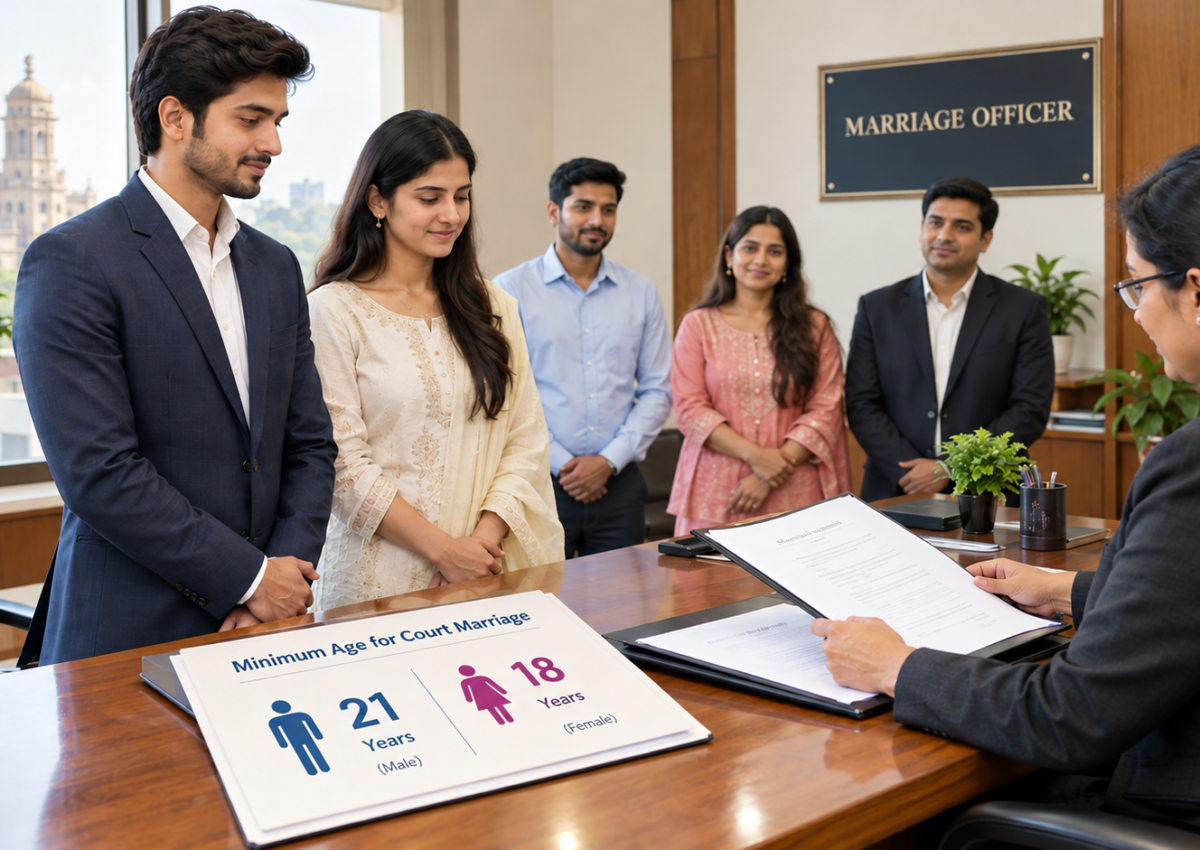
Is Police Verification Required for Court Marriage in Indore?
No, police verification or police permission is not expressly prescribed as a compulsory requirement for every court marriage under the Special Marriage Act, 1954 in Indore. The statutory procedure primarily involves giving notice to the Marriage Officer, publication of the notice, the statutory 30-day objection period, compliance with the conditions of Section 4, and solemnization of the marriage before the Marriage Officer and three witnesses. However, depending upon the facts of a particular case, residence or other documents may be verified administratively, and a specific inquiry can arise if an objection is filed.
This question is frequently asked by couples planning court marriage in Indore, particularly in interfaith marriages, inter-caste marriages, marriages where the parties come from different cities or States, and cases where one or both families are opposed to the relationship.
There is also considerable confusion between police verification, verification of residence, verification of documents, police protection, and police permission or NOC. These are legally different matters.
As a Family Lawyer in Indore, it is important to explain that a couple should not assume that they have to obtain a police NOC merely because they intend to marry under the Special Marriage Act.
At the same time, it would also be incorrect to say that police authorities can never become involved in a Special Marriage Act matter. The actual procedure can depend upon the facts, the nature of the documents submitted, the jurisdictional residence of the parties, objections raised during the statutory period, and administrative practice.
What Is the Direct Answer?
Police verification is not a general statutory prerequisite for solemnization of every court marriage in Indore under the Special Marriage Act, 1954. There is no provision in Sections 4 to 13 of the Act requiring every couple to first obtain a police NOC or police permission before their marriage can be solemnized.
The Marriage Officer is the statutory authority who deals with the marriage.
The police are not the authority that grants permission for an eligible adult couple to marry.
However, where verification of residence, identity or other facts becomes necessary, an administrative verification may occur in an individual case.
What Is Court Marriage in Indore?
The expression “court marriage” is commonly used in India for a marriage solemnized directly before a Marriage Officer under the Special Marriage Act, 1954.
The Special Marriage Act provides a secular legal framework for marriage. It can be used by persons belonging to different religions or different communities, provided the statutory conditions are satisfied.
The procedure is not simply a matter of appearing before a court and obtaining a marriage certificate.
The statutory process ordinarily involves:
- Checking eligibility under Section 4.
- Determining the proper jurisdiction under Section 5.
- Giving notice of intended marriage.
- Publication of the notice under Section 6.
- Allowing the statutory period for objections under Section 7.
- Dealing with any objection according to Section 8.
- Making the declaration required before solemnization.
- Appearing before the Marriage Officer with three witnesses.
- Solemnizing the marriage.
- Entering the marriage certificate in the Marriage Certificate Book.
Sections 5 to 13 of the Special Marriage Act set out these statutory steps.
Therefore, police verification is not listed as one of the basic statutory stages in this sequence.
Does the Special Marriage Act Mention Police Verification?
This is one of the most important legal points.
Sections 5 to 13 of the Special Marriage Act prescribe the principal procedure for solemnization.
Section 5 deals with the notice of intended marriage.
Section 6 deals with the Marriage Notice Book and publication of the notice.
Section 7 provides for objections.
Section 8 provides the procedure when an objection is received.
Section 9 gives the Marriage Officer certain powers in relation to an inquiry under Section 8.
Section 11 deals with the declaration by the parties and witnesses.
Section 12 deals with the place and form of solemnization.
Section 13 deals with the marriage certificate.
There is no general provision in these sections saying that every couple must obtain a police verification report before the Marriage Officer can solemnize the marriage.
This is why it is important not to describe police verification as an automatic statutory requirement applicable to every court marriage.
Is Police NOC Required for Court Marriage in Indore?
Generally, there is no general requirement under the Special Marriage Act for the couple to obtain a police NOC before giving notice or solemnizing the marriage.
A police NOC should not be confused with the statutory notice of intended marriage.
The notice is submitted to the Marriage Officer, not to the police.
The Marriage Officer then follows the procedure prescribed under the Special Marriage Act.
A couple should therefore be cautious if somebody tells them:
“First obtain police permission, otherwise court marriage is impossible.”
That statement is too broad.
The legal position must be examined according to the Special Marriage Act and the particular facts of the case.
Why Do People Think Police Verification Is Mandatory?
There are several reasons for this misconception.
First, some Marriage Officers or administrative offices may verify residence documents.
Second, in some jurisdictions and individual cases, police authorities have been involved in verification of residence or other information.
Third, couples facing family opposition sometimes approach the police for protection.
Fourth, lawyers, agents or marriage consultants may use the expression “police verification” loosely to refer to document verification or residence verification.
Fifth, the procedures followed by Marriage Officers can differ administratively, even though the central statutory framework remains the Special Marriage Act.
Therefore, it is necessary to distinguish the legal requirement from administrative practice.
Is Residence Verification the Same as Police Verification?
No.
This distinction is particularly important in Indore court marriage matters.
Section 5 requires that at least one party must have resided in the district of the Marriage Officer for at least 30 days immediately preceding the notice.
Consequently, the Marriage Officer has a legitimate reason to examine whether the residence statement made by the applicant is genuine.
That does not automatically mean that the couple must obtain a separate police certificate.
There is a significant difference between:
“The Marriage Officer verifies whether the applicant actually resides in the district”
and
“The couple must obtain a police NOC before the marriage.”
The first may arise as part of administrative scrutiny.
The second is not a general requirement imposed by the Special Marriage Act.
What Does Section 5 Say About Residence?
Section 5 provides that the parties must give notice to the Marriage Officer of the district in which at least one of the parties has resided for not less than 30 days immediately preceding the date on which the notice is given.
This is the reason residence proof is important in a court marriage application.
For example, suppose:
The bride lives in Indore and has been residing there for several months.
The groom lives in Bhopal.
They want to marry under the Special Marriage Act in Indore.
The bride’s qualifying residence may establish jurisdiction for the Indore Marriage Officer.
The groom does not necessarily have to become an Indore resident merely because the marriage is being solemnized in Indore.
Can Police Verify the Residence Address?
A residence-related verification can potentially arise in an individual case.
For example, if the Marriage Officer has concerns regarding the address submitted by an applicant, the authority may seek clarification or verification according to the applicable administrative procedure.
But this is different from saying:
“Every court marriage applicant must personally visit the police station and obtain a police verification certificate.”
The latter should not be presented as a universal statutory rule.
The Special Marriage Act itself makes residence relevant, but it does not prescribe a general police-clearance certificate as a condition for every marriage.
What Documents May Be Used to Establish Residence?
The documents depend upon the circumstances and the requirements of the concerned Marriage Officer.
Commonly relevant documents can include:
- Aadhaar card;
- voter ID;
- passport;
- registered rent agreement;
- electricity bill;
- bank correspondence;
- employer records;
- hostel or PG records;
- educational institution records;
- other government documents;
- other reliable evidence of actual residence.
The important point is that the information should be genuine.
A person should not create a false address merely to establish jurisdiction.
Is Aadhaar Address Enough for Court Marriage?
An Aadhaar card can be useful residence evidence, but the legal question under Section 5 is ultimately about residence, not merely the address printed on one particular identity document.
This distinction can become important where:
- the permanent address is in another State;
- the person is living in rented accommodation in Indore;
- the person is a student;
- the person is living in a hostel;
- the person is a working professional;
- the person has recently shifted to Indore.
The Marriage Officer may examine the overall circumstances and documents.
What If the Couple Is From Different States?
A difference in State of residence does not by itself prevent a Special Marriage Act marriage.
For example:
Bride – Rajasthan
Groom – Indore
If the groom has satisfied the Section 5 residence requirement, the couple may potentially proceed through the Indore Marriage Officer.
Similarly:
Bride – Indore
Groom – Maharashtra
The bride’s qualifying Indore residence may provide the necessary jurisdiction.
The fact that one party is from another State does not itself create a police-verification requirement.
Is Police Verification Required for Interfaith Marriage in Indore?
An interfaith marriage under the Special Marriage Act does not automatically require a police NOC merely because the parties belong to different religions.
The Special Marriage Act itself provides the legal mechanism for solemnizing marriages between persons who satisfy its statutory conditions.
The District Indore administration currently provides an application form specifically for the Special Marriage Act, 1954 and lists the relevant office at the Collector Office, New Administrative Sankul, Indore.
The official District Indore forms page also lists several Special Marriage Act forms and affidavits relating to matters such as divorced and widowed applicants.
The published Indore forms do not establish a general rule that every applicant must obtain a police NOC.
Is Police Verification Required for Inter-Caste Marriage?
The same basic principle applies.
An inter-caste marriage does not become a criminal or police matter simply because the parties belong to different castes.
If the couple is proceeding under the Special Marriage Act, the statutory conditions and procedure apply.
A police inquiry may arise in a particular case if there is a separate issue requiring police involvement, but there is no general rule that an inter-caste couple must first obtain police permission to marry.
What If Parents Oppose the Marriage?
This is where the distinction becomes particularly important.
If both parties are legally eligible adults and want to marry voluntarily, parental disagreement does not automatically give the parents a veto over the marriage.
Under the Special Marriage Act, objections are dealt with under the statutory framework.
Section 7 permits an objection before expiry of 30 days from publication of the notice on the ground that the proposed marriage would contravene one or more of the conditions specified in Section 4.
A mere statement such as:
“The parents do not like this marriage”
is not itself the same thing as a statutory objection under Section 7.
Can Parents Call the Police to Stop the Court Marriage?
Parents can approach authorities or make complaints, but a complaint does not automatically invalidate the marriage or give the police authority to prohibit an otherwise lawful marriage.
The Marriage Officer has to act according to the Special Marriage Act.
If a genuine criminal allegation is made, the police may investigate that separate allegation according to law.
For example, allegations involving:
- kidnapping;
- forced marriage;
- forged documents;
- impersonation;
- threats;
- violence;
- fraud;
are different matters from the ordinary civil procedure of solemnizing a marriage.
Therefore, the mere fact that parents have complained to police should not be confused with a statutory police-approval requirement.
What If the Couple Is Concerned About Police or Family Interference?
This is a different legal issue.
Suppose both parties are adults and voluntarily intend to marry, but they apprehend threats from family members.
In such a situation, the issue may become one of protection of life and liberty, rather than police verification for marriage.
The couple may need appropriate legal advice concerning representation to the police authorities or, depending upon the circumstances, appropriate proceedings before the High Court.
Such protection proceedings should not be confused with the ordinary court marriage procedure.
Can Police Stop an Eligible Adult Couple From Marrying?
The police do not ordinarily function as the Marriage Officer under the Special Marriage Act.
The Marriage Officer is the authority responsible for solemnization under the Act.
The Act sets out the conditions in Section 4 and the procedural requirements in Sections 5 onward.
Therefore, the police do not have a general statutory power to grant or refuse marriage permission merely because they disagree with the relationship.
However, if there is an independent legal issue, police powers under other laws may become relevant.
What Happens if Someone Files an Objection?
This is an important distinction.
A person can object under Section 7 before the expiry of 30 days from publication of the notice, but the objection must be based on the statutory grounds in Section 4.
If an objection is filed, Section 8 requires the Marriage Officer to inquire into the objection.
Section 9 gives the Marriage Officer certain civil-court powers for that inquiry, including powers concerning witnesses and documents.
This is a statutory inquiry by the Marriage Officer, not automatically a police investigation.
The Marriage Officer may need to examine documents or evidence to determine whether the objection is legally sustainable.
Can the Marriage Officer Ask for Additional Verification?
In an individual case, the authority may need to verify information or documents.
For example, questions may arise regarding:
- age;
- identity;
- marital status;
- residence;
- divorce;
- death of a previous spouse;
- authenticity of documents;
- jurisdiction;
- an objection filed under Section 7.
The existence of such verification should not automatically be described as “police permission.”
The correct legal question is:
What is being verified, under what authority, and for what purpose?
That distinction is particularly important when advising clients.
Is Police Verification Mentioned in the Indore Special Marriage Act Forms?
The official District Indore website currently provides a Special Marriage Act, 1954 application form. It identifies the office as the Collector Helpline, Collector Office, New Administrative Sankul, Indore.
The District Indore forms page also lists Special Marriage Act affidavits for divorced and widowed applicants.
The official material available through the District Indore website should be checked for the particular application and current local requirements.
Importantly, the mere fact that an office may scrutinize or verify residence documents should not be converted into a blanket statement that a police verification certificate is legally mandatory in every Indore court marriage case.
Is Police Verification Different for a Divorced Person?
A divorced person can marry again after the previous marriage has legally ended, subject to the applicable legal requirements.
The District Indore administration specifically lists Section 4 affidavits for divorced applicants under the Special Marriage Act.
The important documentation issue in such a case is ordinarily proof of the final divorce decree and compliance with the legal requirements.
A divorced applicant should not automatically be told that police verification is mandatory merely because he or she was previously married.
Is Police Verification Required if One Party Is a Widow or Widower?
The same principle applies.
The District Indore forms page lists Section 4 affidavits concerning widowed applicants.
The death certificate or other appropriate proof relating to the previous spouse may be relevant.
Again, this is a documentation and eligibility issue rather than an automatic police-clearance requirement.
What About an NRI or Foreign National?
Foreign-national and NRI marriages can involve additional documentation and legal issues.
For example, depending on the circumstances, questions may arise concerning:
- passport;
- visa;
- nationality;
- marital status;
- certificate of no impediment or equivalent document;
- residence;
- embassy documentation;
- previous marriage;
- divorce;
- foreign documents;
- authentication or apostille requirements.
In such cases, additional verification may occur.
Therefore, it would be unsafe to give an NRI or foreign-national couple a blanket statement that “no verification can ever occur.”
The better legal position is that there is no general statutory police-approval requirement for every Special Marriage Act marriage, but particular cases can involve additional verification because of their facts or documents.
Does Police Verification Mean the Marriage Will Be Delayed?
Not necessarily.
If the Marriage Officer requires clarification or verification, the practical timeline can depend on how quickly the information is obtained.
The statutory process itself already involves the notice and 30-day objection period.
Section 7 provides that after the expiration of 30 days from publication of the notice, the marriage may be solemnized unless an objection has been made.
Therefore, couples should not assume that every reference to verification means an additional fixed 30-day police waiting period.
There is no general provision in the Special Marriage Act creating a separate mandatory “30-day police verification period.”
Can the Police Verify Criminal Record Before Court Marriage?
A general criminal-background clearance is not prescribed by the Special Marriage Act as a universal condition for solemnization.
The Act is concerned with the statutory conditions of marriage and the prescribed procedure.
Section 4 sets out the conditions relating to the proposed marriage, while Sections 5 onward provide the notice and solemnization mechanism.
Therefore, a person should not ordinarily be told that every court marriage applicant must obtain a police clearance certificate showing that he or she has no criminal case.
A pending criminal case and marital eligibility are separate legal questions.
Does Having a Criminal Case Prevent Court Marriage?
Not automatically.
A criminal case is not by itself listed in Section 4 as a universal disqualification from marrying under the Special Marriage Act.
However, the facts of a particular criminal case can be relevant if there are allegations involving fraud, coercion, kidnapping, impersonation or other offences.
Therefore, the existence of a criminal proceeding should be examined separately rather than automatically treating it as a marriage disqualification.
Is Police Verification Required After the Marriage?
The marriage certificate issued under Section 13 is the statutory record of the marriage solemnized under the Act.
Section 13 provides that after solemnization, the Marriage Officer enters the certificate in the Marriage Certificate Book, and the certificate is signed by the parties and three witnesses.
The Act does not establish a general post-marriage police-verification procedure as a condition for the validity of every marriage.
What Are the Three Main Things Couples Should Verify Before Court Marriage?
For an Indore court marriage, I would advise a couple to concentrate on three fundamental areas.
First: Jurisdiction
Determine whether the Indore Marriage Officer has jurisdiction under Section 5.
At least one party must have resided in the relevant district for at least 30 days immediately before giving notice.
Second: Eligibility
Check whether the conditions of Section 4 are satisfied.
Third: Documentation
Ensure that identity, age, residence and marital-status documents are genuine and consistent.
If these matters are correctly addressed, the couple is in a much stronger procedural position.
Common Misconceptions About Police Verification
Misconception 1: Police permission is compulsory
There is no general statutory requirement that every couple obtain police permission before Special Marriage Act solemnization.
Misconception 2: Police must approve the relationship
The police do not decide whether two eligible adults should marry.
Misconception 3: Police verification and residence proof are the same thing
They are not.
Residence proof is documentary evidence concerning residence. Police verification is a separate form of administrative verification.
Misconception 4: Parents can stop the marriage by calling police
A parental complaint does not automatically create a legal prohibition against an otherwise lawful marriage.
Misconception 5: Interfaith marriage automatically requires police clearance
It does not follow from the Special Marriage Act.
Misconception 6: Different State addresses require police NOC
Different State residence does not itself create a universal police-NOC requirement.
Misconception 7: A pending criminal case automatically prevents marriage
A pending criminal case is not by itself a universal disqualification under Section 4.
What Should a Couple Do If Someone Demands Police Verification?
If an official or intermediary says that police verification is required, the couple should calmly ask what exactly is being requested.
For example:
Is it residence verification?
Is it verification of a particular document?
Is it connected with an objection?
Is it required because one party is a foreign national?
Is it a local administrative requirement?
Is a police NOC actually being demanded?
These questions matter because “police verification” can describe different things.
A lawyer assisting the couple should identify the legal and factual basis for the request rather than treating every verification request as a statutory requirement.
Why Residence Verification Can Be Important in Indore
The residence requirement under Section 5 is legally significant.
Suppose neither party has actually resided in Indore for the required period but the couple provides an Indore address merely to obtain jurisdiction.
That can create a serious procedural problem.
The proper approach is to provide truthful information and genuine residence documents.
A lawyer should never advise a client to manufacture residence merely to file the notice in a preferred district.
What if One Party Lives Outside Indore Permanently?
Section 6 specifically deals with the situation where either party is not permanently residing within the local limits of the Marriage Officer who received the notice.
The provision requires the Marriage Officer, in such a situation, to transmit a copy of the notice to the Marriage Officer of the district within whose limits that party is permanently residing, who is then required to affix a copy of the notice.
This is significant.
It shows that the Special Marriage Act itself contains a mechanism for dealing with parties whose permanent residence is elsewhere.
This statutory communication should not automatically be described as “police verification.”
It is a communication between Marriage Officers prescribed by the Act.
What Does Section 6 Mean for an Out-of-City Couple?
Consider:
Bride: Indore resident
Groom: Bhopal resident
The bride satisfies the Section 5 residence requirement.
The Indore Marriage Officer can receive the notice, subject to the statutory requirements.
Because the groom may be permanently residing outside the Indore district, Section 6 contemplates transmission of the notice to the Marriage Officer of the district where he permanently resides.
This is an important statutory procedure and should not be confused with a requirement that the groom obtain police clearance.
What Happens During the 30-Day Notice Period?
The notice is published so that objections can be made in accordance with Section 7.
Section 7 provides that any person may object before expiry of 30 days from publication of the notice, but the objection must be based on the ground that the proposed marriage would contravene one or more conditions specified in Section 4.
If there is no valid objection, the marriage may proceed after the statutory period.
If an objection is made, Section 8 provides the procedure for inquiry by the Marriage Officer.
Again, this is not the same as a routine police investigation of every couple.
What Happens on the Day of Court Marriage?
After completion of the statutory requirements, the parties appear before the Marriage Officer with three witnesses.
Section 11 requires the parties and three witnesses to sign the prescribed declaration in the presence of the Marriage Officer.
Section 12 provides for solemnization.
Section 13 provides for entry of the marriage certificate in the Marriage Certificate Book.
The statutory framework therefore focuses on the Marriage Officer, the parties and the witnesses.
There is no provision making a police officer a compulsory participant in the solemnization ceremony.
What Should You Carry for Court Marriage in Indore?
Although the exact requirements should be confirmed with the concerned Marriage Officer, a couple should generally organize:
Identity documents
Valid government-issued identity documents for both parties.
Age documents
Documents establishing the date of birth and eligibility.
Residence documents
Particularly important where jurisdiction is being established through Indore residence.
Photographs
Recent photographs in the required format and quantity.
Marital-status documents
Where applicable:
- divorce decree;
- death certificate of previous spouse;
- other relevant documents.
Witness documents
Three witnesses should have appropriate identity documents and comply with the Marriage Officer’s requirements.
Affidavits
Where applicable, affidavits required under the Special Marriage Act and local procedure should be prepared.
The District Indore website currently lists Special Marriage Act application forms and several related affidavits.
Is Police Verification Required for Friends Acting as Witnesses?
There is no general rule under the Special Marriage Act that every witness must obtain police verification merely because he or she is acting as a witness.
Section 11 requires three witnesses to sign the declaration, and Section 13 requires the parties and witnesses to sign the marriage certificate.
The witnesses should nevertheless carry the identification and documents required by the Marriage Officer.
Can Friends Be Witnesses in Indore Court Marriage?
Yes, subject to the requirements of the Marriage Officer.
The witnesses do not have to be the parents merely because the couple is getting married under the Special Marriage Act.
This can be particularly useful where the parties have family opposition.
Does Police Verification Protect the Couple From Family Threats?
No.
Police verification for administrative purposes and police protection for threatened persons are entirely different concepts.
If a couple apprehends violence, coercion or unlawful interference, they may require a separate legal remedy concerning protection of life and liberty.
That issue should be addressed separately from the ordinary Special Marriage Act procedure.
What If the Couple Is Facing Threats From Family Members?
If both parties are adults and voluntarily intend to marry but face threats, the couple should consider taking appropriate legal advice immediately.
Possible legal steps depend upon the facts and may include approaching the appropriate police authority or seeking appropriate judicial protection.
The need for protection should not be confused with a requirement that the couple first obtain police permission for the marriage.
Can the Marriage Officer Refuse to Marry Without Police Verification?
The Marriage Officer must act according to the Special Marriage Act and applicable rules and procedure.
If the officer requires verification of a material fact, the issue should be understood in context.
For example, if the question is whether the applicant actually satisfies the residence requirement, the authority may need reliable evidence.
But if someone claims that the law itself requires every couple to obtain a police NOC, that proposition should be checked against the governing statute and applicable rules.
The Special Marriage Act does not make a general police NOC one of the express conditions in Section 4 or one of the principal procedural steps in Sections 5 to 13.
Judicial Decisions and Police Verification
Courts have encountered situations in which Marriage Officers or administrative authorities have undertaken verification.
For example, in Adil Mirza v. Union Territory, Chandigarh, the record discussed police verification of residence in connection with the marriage certificate issued in that particular case. The decision is useful for showing that police verification can occur as an administrative step in an individual case, but it should not be read as creating a universal statutory police-verification requirement for every Special Marriage Act marriage throughout India.
Similarly, in Suraj and Another v. U.T. of Chandigarh and Others, the Punjab and Haryana High Court considered a challenge concerning residence verification by the Marriage Officer. The court noted the statutory procedure and did not find a basis on the record to conclude that an unauthorized verification was being undertaken.
These decisions illustrate an important point: verification may arise in the administration of an individual marriage application, but that is different from saying that every applicant must obtain a police NOC as an express statutory prerequisite.
What Is the Position Specifically in Indore?
For Indore, the official District Administration website currently provides a dedicated application form for marriage under the Special Marriage Act, 1954. The listed address is the Collector Helpline, Collector Office, New Administrative Sankul, Indore.
The official forms page also lists various documents and affidavits connected with the Special Marriage Act, including affidavits concerning divorced and widowed applicants.
The central statutory framework remains the Special Marriage Act, 1954.
Therefore, when advising a client, it is better to distinguish:
What the Act expressly requires
from
What the local Marriage Officer may ask for in a particular case as administrative verification.
This distinction prevents unnecessary confusion.
Practical Advice From a Family Lawyer in Indore
If a couple approaches me with the question:
“Do we need police verification for court marriage in Indore?”
I would first ask:
- Are both parties legally eligible to marry?
- Are both parties adults?
- Is either party already married?
- If previously married, is there a final divorce decree or death certificate?
- Where does each party actually reside?
- Has at least one party resided in the Indore district for the required 30-day period?
- What documents establish the residence?
- Are both parties voluntarily marrying?
- Are there any family threats or criminal allegations?
- Is either party a foreign national or NRI?
- Are there any discrepancies in the documents?
- Are three witnesses available?
Only after examining these questions can the lawyer properly advise whether any additional verification is likely to become relevant.
Important Difference Between Police Verification and Police Protection
These terms should never be mixed up.
Police Verification
This generally refers to checking or confirming information such as residence or identity when an authority seeks such verification.
Police Permission
This would mean that the police have to authorize the marriage.
There is no general requirement under the Special Marriage Act that every couple obtain such permission.
Police Protection
This is a completely different legal issue. It concerns protection from threats, violence or unlawful interference.
A couple may require police protection even though no police verification is required for the marriage itself.
Frequently Asked Questions
Is police verification mandatory for court marriage in Indore?
No. Police verification is not expressly prescribed as a mandatory requirement for every Special Marriage Act court marriage in Indore. However, administrative verification of residence or documents may arise in an individual case.
Do I need a police NOC for court marriage in Indore?
There is no general statutory requirement under the Special Marriage Act to obtain a police NOC before court marriage.
Does the police have to approve my marriage?
No. The Marriage Officer is the statutory authority under the Special Marriage Act for solemnization of the marriage.
Can police verify my residence?
Residence may be verified in an individual case where the authority considers verification necessary. This should not be confused with a universal requirement to obtain a police certificate.
Why is residence important for court marriage?
Because Section 5 requires at least one party to have resided in the district of the Marriage Officer for at least 30 days immediately before giving the notice.
Do both parties need to be Indore residents?
No. Section 5 requires residence of at least one party in the relevant district for the prescribed period.
Can a person from another State marry in Indore?
Yes, provided the statutory jurisdiction and other requirements are satisfied.
Is police verification required for an interfaith marriage?
Not as a universal statutory requirement merely because the parties belong to different religions.
Is police verification required for inter-caste marriage?
Not as a universal requirement under the Special Marriage Act.
Can parents stop a court marriage by approaching police?
A parental complaint does not automatically prevent an otherwise lawful marriage. Any criminal allegation or protection issue has to be considered separately.
Can police stop two adults from marrying?
Police do not ordinarily have a general statutory role as the marriage-permitting authority under the Special Marriage Act.
Is police verification required if one person is divorced?
There is no automatic police-verification requirement merely because a person is divorced. The relevant divorce decree and other statutory documents may need to be produced.
Is police verification required if one party is a widow or widower?
Not merely because of that status. Appropriate proof of the previous spouse’s death may be required.
Do witnesses need police verification?
There is no general statutory requirement that every witness obtain a police-verification certificate merely because he or she is a witness.
Do three witnesses have to appear?
Yes. Section 11 requires the parties and three witnesses to sign the declaration before the Marriage Officer, and Section 13 requires the certificate to be signed by the parties and three witnesses.
Is there a 30-day police verification period?
No separate universal 30-day police-verification period is created by the Special Marriage Act. The Act contains a 30-day objection period following publication of the marriage notice.
Is the 30-day residence requirement the same as police verification?
No. The residence requirement is prescribed by Section 5. Police verification, if undertaken in an individual case, is a separate administrative matter.
Can the Marriage Officer verify the documents?
Yes, the Marriage Officer has to ensure compliance with the statutory requirements, and inquiries may arise particularly when objections are made.
What if someone submits a false residence document?
Providing false information or forged documents can create serious legal consequences. Couples should provide genuine information and documents.
Can a lawyer guarantee that police verification will not happen?
A lawyer should not give such a blanket guarantee. The correct statement is that police verification is not a universal statutory prerequisite, but particular cases may involve administrative verification.
Does police verification mean that the marriage is under suspicion?
Not necessarily. Verification can simply relate to a factual issue such as residence or documentation.
Is police verification different for NRI or foreign-national marriages?
Yes, additional documentation and verification can arise in cases involving foreign nationals or NRIs, depending upon the facts and applicable requirements.
Is police verification required after the marriage?
There is no general post-marriage police-verification procedure under the Special Marriage Act for every marriage.
Conclusion
Police verification is not a general mandatory requirement for every court marriage in Indore under the Special Marriage Act, 1954. The Act does not prescribe a universal police NOC or police permission as a prerequisite for solemnization.
The statutory process primarily revolves around the Marriage Officer, the conditions under Section 4, the residence requirement under Section 5, publication of the notice under Section 6, objections under Section 7, inquiry into objections under Section 8, declaration by the parties and three witnesses under Section 11, solemnization under Section 12 and issuance of the marriage certificate under Section 13.
However, it is equally important not to go to the other extreme and state that police can never be involved in a Special Marriage Act case. Depending upon the facts, residence documents or other information may be verified administratively. Particular cases may also involve police because of a separate complaint, alleged document fraud, threat, coercion, criminal allegation or a request for protection.
The most important distinction is therefore between statutory police permission and case-specific verification.
For couples planning court marriage in Indore, the first legal questions should be:
Does at least one party satisfy the 30-day residence requirement?
Are the conditions of Section 4 satisfied?
Are the identity, age, residence and marital-status documents genuine and consistent?
Are there any objections or independent legal issues?
The District Indore administration currently provides a dedicated application form for the Special Marriage Act, 1954 and lists the Collector Office, New Administrative Sankul, Indore in connection with the form. The official District Indore forms page also lists several Special Marriage Act affidavits, including forms for divorced and widowed applicants.
Accordingly, a couple should not unnecessarily arrange a police NOC simply because an agent or third party says that police permission is mandatory. At the same time, they should be prepared for the possibility that the Marriage Officer may require clarification or verification concerning residence or documents in a particular case.
From the perspective of a Family Lawyer in Indore, the safest approach is to examine the statutory requirements first, verify the correct jurisdiction, prepare genuine residence and identity documents, and then confirm any additional local procedural requirement directly with the concerned Marriage Officer.
The legal position can therefore be stated in one sentence:
For court marriage in Indore under the Special Marriage Act, police verification is not a universal statutory requirement, but residence or document verification may arise in an individual case depending upon the circumstances and administrative procedure.
Disclaimer: This information is intended for general guidance only and does not constitute legal advice. Please consult with a qualified lawyer for personalized advice specific to your situation.
Advocate J.S. Rohilla (Civil & Criminal Lawyer in Indore)
Contact: 88271 22304
