
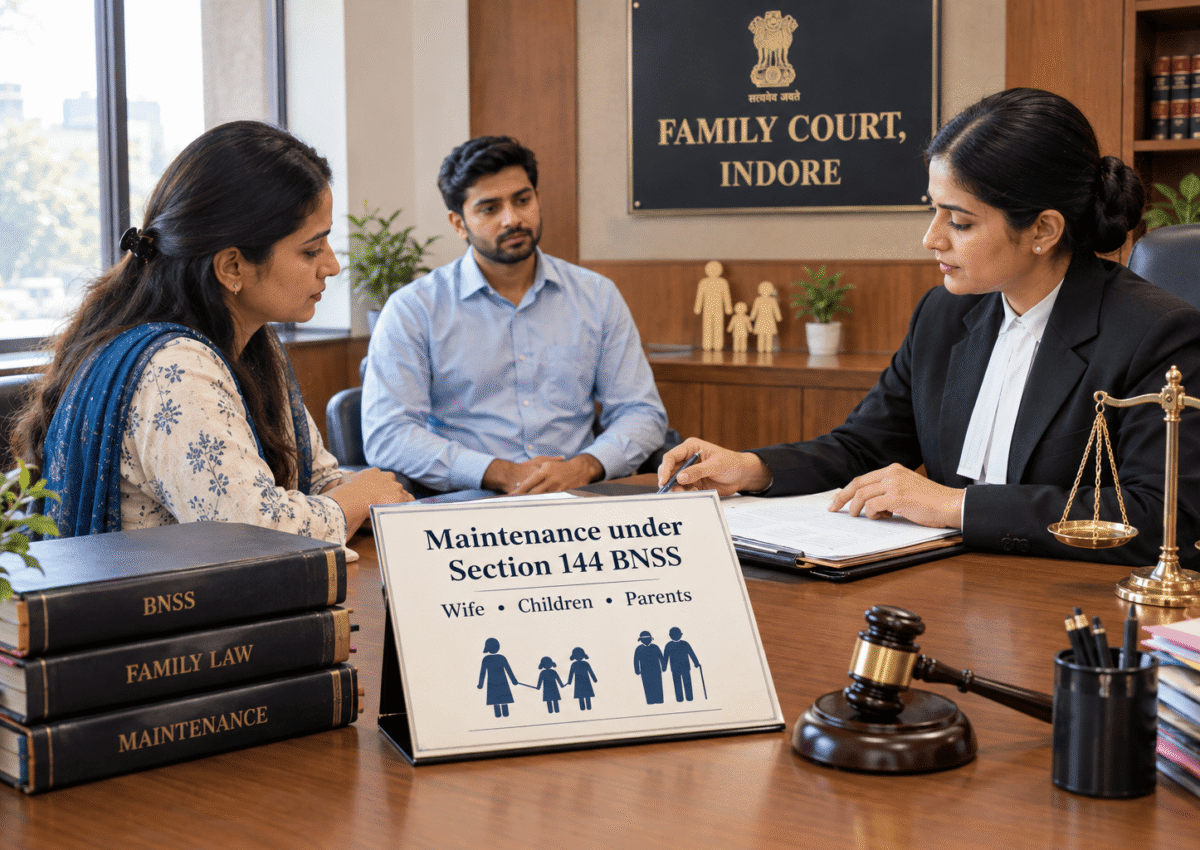
Can Agricultural Land Owned by My Husband Be Considered While Deciding Maintenance in Family Court Indore?
Yes. Agricultural land owned by a husband can be taken into consideration by Family Court, Indore while determining maintenance, particularly where the agricultural land produces income or otherwise demonstrates the husband’s financial resources and capacity.
However, an important distinction must be made:
Ownership of agricultural land is not the same thing as proof of agricultural income.
If a husband owns 20 acres of agricultural land, that fact may be relevant to his financial circumstances. But it does not automatically mean that he earns a particular amount every month from that land.
The Court may have to examine:
- extent of agricultural land;
- location;
- ownership;
- whether it is irrigated or unirrigated;
- crops cultivated;
- number of crops in a year;
- actual agricultural production;
- market value of produce;
- agricultural expenses;
- whether the land is leased out;
- whether the husband personally cultivates it;
- whether someone else cultivates it;
- agricultural income disclosed in tax or financial records;
- income received from sale of agricultural produce;
- whether the land is ancestral or jointly owned;
- husband’s actual share;
- other sources of income;
- and his overall financial capacity.
The Supreme Court’s maintenance jurisprudence requires the Court to examine the overall financial circumstances of the parties rather than mechanically relying upon one isolated figure. In Rajnesh v. Neha, the Supreme Court directed comprehensive disclosure of assets, income and liabilities and identified several factors relevant to determining maintenance.
A particularly relevant decision of the Madhya Pradesh High Court, Indore Bench, also demonstrates that agricultural land and alleged agricultural income can become relevant in maintenance litigation. In that case, the wife’s assertion regarding the husband’s income from agricultural land was considered along with the parties’ affidavits, ancestral property and family circumstances.
1. Why can agricultural land be relevant in a maintenance case?
Section 144 BNSS applies where a person having sufficient means neglects or refuses to maintain his wife, child, father or mother who falls within the statutory requirements.
The expression “sufficient means” is broader than merely monthly salary.
A husband’s financial means may include:
- salary;
- business income;
- professional income;
- rental income;
- agricultural income;
- interest;
- dividends;
- pension;
- investment income;
- income from partnership;
- income from companies;
- and other financial resources.
Section 144 BNSS therefore permits the Court to examine the husband’s actual financial position rather than looking exclusively at his employment salary.
Consequently, if a husband says:
“I have no income because I am not employed.”
but the evidence shows that he owns substantial irrigated agricultural land and earns income from cultivation, the agricultural income may be highly relevant.
2. Does ownership of agricultural land automatically prove income?
No.
This distinction is extremely important.
Suppose the husband owns:
15 acres of agricultural land.
The wife cannot simply assert:
“My husband owns 15 acres, therefore he earns ₹1 lakh per month.”
That conclusion may not be supported by evidence.
Agricultural income depends upon several factors.
For example:
- 15 acres of irrigated land growing commercial crops may produce substantial income.
- 15 acres of unirrigated land may produce considerably less.
- Some land may remain uncultivated.
- Some land may be affected by drought or crop failure.
- The land may be jointly owned.
- The husband may have leased it to another person.
- The husband may receive only a share of the agricultural income.
Therefore, the wife should establish the financial benefit actually available to the husband as far as possible.
3. Agricultural land is still an important financial asset
Although land ownership does not automatically prove monthly income, it can nevertheless be an important indicator of the husband’s financial circumstances.
Consider two husbands.
Husband A
- No agricultural land
- No house
- No business
- Salary ₹35,000
Husband B
- 20 acres agricultural land
- Two commercial shops
- Agricultural income
- Rental income
- Salary ₹35,000
It would be unrealistic to assume that both husbands necessarily have identical financial circumstances merely because their salaries are the same.
The Court can consider the complete financial picture.
The Supreme Court’s Rajnesh v. Neha guidelines expressly recognise that maintenance depends upon the factual circumstances of each case and that the Court can consider relevant factors beyond a single income figure.
4. What if the agricultural land actually generates income?
This is a much stronger case.
Suppose the husband owns:
- 10 acres irrigated land;
- cultivates wheat and soybean;
- sells agricultural produce every year;
- receives substantial agricultural income.
That income can be relevant while assessing his financial capacity.
The wife should try to establish:
- acreage;
- ownership;
- crops;
- irrigation;
- agricultural activity;
- approximate production;
- sale of produce;
- agricultural expenses;
- husband’s share;
- actual income.
The more specific the evidence, the stronger the maintenance claim.
5. What if the husband says that the agricultural land produces no income?
The Court need not automatically accept that statement.
The wife can ask:
- Is the land cultivated?
- What crops are grown?
- Is irrigation available?
- Who cultivates it?
- Is it leased?
- Who receives the crop proceeds?
- Are agricultural produce sales made?
- Is there a tractor or agricultural machinery?
- Who purchases seeds and fertilisers?
- Are there mandi receipts?
- Are there bank deposits corresponding to agricultural sales?
- Is the land shown as agricultural income in financial documents?
- Has the husband made different statements in other proceedings?
The Court can then assess whether the assertion of “no agricultural income” is credible.
6. What if the husband is an agriculturist and has no salary?
This situation frequently arises in rural and semi-urban areas around Indore.
A husband may genuinely have no salary because agriculture is his primary occupation.
That does not mean that he necessarily has no means.
For example:
Husband owns 12 acres of irrigated agricultural land and earns his livelihood from cultivation.
In such a case, the relevant question is not:
“Does he receive a monthly salary?”
The relevant question is:
“What financial resources does his agricultural activity provide, and what is his actual capacity to maintain his wife and children?”
Agricultural income may therefore become the principal basis for assessing his means.
7. What if agricultural income is seasonal?
Agricultural income is often not received in equal monthly instalments.
A farmer may receive substantial amounts:
- after harvesting soybean;
- after wheat harvest;
- after sale of vegetables;
- after sale of fruits;
- or at other agricultural cycles.
The Court can take into account the annual or periodic nature of agricultural income rather than insisting that the husband must receive the same amount every month.
For example, if the evidence establishes annual agricultural income of ₹6 lakh, the Court may consider that financial resource while determining a reasonable monthly maintenance amount.
The exact method of assessment depends on the evidence and circumstances of the case.
8. Can Family Court, Indore consider agricultural land situated outside Indore?
Yes, where the maintenance proceeding is otherwise properly before Family Court, Indore.
The location of the agricultural land is different from the question of territorial jurisdiction of the maintenance proceeding.
For example:
- wife resides in Indore;
- maintenance proceeding is properly instituted in Indore;
- husband resides in Indore;
- husband owns 25 acres of agricultural land in Dewas.
The Dewas agricultural land may still be relevant to the husband’s financial capacity.
Similarly, agricultural land could be situated in:
- Ujjain;
- Dhar;
- Dewas;
- Mhow;
- Khargone;
- Khandwa;
- Ratlam;
- or another State.
Its location does not automatically prevent the Family Court from considering the asset when determining the husband’s financial circumstances.
Section 145 BNSS provides alternative territorial bases for proceedings under Section 144, including the district where the husband or wife resides and where the husband last resided with his wife.
9. What if the husband owns agricultural land in another State?
The same principle applies.
Suppose the wife resides in Indore and the husband owns agricultural land in Rajasthan or Maharashtra.
If the maintenance proceeding is properly pending before Family Court, Indore, the agricultural land may be relevant evidence of his financial resources.
The Court’s consideration of the asset is not dependent upon the property being physically located within Indore.
The wife should, however, establish the husband’s ownership and financial benefit through reliable evidence.
10. What documents can prove agricultural land ownership?
Useful documents may include:
- registered sale deed;
- khasra entries;
- khatauni;
- B-1 records;
- revenue records;
- mutation entries;
- land records;
- property tax or land revenue records;
- partition documents;
- inheritance documents;
- family settlement;
- court orders;
- agricultural lease documents;
- and other relevant revenue records.
For Madhya Pradesh agricultural property, revenue records can be particularly useful in establishing the extent and recorded ownership of agricultural land.
The exact evidentiary value of a particular revenue entry will depend on what it records and the issue for which it is relied upon.
11. Can Khasra and B-1 records help in a maintenance case?
Yes.
Where the wife alleges that her husband owns agricultural land, relevant revenue records can help establish:
- survey/khasra number;
- area;
- recorded owner;
- nature of land;
- co-ownership;
- mutation;
- and other land-related particulars.
But establishing ownership is only the first step.
The wife should then try to establish whether that land produces income and, if so, approximately how much.
This distinction can make the difference between a strong and weak maintenance pleading.
12. What if the agricultural land is ancestral?
Ancestral property requires careful analysis.
If the husband has an interest in ancestral agricultural land, the entire land should not automatically be treated as his exclusive property.
For example:
- total agricultural land: 20 acres;
- multiple co-sharers;
- husband’s actual share: disputed.
The Court may need to determine what financial benefit or share is actually attributable to the husband.
The wife should therefore avoid stating:
“My husband owns 20 acres.”
when the documents actually show joint or family ownership.
A more accurate pleading may be:
“The respondent has an interest/share in approximately 20 acres of ancestral agricultural land, from which he derives or is capable of deriving agricultural income.”
The evidence should support the allegation.
13. What if the husband says the land belongs to the joint family?
This is a common defence.
The wife should examine:
- revenue records;
- partition status;
- names of recorded owners;
- actual cultivation;
- who receives crop proceeds;
- who pays agricultural expenses;
- who manages the land;
- husband’s share;
- and his statements in other proceedings.
The Court may consider the husband’s actual financial benefit rather than merely the label “joint family property.”
At the same time, the wife should not automatically treat every joint-family agricultural asset as the husband’s exclusive income.
14. What if the husband has transferred the agricultural land to his brother?
This can be particularly relevant if the transfer occurred around the time of the matrimonial dispute or maintenance proceedings.
A Madhya Pradesh High Court, Indore Bench decision considered a case in which the wife alleged agricultural income and the record showed that the husband had transferred rights in agricultural land to his brother without consideration; the Court considered the circumstances relating to the agricultural property and the husband’s financial position while upholding the maintenance order.
The important lesson is not that every transfer to a relative must be ignored.
Rather:
A transfer of agricultural property may require scrutiny where it is alleged to have been made to reduce or conceal the husband’s financial resources.
The Court can examine:
- date of transfer;
- consideration;
- relationship between transferor and transferee;
- reason for transfer;
- possession;
- agricultural income after transfer;
- pending matrimonial/maintenance litigation;
- and other surrounding circumstances.
15. Does transfer of land automatically mean that the husband still owns it?
No.
A legally valid transfer cannot simply be ignored merely because the wife claims maintenance.
The question is whether the transfer is genuine and what its legal and factual consequences are.
Therefore, a wife should not simply plead:
“He transferred the land, so it is still his.”
The better approach is to place the relevant circumstances before the Court and seek appropriate disclosure or examination.
16. What if the husband has leased his agricultural land?
This may provide particularly clear evidence of income.
Suppose:
- husband owns 15 acres;
- land is leased to another farmer;
- lease income is ₹2 lakh annually.
The lease agreement, receipts, bank entries or other evidence may establish the financial benefit.
In such a case, the Court can consider the lease income while determining maintenance.
17. What if agricultural land is cultivated by the husband himself?
Self-cultivation can sometimes make calculation more complicated.
The wife should establish, as far as possible:
- acreage;
- crop;
- yield;
- number of crops;
- irrigation;
- market rate;
- agricultural expenses;
- machinery;
- labour;
- sale proceeds.
For example:
10 acres × estimated yield × prevailing sale price = gross agricultural receipts
From this, legitimate agricultural expenses may need to be considered.
The objective is not to artificially inflate the husband’s income.
The objective is to present a realistic picture of his agricultural financial capacity.
18. Gross agricultural receipts are not necessarily net income
This distinction is very important.
Suppose the husband sells agricultural produce for:
₹10 lakh annually.
It would not necessarily be correct to say:
“His income is ₹10 lakh.”
He may have incurred expenses for:
- seeds;
- fertilisers;
- pesticides;
- labour;
- irrigation;
- electricity;
- machinery;
- harvesting;
- transportation;
- land preparation;
- storage;
- and other agricultural activities.
Therefore, the Court may consider the net financial benefit rather than simply treating total sale proceeds as disposable income.
19. What if the husband claims crop failure?
Agriculture is inherently subject to risk.
The husband may genuinely face:
- drought;
- excessive rainfall;
- crop disease;
- pest attack;
- market collapse;
- natural calamity;
- irrigation failure.
Such circumstances can affect agricultural income.
A genuine claim of crop failure should ideally be supported by evidence.
The Court can then consider whether the reduction in agricultural income is temporary or represents the husband’s normal financial position.
20. What if the husband owns irrigated agricultural land?
Irrigation may be relevant because it can affect the nature and productivity of the land.
A wife may therefore consider producing evidence regarding:
- irrigation facilities;
- borewell;
- well;
- canal;
- electricity connection;
- multiple crop cultivation;
- horticulture;
- commercial crops.
However, irrigation alone does not establish a particular income figure.
It is one factor in determining the potential and actual agricultural activity.
21. Can the Court consider the husband’s agricultural income even if he is not an income-tax assessee?
Yes, the absence of an income-tax return does not automatically establish that the husband has no agricultural income.
Agricultural income has its own tax treatment under the Income-tax framework, but the maintenance court’s inquiry is not simply identical to an income-tax assessment.
The Family Court can consider other evidence of agricultural activity and income.
Possible evidence may include:
- mandi receipts;
- sale bills;
- bank deposits;
- crop-sale records;
- lease agreements;
- agricultural machinery;
- revenue records;
- crop records;
- and other reliable evidence.
22. What if the husband says “agricultural income is tax-free, so it cannot be counted”?
That would be an incorrect approach.
Tax treatment and maintenance assessment are two different questions.
The fact that a particular category of agricultural income may receive tax treatment different from salary income does not mean that the income is irrelevant for determining financial capacity in a maintenance proceeding.
The maintenance Court is concerned with the husband’s actual means and financial circumstances.
23. What if the husband receives agricultural income in cash?
This can be difficult to prove, but not impossible.
The wife may rely, where legally obtainable and relevant, upon:
- mandi receipts;
- sale records;
- crop-sale documents;
- statements made by the husband;
- agricultural lease documents;
- evidence concerning cultivation;
- bank deposits following crop sales;
- and other reliable material.
A mere allegation that:
“He is a farmer, so he must be earning ₹2 lakh every month”
would be weak.
The better approach is to establish the agricultural activity and then present evidence from which a reasonable assessment can be made.
24. Can the husband’s tractor and agricultural machinery be considered?
Yes, as part of the overall financial picture, although such assets do not automatically constitute monthly income.
For example, ownership of:
- tractor;
- combine harvester;
- agricultural equipment;
- irrigation equipment;
- transport vehicles
may support the existence and scale of agricultural operations.
But the Court should distinguish between:
assets used for agriculture
and
actual income generated from agriculture.
A tractor may be a productive asset, but it is not itself monthly income.
25. What if the husband claims the agricultural land is unproductive?
The wife can examine the reason.
Possible circumstances include:
- barren land;
- lack of irrigation;
- disputed possession;
- litigation;
- government acquisition;
- land under development restriction;
- crop failure;
- tenancy dispute;
- or genuinely uncultivated land.
If the land is genuinely unproductive, its financial significance may be different.
But if the husband claims “no income” while the evidence shows active cultivation, the Court may examine the contradiction.
26. Can the Court consider the market value of agricultural land?
Yes, the value of the land may form part of the husband’s overall asset position, but market value should not be confused with monthly income.
For example:
Agricultural land worth ₹2 crore does not mean the husband earns ₹2 lakh per month.
The wife should therefore avoid using property valuation as an artificial income calculation.
Instead, the better argument is:
“The respondent owns substantial agricultural assets and derives or has the capacity to derive income from them. The asset position should be considered along with his disclosed income, agricultural receipts and other financial resources.”
27. Can agricultural land affect interim maintenance?
Yes.
If reliable evidence is available at the interim stage showing that the husband has substantial agricultural income or agricultural resources, the Court can take that evidence into account when assessing interim maintenance.
This is particularly important where the husband has stated:
“I have no income.”
and the wife produces evidence that he:
- cultivates substantial land;
- receives agricultural income;
- leases land;
- or derives significant financial benefit from agricultural property.
The Supreme Court’s Rajnesh v. Neha framework specifically applies to maintenance proceedings and requires disclosure of assets and income by both parties.
28. What if the husband does not disclose agricultural land?
This can be a significant issue.
Suppose the husband files his affidavit showing:
- salary: ₹30,000;
- property: one residential house;
- agricultural land: not disclosed.
The wife subsequently produces revenue records showing that he owns 12 acres.
The wife can bring this discrepancy to the Court’s attention.
The issue then becomes:
Why was the agricultural land not disclosed?
The husband may have a legitimate explanation, such as:
- land sold before the relevant period;
- mutation not updated;
- joint family property;
- no present ownership;
- mistaken omission.
But if the omission is unexplained, it can affect the Court’s assessment of the credibility and completeness of the financial disclosure.
29. What does Rajnesh v. Neha require regarding financial disclosure?
The Supreme Court directed that affidavits of assets and liabilities should be filed by parties in maintenance proceedings before Family Courts, District Courts and Magistrates’ Courts across the country.
This is particularly important where agricultural property is involved.
A proper financial disclosure should enable the Court to understand:
- immovable properties;
- agricultural land;
- income;
- liabilities;
- investments;
- bank accounts;
- and other relevant financial circumstances.
The Supreme Court continues to rely upon the Rajnesh disclosure framework in current proceedings. A 2026 Supreme Court office report records directions requiring parties to file affidavits of assets and income in accordance with Rajnesh v. Neha.
30. What if the agricultural land is in the name of the husband but cultivated by his father?
This requires careful factual examination.
The wife should find out:
- who owns the land;
- who cultivates it;
- who receives crop proceeds;
- who pays cultivation expenses;
- whether the father has an independent right;
- whether the husband receives any share;
- and whether the husband has disclosed the land.
The Court should not automatically treat all agricultural income generated from family land as the husband’s personal income.
The actual financial benefit must be established.
31. What if the husband says the agricultural income belongs to his father?
Again, documentary and factual evidence becomes important.
The wife may examine:
- title;
- revenue records;
- cultivation records;
- sale receipts;
- bank accounts;
- tax declarations;
- family arrangements;
- and the husband’s previous statements.
If the father is genuinely the owner and receives the agricultural income, that should be distinguished from a situation where the father is merely a nominal recipient while the husband actually controls the land and income.
32. Can the husband be asked to disclose agricultural income from family land?
Where relevant to the maintenance proceeding, the wife can seek appropriate financial disclosure regarding the husband’s assets and sources of income.
A focused request is preferable.
For example:
“The respondent may be directed to disclose his share, if any, in the agricultural land situated at ________, together with details of cultivation, lease, agricultural receipts, crop income and other financial benefits derived therefrom.”
This is more effective than simply asking the Court to treat all family agricultural land as the husband’s income.
33. What if the husband owns agricultural land but gives it on lease?
This can be one of the easiest agricultural-income cases to establish.
Evidence may include:
- lease deed;
- batai arrangement;
- rent receipts;
- bank transfer;
- written agreement;
- tenant statement;
- revenue records;
- or other relevant documents.
If the husband receives a fixed annual lease amount, that can provide a relatively clear basis for assessing the financial resource.
34. What if the husband receives agricultural income jointly with his brothers?
The Court should consider his actual share.
For example:
- agricultural income: ₹9 lakh annually;
- three equal owners;
- husband’s share: one-third.
The entire ₹9 lakh should not automatically be attributed to him.
The wife should establish:
- ownership;
- share;
- actual distribution;
- and the amount actually received.
35. Can agricultural land be relevant even if it does not currently produce income?
Yes, but the argument must be carefully framed.
For example, if the husband owns substantial agricultural land but currently leaves it uncultivated, the wife may argue that the asset forms part of his overall financial position and earning capacity.
But she should not automatically claim that the land generates a specific income without evidence.
The Court may consider:
- present use;
- potential use;
- location;
- irrigation;
- cultivation history;
- lease possibilities;
- and other circumstances.
36. What evidence should a wife in Indore collect?
If agricultural land is relevant to the maintenance case, I would suggest preparing an Agricultural Property and Income Chart.
For example:
| Particular | Details |
|---|---|
| Location | Village ______, Tehsil ______ |
| Khasra Nos. | ______ |
| Total land | 12 acres |
| Husband’s share | 50% |
| Irrigation | Borewell |
| Crops | Soybean/Wheat |
| Cultivation | Self/Lease |
| Approx. annual production | ______ |
| Sale proceeds | ______ |
| Agricultural expenses | ______ |
| Net income | ______ |
| Supporting documents | B-1/Khasra/Mandi receipts etc. |
This makes the case much more concrete.
37. What documents are particularly useful in Madhya Pradesh?
For agricultural property in Madhya Pradesh, depending on the facts, useful documents may include:
- Khasra;
- B-1;
- mutation entries;
- revenue records;
- registered sale deeds;
- partition documents;
- inheritance documents;
- agricultural lease;
- crop-related documents;
- mandi receipts;
- sale bills;
- bank statements reflecting agricultural receipts;
- electricity records for irrigation;
- and other relevant documents.
The precise document required depends upon the allegation being proved.
38. Can the wife use the husband’s statements in other cases?
Yes, where legally admissible and relevant.
This can be particularly powerful.
Suppose the husband stated in another proceeding:
“I own 15 acres of agricultural land.”
but in the maintenance case he says:
“I have no agricultural land.”
That contradiction should be specifically brought to the Court’s attention.
Similarly, if he previously disclosed:
“Agricultural income ₹5 lakh annually”
but later says:
“Agricultural income is zero,”
the inconsistency may require explanation.
39. Can lifestyle evidence support an agricultural-income claim?
It can be relevant, but should not be the sole basis.
For example, evidence of:
- expensive vehicles;
- large agricultural operations;
- frequent travel;
- significant investments;
- expensive property;
- substantial business activity;
may be relevant when considered with documentary evidence.
However, the wife should avoid the simplistic argument:
“He has a good car, therefore he earns ₹2 lakh from agriculture.”
Lifestyle is supporting evidence, not necessarily proof of a precise income figure.
40. What if the husband has substantial agricultural land but claims heavy agricultural debt?
Debt can certainly be relevant.
The Court may examine:
- bank loans;
- Kisan Credit Card liabilities;
- agricultural loans;
- machinery loans;
- outstanding amounts;
- interest;
- and actual repayment obligations.
But again, the existence of a loan does not automatically mean that agricultural income is zero.
The Court can consider both:
income/resources
and
genuine liabilities.
41. What if the agricultural land was purchased using a bank loan?
The loan liability can be considered.
But the Court may still consider:
- present value of land;
- agricultural income;
- loan EMI;
- outstanding principal;
- other assets;
- and overall financial circumstances.
The correct assessment is therefore comprehensive rather than one-dimensional.
42. Can the husband argue that agricultural income is uncertain?
Yes, and there can be genuine merit in that argument.
Agricultural income can vary because of:
- weather;
- crop prices;
- crop yield;
- disease;
- irrigation;
- market conditions.
The Court should therefore avoid assuming a fixed agricultural income without evidence.
But uncertainty does not mean agricultural resources become irrelevant.
The Court can consider the historical or average financial benefit where evidence permits.
43. What if the husband deliberately understates agricultural income?
The wife should compare:
revenue records + acreage + crops + sale receipts + bank transactions + financial affidavit.
For example:
Husband states agricultural income: ₹1 lakh annually.
But:
- 20 acres irrigated;
- two crops annually;
- mandi receipts show substantial sales;
- bank account shows repeated agricultural credits.
That discrepancy can become important evidence.
The Court can then determine the credibility of the disclosure.
44. Can agricultural land be considered while determining maintenance for children?
Yes.
Where a child is claiming maintenance under Section 144 BNSS, the husband’s financial capacity is relevant to determining his ability to contribute towards the child’s reasonable needs.
Agricultural income can therefore be relevant alongside:
- salary;
- business;
- rental income;
- investments;
- property;
- and other resources.
The child’s needs may include:
- education;
- food;
- clothing;
- medical care;
- accommodation;
- transportation;
- and other reasonable expenses.
45. Does agricultural land itself create an automatic right to maintenance?
No.
The wife still has to establish the statutory ingredients of the maintenance claim.
Broadly, the Court examines matters such as:
- existence of the marital relationship;
- wife’s inability to maintain herself, where applicable;
- husband’s sufficient means;
- neglect or refusal to maintain;
- and the statutory circumstances affecting entitlement.
Agricultural land is evidence relevant primarily to the husband’s means.
It does not by itself prove every ingredient of the claim.
46. Can a wife living in Indore rely on agricultural land owned by a husband living elsewhere?
Yes, provided the maintenance proceeding is properly maintainable before Family Court, Indore.
For example:
Wife resides in Indore. Husband resides in Delhi. Husband owns 30 acres of agricultural land in Dewas.
The agricultural land can still be relevant to his financial capacity.
The territorial jurisdiction question under Section 145 BNSS is distinct from the evidentiary question of what assets and income the husband possesses.
47. What should a husband do if his wife’s allegation regarding agricultural income is exaggerated?
A husband who genuinely has agricultural property should also adopt a transparent approach.
He should produce:
- revenue records;
- ownership/share details;
- crop details;
- agricultural expenses;
- loan documents;
- sale receipts;
- bank statements where relevant;
- proof of crop failure if claimed;
- lease documents if land is leased;
- and other relevant financial information.
If the land is jointly owned, clearly disclose the husband’s actual share.
If the land belongs to his parents, establish that fact.
If the land is uncultivated, explain why.
A documentary explanation is much stronger than simply stating:
“The wife is lying.”
48. Agricultural land and rental property should be considered separately
This distinction is useful when preparing a maintenance case.
Rental property
The principal question is:
How much rent is actually received?
Agricultural property
The questions may include:
How much land does he own?
Who cultivates it?
What crops are grown?
What is the annual production?
What are the agricultural expenses?
What is his share?
What agricultural income does he actually receive?
Therefore, agricultural income often requires more detailed evidence than rental income.
49. A practical strategy for the wife before Family Court, Indore
If agricultural land is an important part of the husband’s financial position, I would suggest the following litigation strategy.
First — establish ownership
Obtain reliable revenue/property records.
Second — establish actual agricultural activity
Show:
- cultivation;
- crops;
- irrigation;
- lease;
- or other use.
Third — establish income
Use:
- mandi receipts;
- sale bills;
- bank credits;
- lease payments;
- other reliable documents.
Fourth — establish the husband’s share
Do not attribute family property automatically to him.
Fifth — compare with his financial affidavit
Identify omissions or contradictions.
Sixth — seek appropriate disclosure
Ask for relevant documents rather than making an unrestricted demand for everything.
Seventh — present the complete financial picture
Combine:
agricultural income + salary + business + rent + investments + property + earning capacity.
That is generally more persuasive than relying on agricultural land alone.
50. A model pleading concerning agricultural land
Where supported by evidence, a wife may plead along these lines:
“That the respondent has substantial financial resources apart from his stated income. The respondent is the recorded owner/co-owner/interested person in agricultural land situated at Village ________, Tehsil ________, District ________, Madhya Pradesh, bearing Khasra Nos. ________, admeasuring approximately ______ acres. The said land is irrigated and is being cultivated/leased out and generates agricultural income from ______ crops. The respondent has not made complete disclosure of the said agricultural asset and the income derived therefrom in his affidavit of assets, income and liabilities. The petitioner therefore submits that the respondent’s actual financial capacity is substantially higher than the income disclosed by him. The petitioner accordingly prays that the respondent be directed to make complete disclosure regarding the said agricultural property, his ownership/share therein, cultivation/lease arrangements, agricultural receipts and other income derived therefrom, and that the same be duly taken into consideration while determining the interim and final maintenance payable to the petitioner.”
The paragraph should be modified according to the actual documents and facts.
51. What should not be argued?
A wife should generally avoid an unsupported argument such as:
“My husband owns 20 acres, therefore his monthly income is ₹2 lakh.”
The Court may ask:
- What is the crop?
- Is it irrigated?
- What is the yield?
- What is the husband’s share?
- Who cultivates?
- What are the expenses?
- What evidence establishes the income?
A better argument is:
“The respondent owns substantial agricultural land, actively cultivates it and derives agricultural income. The extent and nature of the agricultural property, together with the evidence of agricultural receipts and the respondent’s other resources, demonstrate that his financial capacity is substantially greater than what he has disclosed.”
That is a much more defensible approach.
52. Important distinction: agricultural asset versus agricultural income
This distinction should be kept at the centre of the case.
Agricultural asset
The land itself.
Agricultural income
Money actually generated from:
- cultivation;
- sale of crops;
- lease;
- agricultural operations;
- or other agricultural activity.
The first may demonstrate financial resources.
The second is direct evidence of income.
The strongest maintenance case often establishes both.
53. Can the Court consider agricultural land along with the husband’s earning capacity?
Yes.
Suppose an able-bodied husband owns substantial agricultural land but claims that he has no current income.
The Court may examine:
- whether the land is capable of cultivation;
- whether he previously cultivated it;
- whether he has stopped working;
- whether he leases it;
- whether he has other employment;
- his qualifications;
- his business history;
- and his overall financial capacity.
The Supreme Court has recognised in maintenance jurisprudence that a bare assertion of financial inability cannot necessarily be accepted without examining the surrounding circumstances. The assessment must be based on the evidence and the overall financial position.
54. Can agricultural land help establish that the husband has sufficient means even if exact income cannot be proved?
It can be relevant evidence, but the wife should avoid overstating the proposition.
The safest argument is:
Agricultural land is a relevant financial resource and, depending upon its extent, use, productivity and the husband’s interest in it, may support an assessment that the husband has sufficient means.
The Court can then consider the land along with all other evidence.
55. Frequently Asked Questions
Can Family Court, Indore consider agricultural land owned by my husband?
Yes. It can be relevant to his financial circumstances and, where it generates income, directly relevant to his means.
Does ownership of agricultural land automatically prove agricultural income?
No. Ownership and income are separate issues.
What if the husband owns 10 acres but says he earns nothing?
The Court may examine cultivation, irrigation, crops, lease arrangements, sale proceeds and other evidence before accepting or rejecting that assertion.
Can ancestral agricultural land be considered?
Yes, but the husband’s actual share and financial benefit must be determined.
Can land outside Indore be considered?
Yes, if the maintenance proceeding is properly pending before Family Court, Indore. The property’s location does not by itself make it irrelevant to financial capacity.
Can agricultural income be considered for interim maintenance?
Yes, where relevant evidence is available.
What if the husband gives the agricultural land to his brother?
The legal effect of the transfer must be examined. The circumstances, timing, consideration and genuineness of the transaction may become relevant.
Can Khasra and B-1 records help?
Yes. They can be important evidence concerning recorded agricultural landholding, subject to their contents and evidentiary context.
Is agricultural income the same as turnover from sale of crops?
No. Gross sale proceeds are not necessarily net agricultural income.
Can agricultural land be considered if it is not cultivated?
It may still be relevant as an asset, but the wife should not automatically claim that it generates a particular income without evidence.
Can the husband claim that agricultural income is uncertain?
Yes. Agricultural income can fluctuate, and the Court can consider genuine variations and risks.
Can the husband hide agricultural land from his financial affidavit?
He should make complete and accurate disclosure. An unexplained omission may become significant in the maintenance proceedings.
Conclusion
Yes, agricultural land owned by a husband can be considered by Family Court, Indore while deciding maintenance under Section 144 BNSS.
But the correct legal approach is to distinguish between:
ownership of agricultural land
and
income actually generated from agricultural land.
If the husband owns substantial agricultural land and:
- cultivates it;
- receives crop income;
- leases it;
- earns agricultural receipts;
- or otherwise derives financial benefit from it,
that evidence can be highly relevant to determining his “sufficient means” and the appropriate quantum of maintenance.
At the same time, the Court should not mechanically convert the market value of agricultural land into a monthly income figure.
For a wife appearing before Family Court, Indore, the strongest case is usually built by establishing:
agricultural land + ownership/share + cultivation/lease + crops + actual receipts + agricultural expenses + other income + assets + liabilities + overall financial capacity.
The Supreme Court’s Rajnesh v. Neha framework makes complete disclosure of assets and income particularly important in maintenance proceedings.
The Madhya Pradesh High Court, Indore Bench has also considered allegations concerning agricultural income and agricultural property in maintenance litigation, demonstrating the practical relevance of such evidence in the local context.
Therefore, if a husband tells Family Court, Indore:
“I have no salary and no income,”
but he owns substantial agricultural land which is cultivated and produces income, the wife should not merely argue that he owns land. She should place evidence before the Court showing how that land contributes to his actual financial resources.
That distinction—between landholding and income generation—is the key to effectively presenting an agricultural-income issue in a maintenance case.
Disclaimer: This information is intended for general guidance only and does not constitute legal advice. Please consult with a qualified lawyer for personalized advice specific to your situation.
Advocate J.S. Rohilla (Civil & Criminal Lawyer in Indore)
Contact: 88271 22304
