
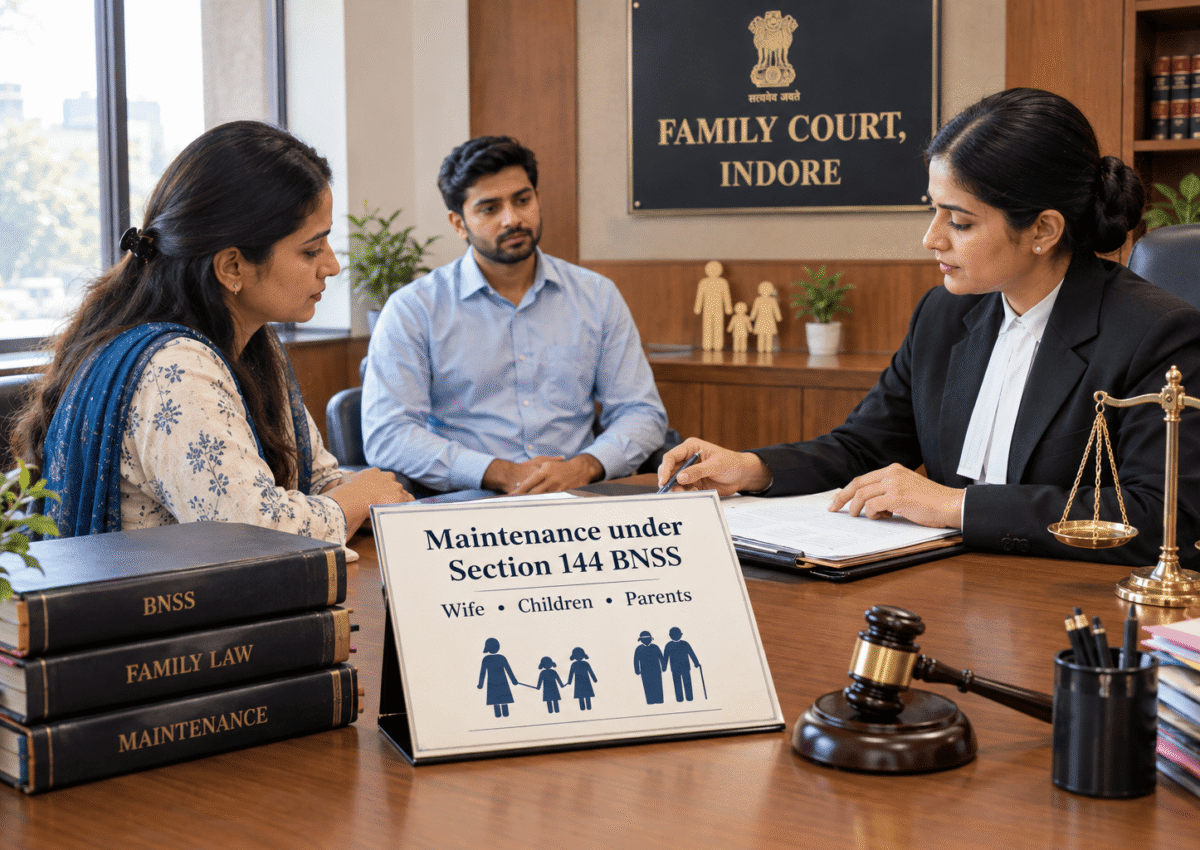
How Can I Prove My Husband’s Actual Income in a Maintenance Case Before Family Court Indore?
One of the most difficult issues faced by a wife in a maintenance proceeding is proving the actual income and financial capacity of her husband.
The problem is particularly serious when the husband is a businessman, self-employed professional, property dealer, contractor, trader, consultant, partner in a firm, director of a company, or otherwise receives income from several sources.
A salaried husband may have a salary slip and Form 16. A businessman, however, may have several businesses, multiple bank accounts, cash transactions, investments, properties and other financial resources. He may disclose only his declared taxable income and claim that he has very little money available for maintenance.
The wife may know that her husband earns substantially more, but simply saying before the Family Court, Indore that “my husband earns a lot” is usually not enough.
The real question is:
How can a wife place sufficient material before Family Court, Indore to enable the Court to determine the husband’s real income and financial capacity?
The answer lies in a combination of financial disclosure, documentary evidence, cross-examination, business records, bank records, property information, lifestyle evidence, previous financial statements and contradictions in the husband’s own disclosures.
1. Why proving the husband’s actual income is important
Under Section 144 of the Bharatiya Nagarik Suraksha Sanhita, 2023, maintenance can be ordered where a person having sufficient means neglects or refuses to maintain his wife, child, father or mother in circumstances covered by the provision. The provision also permits interim maintenance and expenses of proceedings during the pendency of the case.
Therefore, the husband’s financial capacity is a fundamental consideration in determining maintenance.
If a husband genuinely earns ₹50,000 per month, the Court will consider his financial circumstances on that basis.
But if he actually has substantial business income and deliberately discloses only ₹30,000 or ₹40,000 per month, the wife should have an opportunity to demonstrate the discrepancy.
The Supreme Court in Rajnesh v. Neha emphasized the importance of disclosure of assets, income, expenditure and liabilities in maintenance proceedings. The prescribed disclosure framework requires parties to provide detailed financial information rather than merely stating a monthly income figure.
The Supreme Court continues to direct parties in current proceedings to file affidavits of assets and income in accordance with Rajnesh v. Neha. A July 2026 Supreme Court office report records such a direction requiring disclosure of assets and income both in India and abroad.
2. You do not necessarily have to know the exact income before filing the case
This is an important practical point.
A wife may say:
“I don’t know exactly how much my husband earns because he controls the business and finances.”
That does not necessarily mean that she cannot claim maintenance.
A wife may have sufficient information to show that the husband’s financial disclosure requires examination even if she does not know his precise monthly income.
For example, she may know that:
- he operates a business;
- he owns commercial property;
- he has several vehicles;
- he runs a factory;
- he is a partner in a firm;
- he has multiple bank accounts;
- he regularly undertakes substantial business transactions;
- he maintains an expensive lifestyle;
- he has substantial investments.
She can place those facts before the Court and seek appropriate financial disclosure.
The purpose of the proceedings is not to require the wife to possess the husband’s complete accounting records before she can seek maintenance.
3. The husband’s affidavit of assets, income, expenditure and liabilities is extremely important
The first document that should be carefully examined is the husband’s financial disclosure.
The Rajnesh v. Neha framework requires disclosure of financial information concerning:
- income;
- employment/business;
- assets;
- liabilities;
- expenditure;
- bank accounts;
- investments;
- properties;
- vehicles;
- financial interests;
- other relevant financial circumstances.
The prescribed affidavit also contains a declaration that the deponent has made a full and accurate disclosure and an undertaking to inform the Court about material changes in employment, assets, income and expenses.
Therefore, when the husband files his affidavit before Family Court, Indore, the wife should not merely read the figure appearing under “monthly income”.
She should audit the affidavit from the litigation point of view.
4. Compare the husband’s income with his lifestyle
Suppose the husband states:
“My monthly income is ₹35,000.”
But the evidence shows that he:
- owns a luxury vehicle;
- lives in an expensive house;
- operates a substantial business;
- pays substantial school fees for children;
- frequently travels;
- owns commercial property;
- maintains several vehicles;
- makes substantial investments.
The wife should identify these discrepancies.
Lifestyle alone may not establish an exact income.
But lifestyle can become important corroborative evidence when considered with business records, property ownership, expenditure and other financial information.
The proper argument is not:
“He drives an expensive car, therefore he earns ₹5 lakh per month.”
Instead:
“The income disclosed by the husband appears inconsistent with his known assets, business activities, expenditure and standard of living, and therefore complete financial disclosure and examination of the relevant records are necessary.”
That is a much stronger legal approach.
5. Find out whether the husband is salaried, self-employed or a businessman
The method of proving income depends heavily upon the husband’s occupation.
Salaried husband
Look for:
- salary slips;
- Form 16;
- employment letter;
- bank credits;
- employer information;
- annual compensation;
- bonus;
- incentives;
- commissions;
- allowances;
- benefits.
Businessman
Look for:
- GST records;
- ITRs;
- balance sheets;
- profit and loss accounts;
- bank accounts;
- business registration;
- invoices;
- business premises;
- partnership documents;
- company records;
- business assets;
- withdrawals;
- remuneration;
- dividends.
Professional
For a doctor, lawyer, consultant, architect, engineer or other professional, relevant evidence may include:
- clinic/office;
- professional establishment;
- professional registration;
- clients;
- professional advertisements;
- bank receipts;
- consultation fees;
- invoices;
- business accounts;
- professional assets;
- publicly available professional information.
Property dealer/investor
Look at:
- properties;
- transactions;
- brokerage;
- development activity;
- rental income;
- capital gains;
- bank transactions;
- business entities.
The evidence should be tailored to the occupation.
6. Income Tax Returns are important—but they are not always the whole story
A husband may produce his Income Tax Returns and say:
“This proves that my income is only ₹5 lakh per year.”
The wife should examine what exactly the ITR establishes.
Taxable income and overall financial capacity are not necessarily identical concepts.
A businessman may have:
- business expenses;
- depreciation;
- deductions;
- interest expenses;
- other accounting adjustments.
Therefore, an ITR is an important document but should be considered along with the complete financial picture.
The wife should not simply ask the Court to ignore the ITR.
Instead, she should identify evidence showing why the disclosed taxable income does not adequately explain the husband’s:
- assets;
- business activity;
- expenditure;
- bank transactions;
- lifestyle;
- investments;
- other financial resources.
7. GST records can be particularly useful in business cases
If the husband operates a GST-registered business, GST records may provide useful information about the scale of business activity.
They may help establish:
- existence of business;
- nature of business;
- business turnover;
- continuing business activity;
- transactions with customers/suppliers.
But there is an important legal distinction:
Turnover is not the same thing as personal income.
For example, if a business has a turnover of ₹2 crore, it does not automatically mean that the husband personally earns ₹2 crore.
The business may incur substantial legitimate expenses.
Therefore, GST information should generally be used to establish the scale and continuity of business activity, followed by examination of profit, remuneration, withdrawals, assets and other financial benefits.
8. Examine the husband’s bank accounts
Bank transactions can sometimes provide a much clearer picture than a bare statement of income.
Depending upon the facts and appropriate directions of the Court, relevant bank records may help establish:
- salary credits;
- business receipts;
- transfers;
- investments;
- rent;
- loan repayments;
- large purchases;
- recurring payments;
- transfers to family members;
- unexplained deposits.
The wife should identify specific bank accounts wherever possible.
If the husband says:
“I have only one savings account.”
but evidence suggests that he operates a business through several accounts, the discrepancy should be brought to the Court’s attention.
9. Ask for disclosure of all sources of income
A common mistake is to focus only on the husband’s principal business.
A husband may have income from several sources:
- business;
- salary;
- consultancy;
- commission;
- rent;
- interest;
- dividends;
- investments;
- agriculture;
- professional practice;
- online business;
- partnership;
- company remuneration.
The Rajnesh v. Neha disclosure framework is designed to obtain a fuller picture of financial circumstances rather than reducing the inquiry to one monthly salary figure.
Therefore, the wife should specifically examine whether the husband has disclosed all sources.
10. Check whether the husband owns properties
Property ownership may be relevant in assessing financial capacity.
The wife should identify, where lawfully available:
- residential properties;
- commercial properties;
- agricultural land;
- plots;
- flats;
- shops;
- offices;
- warehouses;
- properties jointly held;
- rental properties.
The existence of property does not automatically establish a particular monthly income.
However, it can be relevant to:
- financial resources;
- rental income;
- standard of living;
- credibility of the husband’s financial disclosure;
- overall economic circumstances.
11. Check rental income separately
A husband may disclose income from business but omit rental income.
For example, he may own:
- two shops;
- an office;
- several flats;
- commercial premises.
If those properties are rented, rental receipts can form a significant additional source of income.
The wife should therefore specifically ask:
“What immovable properties does the husband own, and do any of them generate rental income?”
12. Check vehicles and other valuable assets
Vehicles are not income by themselves.
Nevertheless, they can provide useful evidence concerning financial circumstances.
For example, the husband may claim:
“I have no substantial income.”
while owning:
- luxury cars;
- commercial vehicles;
- multiple motorcycles;
- business vehicles.
The wife should use such information carefully as corroborative evidence rather than treating the vehicle’s value as the husband’s monthly income.
13. Look at the husband’s previous income
Previous income can be extremely important.
Suppose the husband was earning ₹2 lakh per month before matrimonial disputes arose.
After the wife files a maintenance case, he suddenly claims:
“I earn ₹25,000 per month.”
The wife should examine:
- previous employment;
- previous business;
- earlier ITRs;
- previous salary;
- previous bank statements;
- previous financial disclosures;
- lifestyle;
- business advertisements;
- documents filed in earlier proceedings.
A sudden and unexplained fall in income can be a relevant factual circumstance.
It does not automatically prove concealment, but it may require explanation.
14. Compare statements made in different court proceedings
This can be a powerful method of testing credibility.
Suppose the husband stated in one proceeding:
“I am running a business with an annual turnover of ₹1 crore.”
But in the maintenance case he states:
“I am unemployed and have no income.”
The wife should place both statements before the Court.
Similarly, contradictions may arise between:
- divorce proceedings;
- maintenance proceedings;
- domestic violence proceedings;
- property proceedings;
- loan documents;
- business documents;
- tax documents.
A party’s own previous statement may become important evidence when compared with the present disclosure.
15. What if the husband claims that his business belongs to his father or brother?
This is common in family businesses.
The wife should not automatically assume that every family business is the husband’s income.
Instead, establish facts such as:
- Who operates the business?
- Who manages employees?
- Who deals with customers?
- Who signs documents?
- Who receives money?
- Who owns the business premises?
- What is the husband’s role?
- Does he receive remuneration?
- Does he receive profits?
- Does he have a partnership interest?
- Is the business actually controlled by him?
If the husband is genuinely not the owner and does not receive income from the business, that fact will have to be considered.
But if the evidence shows that he actually operates the business and derives financial benefit from it, the wife should place that evidence before the Court.
16. What if the husband is a director of a company?
Being a director does not automatically mean that the husband’s income equals the company’s turnover.
The wife should distinguish between:
- company turnover;
- company profit;
- director’s salary;
- remuneration;
- dividends;
- shareholding;
- benefits;
- loans/advances;
- personal assets.
The objective is to establish the husband’s personal financial benefit and financial capacity, not simply the company’s gross revenue.
17. Can the Court ask for bank statements and other documents?
Appropriate disclosure or production of relevant documents can be sought where those records are material to determining income and financial capacity.
The Supreme Court itself has, in maintenance-related proceedings, directed production of financial material such as bank statements, income-tax returns and property details.
Therefore, where a husband claims an unusually low income, the wife can seek appropriate directions concerning relevant financial records.
The request should be specific and justified.
For example:
“The husband has disclosed that he is carrying on business through ______. The relevant bank and business records are necessary to verify the income disclosed by him.”
This is preferable to an unnecessarily broad demand for every financial document in existence.
18. What if the husband does not disclose his exact income?
This can become important.
In Rajnesh v. Neha, the Supreme Court recognized that where the husband does not disclose the exact amount of his income, the Court may draw an adverse inference in appropriate circumstances. The judgment also emphasizes that the husband must establish, with necessary material, genuine reasons for inability to discharge his maintenance obligation.
Therefore, if the husband provides an incomplete or evasive disclosure, the wife should place the specific deficiencies before the Court.
She should create a clear record of:
- what was disclosed;
- what was omitted;
- what evidence contradicts the disclosure;
- why the omitted information is relevant; and
- what direction is being requested from the Court.
19. Can an able-bodied husband claim that he has no income?
A husband can plead genuine unemployment or financial difficulty.
But a bare statement of “no income” does not necessarily resolve the matter.
In Shamima Farooqui v. Shahid Khan, the Supreme Court dealt with the position of an able-bodied husband and emphasized that an able-bodied person cannot simply avoid the obligation of maintenance by asserting an inability to earn without cogent explanation.
Therefore, where the husband is:
- educated;
- professionally qualified;
- experienced;
- physically capable;
- previously earning;
- running or capable of running a business,
the wife can place those circumstances before the Court.
However, this does not mean that the Court automatically treats an unemployed husband as earning any arbitrary amount.
Genuine circumstances must be considered.
20. What evidence can a wife herself produce?
A wife can produce documents lawfully in her possession.
For example:
- husband’s salary slips previously given to her;
- bank documents;
- business cards;
- invoices;
- business correspondence;
- property documents;
- photographs of business premises;
- publicly available business information;
- previous financial statements;
- documents filed by the husband elsewhere;
- information concerning vehicles;
- information concerning investments;
- communications showing business activities.
The wife should maintain the original documents wherever possible and explain their source and relevance.
21. Can social-media and website information help?
Yes, particularly where the husband publicly represents himself as:
- businessman;
- company director;
- proprietor;
- property developer;
- consultant;
- professional.
For example, the husband’s own website may state:
“Founder and Managing Director of XYZ.”
A professional profile may state:
“Successfully running XYZ business since 2015.”
Such material may help establish the nature of his professional/business activities.
But online information should generally be treated as supporting evidence, and wherever possible it should be corroborated by more reliable financial or official records.
22. What if the husband maintains an expensive lifestyle?
This may be relevant, particularly when combined with other evidence.
Consider a husband who claims:
Income: ₹30,000 per month.
But evidence shows:
- luxury vehicle;
- expensive residence;
- substantial children’s expenses;
- frequent air travel;
- foreign holidays;
- expensive memberships;
- multiple properties.
The wife can place these facts before the Court.
The Court may then examine whether the financial disclosure is consistent with the surrounding circumstances.
Again, the correct approach is cumulative evidence, not a single lifestyle photograph.
23. What if the husband deliberately transferred his assets?
The wife should examine the timing.
For example:
Before separation:
Husband owns property and operates a profitable business.
After maintenance dispute begins:
Property transferred to brother.
After filing of maintenance case:
Husband claims he has no assets.
Such chronology can be important.
The wife should collect the relevant documentary material and request the Court to consider the circumstances.
The mere fact that an asset is transferred does not automatically prove fraudulent concealment, but suspicious or unexplained transactions can warrant closer examination.
24. Can the wife ask the Court to draw an adverse inference?
Where relevant financial information is withheld despite appropriate directions and the circumstances justify it, the wife can request the Court to draw an appropriate adverse inference.
The strongest approach is to show:
Disclosure required → disclosure made → specific omission → evidence of omission → relevance of omitted information → request for appropriate consequence.
This is much more effective than simply stating:
“The husband is lying.”
25. What if the husband produces a very low ITR?
Do not immediately argue that the ITR is false.
Instead, compare it with:
- business activity;
- GST records;
- assets;
- bank transactions;
- properties;
- previous ITRs;
- expenditure;
- lifestyle;
- business premises;
- vehicles;
- investments.
For example:
Husband’s disclosed annual income: ₹4 lakh.
But:
Commercial property + multiple vehicles + substantial business + significant bank transactions + high business activity.
The wife can then argue that the disclosed income requires examination in the context of the complete financial circumstances.
26. How should the wife cross-examine the husband?
Cross-examination should be specific rather than argumentative.
Instead of asking:
“You are a rich businessman, aren’t you?”
ask questions such as:
“You are carrying on business under the name ______, correct?”
“The business premises are situated at ______?”
“You are associated with the said business since ______?”
“You have disclosed an income of ₹_____ in your affidavit?”
“You have not disclosed ______ in your affidavit?”
“You have not disclosed the bank account operated for ______ business?”
“You own/use vehicle bearing registration number ______?”
“You have not disclosed rental income from ______ property?”
Each admission can become part of the financial picture.
27. Prepare a financial contradiction chart
This is one of the most practical tools for a maintenance case.
For example:
| Financial issue | Husband’s disclosure | Evidence available | Issue |
|---|---|---|---|
| Monthly income | ₹40,000 | Business records | Income appears understated |
| Business | XYZ Traders | GST/business material | Substantial activity |
| Property | 1 house | 2 commercial properties | Incomplete disclosure |
| Vehicles | 1 vehicle | 3 vehicles | Requires explanation |
| Bank accounts | 1 | Evidence of other accounts | Disclosure issue |
| Rental income | Nil | Commercial premises | Requires examination |
| Previous income | ₹50,000 | Earlier records ₹1.5 lakh | Contradiction |
Such a chart allows the Court to see the financial dispute quickly.
28. What if the husband is earning cash?
Cash income can be more difficult to establish.
The wife should therefore focus on circumstantial and documentary evidence.
For example:
- nature of business;
- scale of operations;
- employees;
- premises;
- customers;
- purchases;
- sales;
- advertisements;
- bank deposits;
- assets;
- previous income;
- business expansion;
- lifestyle.
The allegation should be supported by facts rather than simply saying:
“He earns cash.”
29. What if the husband says that his business is running at a loss?
Ask:
- How long has the business been running at a loss?
- What is the turnover?
- What are the expenses?
- What are the assets?
- What happened to previous profits?
- Are there other businesses?
- Has the business recently been transferred?
- Is he still operating the business?
- What do the GST/ITR/bank records show?
A genuine business loss should be considered.
But a bare assertion of loss should not necessarily be accepted without examination where contradictory evidence exists.
30. What if the husband has stopped working deliberately?
This issue overlaps with earning capacity.
If an able-bodied husband who was previously earning substantially suddenly stops working after matrimonial litigation begins, the wife should establish:
- his previous occupation;
- previous income;
- qualifications;
- business experience;
- reason for leaving;
- timing of cessation;
- present capacity to earn;
- assets and lifestyle.
The Supreme Court has emphasized that an able-bodied husband cannot simply rely upon an unsupported plea of inability to earn.
But again, the Court must distinguish deliberate unemployment from genuine circumstances beyond the husband’s control.
31. Can the wife’s own income affect the case?
Yes, the wife’s financial position can be relevant to the determination of maintenance.
But the existence of some income does not automatically mean that she is disentitled to maintenance.
The Court may consider:
- wife’s actual income;
- her reasonable needs;
- husband’s financial capacity;
- standard of living;
- children’s expenses;
- liabilities;
- other circumstances.
Therefore, the wife should also make truthful financial disclosure.
A credible and transparent financial case is generally stronger than one in which either party conceals material information.
32. Can the wife seek interim maintenance before the actual income is finally determined?
Yes.
Section 144 BNSS expressly permits interim maintenance during the pendency of the proceeding, along with reasonable expenses of the proceeding. It also states that such application should, as far as possible, be disposed of within sixty days from service of notice.
Therefore, the wife need not necessarily wait until the entire maintenance proceeding reaches final evidence before seeking interim relief.
Where there is an income dispute, the wife should place the available evidence before the Court at the interim stage itself.
33. What if the husband lives outside Indore?
The husband’s residence or business outside Indore does not by itself prevent a maintenance proceeding from being heard in Family Court, Indore where the statutory territorial jurisdiction requirements are satisfied.
Section 145 BNSS provides alternative territorial bases for proceedings under Section 144, including the district where the husband or wife resides and the place where the husband last resided with his wife, subject to the statutory requirements.
Thus, the wife should separately establish:
- jurisdiction of Family Court, Indore; and
- husband’s actual income/financial capacity.
The two questions should not be confused.
34. What if the husband is working abroad?
The same financial-disclosure principles become even more important.
The Rajnesh v. Neha disclosure framework specifically contains provisions concerning parties living abroad, including foreign employment, foreign-currency income, foreign expenditure and other financial information.
Therefore, if the husband is employed or conducting business abroad, the wife should identify:
- country of employment;
- employer/business;
- salary or remuneration;
- foreign bank accounts;
- foreign property;
- foreign investments;
- Indian income;
- remittances;
- lifestyle.
35. A practical strategy for proving actual income before Family Court, Indore
For a wife, I would generally recommend the following sequence.
Step 1: Determine the husband’s occupation
Is he:
- salaried;
- businessman;
- self-employed;
- professional;
- property dealer;
- partner;
- director;
- contractor?
Step 2: Identify every known source of income
Prepare a list.
Step 3: Obtain and scrutinize his financial affidavit
Look beyond the monthly income figure.
Step 4: Compare his disclosure with known facts
Look at:
- properties;
- vehicles;
- business;
- bank accounts;
- expenditure;
- investments;
- lifestyle.
Step 5: Collect documents already available with you
Do not rely solely upon oral allegations.
Step 6: Identify specific documents that are missing
Ask for relevant disclosure/production.
Step 7: File an appropriate application
Seek directions for clarification, disclosure and production of relevant financial material, depending upon the facts and procedural stage.
Step 8: Cross-examine on specific financial facts
Build admissions one by one.
Step 9: Demonstrate contradictions
Prepare a concise comparative chart.
Step 10: Ask the Court to assess the complete financial capacity
The ultimate objective is not to prove an arbitrary income figure.
It is to enable the Court to determine a fair maintenance amount on the basis of the husband’s actual financial circumstances and capacity.
36. Documents that may be relevant in a business-income case
Depending upon the facts, the following checklist may be useful:
Business documents
- GST registration;
- GST returns;
- business registration;
- partnership deed;
- company records;
- invoices;
- bills;
- balance sheets;
- profit and loss statements;
- audited accounts.
Tax documents
- ITRs;
- computation of income;
- tax audit reports;
- relevant financial statements.
Banking documents
- savings account statements;
- current account statements;
- business account statements;
- investment account statements;
- loan accounts.
Property documents
- sale deeds;
- ownership records;
- property details;
- rent agreements;
- rental receipts.
Vehicle information
- registration details;
- ownership;
- commercial vehicles;
- business vehicles.
Other evidence
- business website;
- advertisements;
- professional profiles;
- business cards;
- photographs;
- documents filed in other litigation;
- previous financial disclosures.
Not every document will be necessary in every case. The documents should be selected according to the particular factual dispute.
37. What should a wife say in her maintenance petition?
A wife should avoid a vague statement such as:
“My husband earns very well.”
A more useful pleading would identify the business and the basis of knowledge.
For example:
“The respondent is carrying on business under the name and style of ______ at ______ and is financially well established. The respondent has substantial business activities, assets and other financial resources. The petitioner, during the subsistence of the matrimonial relationship, was aware of the respondent’s business activities and financial position. However, the respondent has not made complete disclosure of his actual income and financial resources. The income disclosed by the respondent is inconsistent with his business activities, assets, expenditure and standard of living. The petitioner therefore prays that the respondent be directed to make complete disclosure of his income, assets, expenditure and liabilities and that the relevant financial records be produced as may be necessary for determination of the respondent’s actual financial capacity.”
The pleading should always be modified according to the evidence actually available.
38. Do not confuse “income” with “financial capacity”
This is perhaps the most important concept in these cases.
The husband may have:
- low taxable income;
- substantial assets;
- business interests;
- rental properties;
- investments;
- earning capacity;
- financial support from business;
- other resources.
The Court’s inquiry is not necessarily reduced to one isolated monthly number.
The complete financial circumstances of the parties are relevant.
39. What if the husband refuses to cooperate with financial disclosure?
The wife should place the non-compliance before the Family Court and seek appropriate directions.
The Supreme Court’s continuing use of the Rajnesh v. Neha framework demonstrates the importance attached to financial disclosure in maintenance proceedings.
The wife should preserve a clear record of every deficiency rather than repeatedly making general allegations.
40. Can the Court determine income on the basis of available evidence if exact income is difficult to prove?
The difficulty of establishing an exact figure does not mean that the Court must accept an obviously unreliable disclosure without examination.
Where a party fails to provide adequate financial information, and the circumstances justify it, the Court may consider the available evidence and draw appropriate conclusions.
The Supreme Court has recognized that non-disclosure of exact income can justify an adverse inference in an appropriate case.
Therefore, the wife should concentrate on proving the financial circumstances from which the Court can reasonably assess the husband’s capacity, rather than believing that she must produce a perfect monthly income calculation herself.
41. Frequently Asked Questions
Can I prove my husband’s income without having his bank statements?
Yes. Bank statements are useful but not the only form of evidence. Business records, tax records, property information, previous disclosures, employment records, lifestyle evidence and other material may also be relevant.
My husband is a businessman. How can I prove his income?
Identify his businesses and seek appropriate financial disclosure. GST records, ITRs, business accounts, bank records, property details, business documents and previous financial records may all become relevant depending on the facts.
Can I rely only on his ITR?
You can rely on it, but the Court may consider the complete financial circumstances. If the ITR appears inconsistent with the husband’s assets, business activities or expenditure, place the specific discrepancies before the Court.
Does business turnover equal income?
No. Turnover and net income/profit are different concepts. Turnover may nevertheless be useful evidence concerning the scale of business activity.
What if my husband says the business belongs to his father?
You should establish whether the husband actually receives income from or controls the business. Nominal ownership and actual financial benefit may need to be distinguished.
Can I ask for his bank statements?
You can seek appropriate directions for disclosure or production where the records are relevant to the income dispute.
Can I use evidence from another case where my husband disclosed higher income?
Yes. If the document or statement is genuine and relevant, it can be important evidence of a financial inconsistency.
What if my husband deliberately stops working?
The Court can consider the circumstances surrounding the cessation of employment/business. An able-bodied husband cannot ordinarily defeat maintenance merely by making an unsupported assertion that he has no income, although genuine inability must be considered.
Do I have to know my husband’s exact income before filing maintenance?
No. A wife may not know the exact income, particularly where the husband controls the finances. The important thing is to provide the Court with the available facts and seek appropriate disclosure.
Can I get interim maintenance while the income dispute is pending?
Yes. Section 144 BNSS provides for interim maintenance during pendency, subject to the statutory requirements.
Can maintenance be awarded from the date of filing?
Section 144 BNSS permits the Court to direct that maintenance/interim maintenance be payable from the date of the application.
42. Final practical advice
If your husband has not disclosed his actual income, do not make your entire maintenance case dependent upon the statement:
“He earns ₹_____ per month.”
Instead, build the case systematically.
Show:
Who he is → what he does → what businesses he operates → what assets he owns → what income he has disclosed → what he has failed to disclose → what evidence contradicts him → what documents can establish the truth.
The strongest maintenance cases are generally not based upon allegations alone. They are based upon documentary evidence, financial inconsistencies, specific pleadings and a systematic challenge to incomplete disclosure.
For a wife appearing before Family Court, Indore, the Rajnesh v. Neha financial-disclosure framework is particularly important. The Supreme Court has continued to direct parties in current proceedings to file affidavits of assets and income under that framework.
If the husband is a businessman or self-employed person, the wife should therefore focus on obtaining a complete financial picture, rather than merely trying to guess his monthly income.
The ultimate objective is to enable Family Court, Indore to determine maintenance on the basis of the husband’s real financial circumstances, resources and capacity, while also considering the wife’s financial position, reasonable needs and all other relevant circumstances.
Disclaimer: This information is intended for general guidance only and does not constitute legal advice. Please consult with a qualified lawyer for personalized advice specific to your situation.
Advocate J.S. Rohilla (Civil & Criminal Lawyer in Indore)
Contact: 88271 22304
