
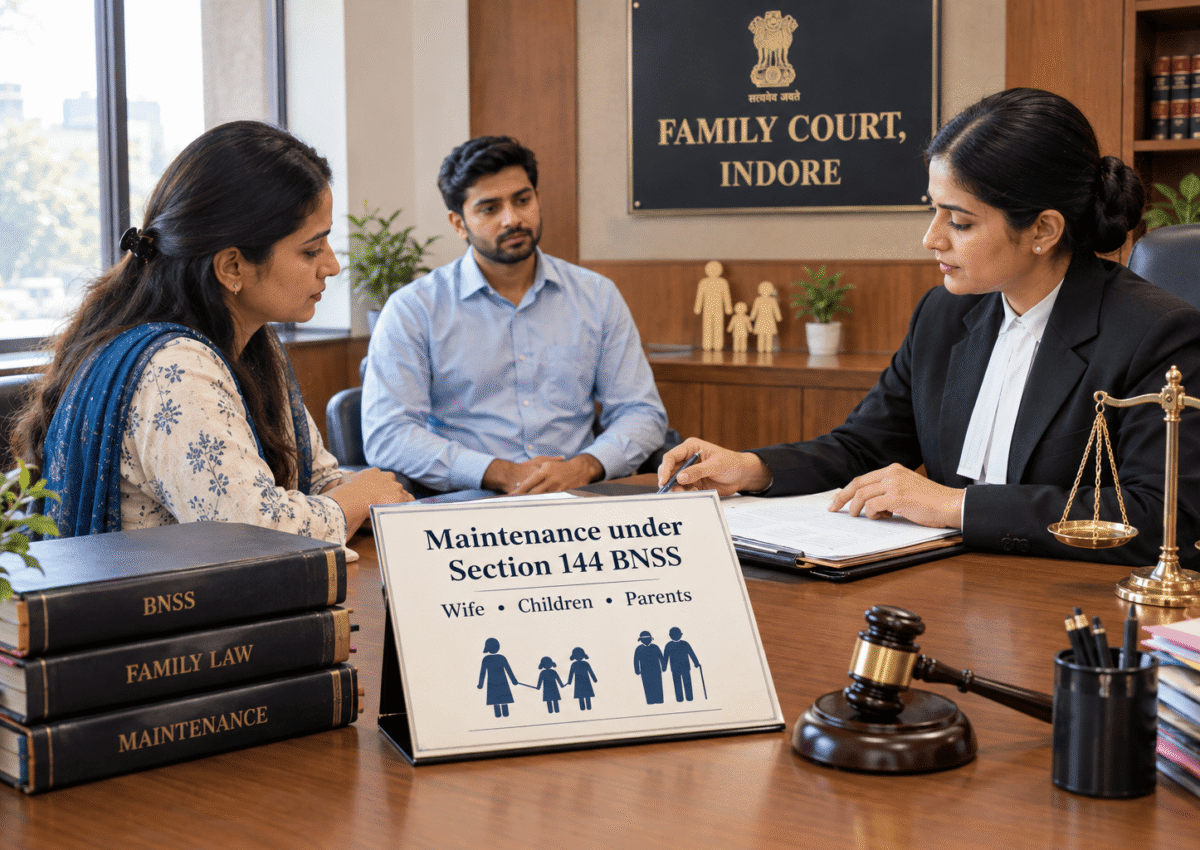
Can an Educated Wife Claim Maintenance if She Is Not Presently Employed?
Yes. An educated wife can claim maintenance from her husband even if she is presently unemployed.
The fact that a wife possesses a degree, professional qualification, technical education or previous work experience does not, by itself, mean that she has sufficient means to maintain herself.
In a maintenance proceeding before the Family Court, Indore, the Court is required to examine the actual financial circumstances of both spouses. The wife’s education and earning capacity may be relevant factors, but they cannot automatically be treated as proof that she has sufficient income to support herself.
The Supreme Court in Rajnesh v. Neha specifically recognised that the fact that a wife is educated or capable of supporting herself is not, by itself, an answer to a claim for maintenance. The Court has to consider the factual circumstances, the wife’s independent income, her reasonable needs and the husband’s financial capacity.
1. Can an educated wife claim maintenance under Section 144 BNSS?
Yes, subject to fulfilment of the statutory requirements.
Section 144 BNSS provides for maintenance of a wife who is unable to maintain herself where her husband, having sufficient means, neglects or refuses to maintain her. The provision also permits interim maintenance and reasonable expenses of proceedings.
Therefore, the basic questions are not simply:
“Is the wife educated?”
or
“Does the wife have a degree?”
The more relevant questions are:
- Is she presently earning?
- Does she have sufficient independent income?
- What are her reasonable monthly requirements?
- What is the husband’s actual financial capacity?
- Has the husband neglected or refused to maintain her?
- What is the standard of living of the parties?
- What are the respective assets and liabilities of the parties?
- Are there children whose expenses also have to be considered?
2. Is being educated the same as being financially independent?
No.
This is one of the most important distinctions in maintenance litigation.
A woman may be:
- highly educated;
- professionally qualified;
- a graduate;
- a postgraduate;
- an engineer;
- a lawyer;
- an MBA;
- a doctor;
- a teacher; or
- previously employed,
and nevertheless be presently without sufficient income to maintain herself.
Education establishes qualification. It does not necessarily establish present income.
For example, a wife may have an MBA but presently have no employment. Another woman may be an engineer who left employment after marriage. A professionally qualified woman may have stopped working because of pregnancy, childcare, relocation, family responsibilities or circumstances arising from the matrimonial relationship.
The Court must examine the actual circumstances rather than treating educational qualification as equivalent to a salary.
3. What did the Supreme Court say in Rajnesh v. Neha?
The Supreme Court’s decision in Rajnesh v. Neha is particularly important in maintenance cases.
While discussing the criteria for determining maintenance, the Court identified several relevant factors, including:
- the status of the parties;
- reasonable needs of the wife and dependent children;
- whether the applicant is educated and professionally qualified;
- whether she has an independent source of income;
- whether that income is sufficient to maintain the same standard of living as in the matrimonial home;
- whether she was employed before marriage;
- whether she worked during the marriage; and
- whether she sacrificed employment opportunities for family responsibilities and child-rearing.
Importantly, the Supreme Court stated that merely being educated and capable of supporting herself is not, by itself, an answer to a maintenance claim.
This principle is highly relevant when an educated but unemployed wife approaches the Family Court, Indore.
4. Can the husband argue that the wife is educated and therefore she should get a job?
The husband can certainly raise this contention.
However, the argument does not automatically defeat the maintenance claim.
The Court may examine whether the wife:
- is actually earning;
- has any independent source of income;
- recently left employment;
- was working before marriage;
- stopped working after marriage;
- sacrificed employment opportunities for family responsibilities;
- has children requiring care;
- has health or other genuine limitations;
- has been attempting to obtain employment;
- has professional qualifications that are presently usable; and
- has sufficient financial resources from other sources.
The issue is therefore not simply “Can she theoretically earn?”
The more important question is whether she presently has sufficient means to maintain herself in the circumstances of the case.
5. Does the wife have to prove that she is completely incapable of working?
Not necessarily.
This is an important practical distinction.
Section 144 BNSS is concerned with whether the wife is unable to maintain herself and whether the husband, having sufficient means, neglects or refuses to maintain her.
It does not create a simple rule that a wife must prove permanent physical incapacity to work before she can claim maintenance.
An educated woman may be physically capable of working but still have no present employment or sufficient income.
Her earning capacity can be considered as one factor, but it is not necessarily equivalent to actual income.
6. What if the wife resigned from her job after marriage?
This situation requires careful examination.
A husband may argue:
“She was earning before marriage. She voluntarily left her job. Therefore, she cannot now claim maintenance.”
That argument is not automatically conclusive.
The Court can examine why she left the employment.
For example:
- Did she leave because the husband required her to do so?
- Did she relocate because of the husband’s employment?
- Did she leave employment because of pregnancy?
- Did she have to take care of children?
- Did she have to care for elderly family members?
- Was she prevented from continuing employment?
- Did the matrimonial circumstances make continuation of employment difficult?
- Did she voluntarily resign without any compelling reason?
The Supreme Court in Rajnesh v. Neha specifically recognised the relevance of whether the wife sacrificed employment opportunities for nurturing the family, child-rearing and looking after family members.
Therefore, the circumstances surrounding cessation of employment can be highly relevant.
7. What if the wife has a professional degree but has never worked?
A professional qualification does not automatically establish independent income.
For example:
A wife is an MBA but has never been employed.
or:
A wife is an engineer but discontinued employment after marriage.
or:
A wife is professionally qualified but presently has no job.
In such cases, the Court may consider her qualifications and potential earning capacity while examining the overall circumstances, but it should not simply assume that she receives a salary when she does not.
The actual financial circumstances remain important.
8. Can the Court consider the wife’s earning capacity?
Yes.
This is where the distinction between earning capacity and actual income becomes important.
The Court may consider educational qualifications, professional experience and earning capacity as part of the overall assessment.
However:
Potential earning capacity ≠ actual income.
A court should not mechanically assume a particular monthly salary merely because the wife possesses a particular degree.
For example, an MBA does not automatically mean that the wife earns ₹1 lakh per month.
An engineering degree does not automatically establish a current salary.
A law degree does not establish that the wife is presently earning through legal practice.
The actual evidence and circumstances remain relevant.
9. What if the husband himself is highly educated and earns substantially more?
This can strengthen the wife’s case on quantum, depending upon the evidence.
The Court may compare:
- educational and professional status;
- actual income;
- earning capacity;
- assets;
- liabilities;
- standard of living;
- reasonable expenses; and
- financial responsibilities of each spouse.
The Supreme Court has repeatedly emphasised that maintenance must be determined after considering the financial circumstances of both parties rather than by applying a rigid formula.
10. Can an unemployed wife claim interim maintenance?
Yes, if the statutory requirements are satisfied.
Section 144 BNSS expressly provides for interim maintenance and reasonable expenses of proceedings.
This is particularly significant for a wife who has no present income and is dependent upon others for her day-to-day expenses.
The application for interim maintenance should clearly disclose:
- present employment status;
- absence of independent income;
- reasonable monthly expenditure;
- assets, if any;
- liabilities;
- children’s expenses, where applicable; and
- the husband’s financial position.
11. Does the wife’s parents’ financial position matter?
Ordinarily, the financial position of the wife’s parents is not a substitute for the husband’s legal responsibility.
The Supreme Court in Rajnesh v. Neha referred to the principle that the financial position of the parents of the applicant-wife is not ordinarily material for determining the quantum of maintenance.
Therefore, if an educated wife is staying with her parents because she presently has no income, the husband cannot simply argue:
“Her father is financially well-off, so he should maintain her.”
The matrimonial maintenance claim must be examined on its own legal and factual basis.
12. What if the wife is living with her parents in Indore?
This is a common situation in Family Court, Indore.
A wife may return to her parental home in Indore after matrimonial separation and have no present employment.
Her residence with her parents does not automatically mean that she is financially independent.
If the territorial jurisdictional requirements under Section 145 BNSS are satisfied, the proceeding may be instituted in the appropriate court having jurisdiction. Section 145 includes the district where the wife resides among the statutory jurisdictional bases.
The wife should nevertheless establish genuine residence where jurisdiction is disputed.
13. Can the husband say that the wife is deliberately unemployed?
He can raise such a defence, but it should be supported by facts and evidence.
For example, the husband may contend that the wife:
- voluntarily left a well-paying job;
- rejected suitable employment;
- has substantial professional income that she has not disclosed;
- runs a business;
- receives income from property; or
- is deliberately suppressing her actual financial resources.
The Family Court can examine such evidence.
However, a bare allegation that:
“She is educated and deliberately sitting at home”
should not by itself establish that she has sufficient means to maintain herself.
14. What if the wife previously earned a high salary?
This situation requires greater scrutiny.
Suppose the wife was earning ₹1,00,000 per month before separation but is currently unemployed.
The Court may naturally examine:
- why she stopped working;
- when she stopped working;
- whether she resigned voluntarily;
- whether she has received any settlement;
- whether she has savings or investments;
- whether she is capable of resuming employment;
- whether she has children requiring care;
- whether the husband contributed to her leaving employment; and
- whether she presently has any independent income.
Her previous salary can be relevant evidence, but it does not automatically mean that she presently has ₹1 lakh per month available to her.
15. What if the wife left employment because of childcare?
This can be particularly important.
A wife may have left employment to:
- give birth to a child;
- care for a young child;
- manage childcare;
- accompany the husband’s transfer;
- manage the household; or
- attend to family responsibilities.
The Supreme Court has expressly identified sacrifices of employment opportunities for family responsibilities and child-rearing as relevant considerations while determining maintenance.
The wife’s contribution to the family should therefore not be ignored merely because it did not generate a salary.
16. What if the wife is unemployed because the husband does not allow her to work?
This is a fact-sensitive issue.
If there is evidence that the husband:
- prohibited employment;
- forced her to resign;
- repeatedly prevented her from working;
- required her to remain at home;
- objected to her employment after marriage; or
- made continuation of employment practically impossible,
those facts may become relevant to the maintenance dispute.
The wife should plead specific facts rather than making a vague allegation.
For example:
“The petitioner was employed prior to marriage and continued her employment until ______. Thereafter, owing to the insistence and conduct of the respondent and the circumstances prevailing in the matrimonial home, she was compelled to discontinue her employment.”
The pleading should be supported by whatever documentary or other evidence is available.
17. What if the wife is educated but has no work experience?
The Court can still consider her education and potential earning capacity, but lack of work experience may also be relevant.
For example, a woman who possesses a degree but has never entered the workforce stands in a different factual position from a woman who was earning ₹2 lakh per month until immediately before filing the maintenance case.
The Court should examine the actual circumstances rather than applying a blanket rule to all educated women.
18. What documents should an unemployed wife produce?
A wife filing a maintenance case before Family Court, Indore should be prepared to disclose her financial circumstances honestly.
Useful documents may include:
- educational certificates;
- previous employment records;
- previous salary slips;
- bank statements;
- income-tax returns, if applicable;
- resignation letter;
- employment termination documents;
- rent documents;
- medical records;
- children’s school-fee documents;
- medical expenses;
- loan or liability documents;
- insurance expenses;
- evidence concerning assets; and
- other documents showing her actual financial requirements.
She should also comply with the applicable financial disclosure requirements.
The Supreme Court continues to apply the Rajnesh v. Neha framework requiring disclosure of assets and income in maintenance litigation. A 2026 Supreme Court matter, for example, records directions requiring the parties to file affidavits of assets and income in India and abroad in accordance with Rajnesh v. Neha.
19. Can an educated wife claim maintenance if she has some savings?
Possibly, depending upon the amount and overall circumstances.
The existence of a bank account or some savings does not automatically establish that the wife has sufficient means for her continuing maintenance.
The Court may examine:
- the amount of savings;
- whether they are sufficient for long-term support;
- whether they generate income;
- whether they were received as one-time amounts;
- whether they are being used for essential expenses; and
- the wife’s overall financial position.
Again, the issue is one of actual financial sufficiency.
20. What if the wife owns property?
Property ownership may be relevant, but ownership of property is not automatically equivalent to monthly income.
The Court can examine:
- whether the property is self-occupied;
- whether it generates rent;
- its actual income;
- whether it is jointly owned;
- whether it is inherited;
- whether it is subject to a loan;
- whether the wife has any beneficial interest; and
- the overall financial circumstances.
Therefore, a wife should disclose property honestly rather than assuming that ownership automatically destroys her maintenance claim.
21. What if the husband claims that the wife is capable of earning ₹50,000 per month?
The husband should ideally substantiate such an allegation.
For example, if he says that the wife can earn ₹50,000 because she has a particular qualification, the Court may examine:
- her actual professional experience;
- previous salary;
- employment history;
- current employment opportunities;
- age;
- location;
- family responsibilities;
- childcare;
- health;
- professional registration; and
- other relevant circumstances.
The Court should not necessarily equate a theoretical salary with actual monthly income.
22. Does the wife have to prove that she is completely helpless?
No.
The object of maintenance is not necessarily to reduce a person to complete destitution before assistance becomes available.
The Supreme Court in Rajnesh v. Neha explained that the purpose of maintenance is to prevent the dependent spouse from being reduced to destitution or vagrancy following the failure of the marriage.
Therefore, the case should be presented in terms of reasonable financial support, not merely extreme poverty.
23. What about the standard of living during marriage?
The standard of living of the parties is a relevant factor.
The Court may examine:
- type of residence;
- lifestyle;
- household expenditure;
- education;
- travel;
- medical facilities;
- social circumstances;
- husband’s income and assets; and
- other indicators of the matrimonial standard of living.
The Supreme Court has recognised the standard of living of the parties and their respective earning capacities as relevant factors in determining maintenance and financial support.
This does not mean that the wife is automatically entitled to replicate every luxury enjoyed by the husband. It means that the Court considers the overall matrimonial circumstances while determining reasonable support.
24. Can the wife claim litigation expenses also?
Yes, where legally permissible and on the facts of the case.
Section 144 BNSS expressly contemplates reasonable expenses of proceedings along with interim maintenance.
For an unemployed wife, litigation expenses can be particularly significant because she may have no independent income from which to meet:
- advocate’s fees;
- travel;
- documentation;
- court-related expenses; and
- other reasonable litigation costs.
25. Can maintenance be denied if the wife is highly educated?
Not merely because she is highly educated.
This is perhaps the central answer to the question.
The Court can consider her education and earning capacity, but it should also consider whether she actually has sufficient independent income.
A highly educated unemployed wife is not automatically treated as a woman earning a salary.
The Supreme Court’s decision in Rajnesh v. Neha makes this distinction particularly clear.
26. Practical examples
Example 1: MBA wife with no employment
The wife has an MBA but has not worked after marriage. The husband earns ₹2 lakh per month.
The wife can claim maintenance. Her MBA qualification may be relevant, but it does not establish that she has a present income of ₹2 lakh or any other particular amount.
Example 2: Wife left employment after childbirth
The wife was employed before the birth of the child and left employment to take care of the child.
Her decision to leave employment may be considered in the context of family and childcare responsibilities.
Example 3: Wife voluntarily resigned immediately before filing
The wife was earning ₹1.5 lakh per month, resigned shortly before filing the maintenance case without an apparent reason and has substantial professional experience.
The Court may scrutinise the circumstances much more closely and consider whether she has deliberately suppressed her earning capacity.
Example 4: Wife has no income but owns a house
The wife owns a residential property but receives no rent from it because she lives there.
The mere value of the house should not automatically be treated as monthly income.
Example 5: Wife is unemployed and has a minor child
The wife is unemployed and has the primary responsibility of caring for a minor child.
The child’s reasonable expenses and the wife’s financial requirements may both become relevant while determining appropriate support.
27. What should a wife specifically establish in her maintenance case?
A well-prepared maintenance case should establish five broad areas:
A. Present income
Clearly state:
- presently unemployed;
- no salary;
- no business income;
- no regular professional income;
- no sufficient independent source of income.
B. Reasonable expenditure
Provide a realistic monthly budget covering:
- accommodation;
- food;
- clothing;
- medical expenses;
- transportation;
- communication;
- personal expenses;
- insurance;
- children’s expenses; and
- other necessary expenditure.
C. Husband’s financial capacity
Place available information concerning:
- salary;
- business;
- profession;
- property;
- rental income;
- agricultural income;
- investments;
- lifestyle; and
- other financial resources.
D. Circumstances of unemployment
Explain:
- whether she worked before marriage;
- why she stopped working;
- whether she has children;
- whether she was required to leave employment;
- whether she was prevented from working; and
- her present employment circumstances.
E. Full financial disclosure
The wife should make a truthful disclosure of her own assets, liabilities and financial circumstances.
This is important because maintenance litigation increasingly focuses upon complete financial disclosure rather than unsupported allegations of income.
28. Suggested pleading for an educated but unemployed wife
Depending upon the facts of the particular case, the following pleading can be adapted:
“That the petitioner is an educated woman but is presently unemployed and has no regular independent source of income sufficient to maintain herself. The petitioner possesses educational qualifications; however, mere educational qualification does not constitute actual income or financial independence. The petitioner is presently dependent upon her family/limited personal resources for meeting her day-to-day expenses.
That the respondent is an able-bodied person having sufficient means and is earning substantially more than the petitioner. The respondent has sufficient financial capacity to maintain the petitioner but has neglected and/or refused to provide reasonable maintenance to her.
That the petitioner has made complete and truthful disclosure of her income, assets, liabilities and expenditure. The petitioner is presently unable to maintain herself according to the circumstances and standard of living enjoyed during the matrimonial relationship.
That the petitioner respectfully submits that her educational qualification or potential earning capacity cannot, by itself, be treated as equivalent to actual income sufficient for her maintenance. The respective financial circumstances, reasonable needs, earning capacities, assets, liabilities and standard of living of both parties may kindly be considered while determining the appropriate amount of maintenance.
That the petitioner therefore prays that appropriate interim and/or final maintenance and reasonable litigation expenses may kindly be awarded in accordance with law.”
29. What should an advocate check before filing such a case in Family Court, Indore?
Before filing, it is advisable to prepare a complete financial and factual assessment.
Wife’s side
Check:
- educational qualification;
- previous employment;
- last salary;
- date of resignation;
- reason for leaving employment;
- present income;
- bank accounts;
- property;
- investments;
- liabilities;
- monthly expenditure;
- children’s expenses;
- medical issues, if relevant;
- husband’s employment;
- husband’s business;
- husband’s properties;
- rental income;
- lifestyle;
- previous maintenance proceedings; and
- orders passed by other courts.
Husband’s side
If representing the husband, carefully examine:
- wife’s qualifications;
- previous employment;
- previous salary;
- current employment;
- professional practice;
- business interests;
- property;
- investments;
- undisclosed income;
- bank transactions, where legally obtainable;
- reasons for resignation;
- financial affidavit; and
- evidence contradicting the wife’s claim of having no income.
The case should be built around evidence rather than assumptions.
30. Important distinction: unemployed does not automatically mean maintenance is payable
It is equally important not to overstate the law.
An unemployed wife does not automatically receive maintenance merely because she is unemployed.
She still has to satisfy the applicable statutory requirements.
The Court may examine:
- whether she is legally entitled to maintenance;
- whether the husband has sufficient means;
- whether there is neglect or refusal to maintain;
- whether she is unable to maintain herself;
- whether any statutory disqualification applies;
- her own financial resources; and
- the overall circumstances.
Section 144 itself contains circumstances in which a wife may not be entitled to maintenance, including where she is living in adultery, refuses to live with her husband without sufficient reason, or the parties are living separately by mutual consent.
Therefore, every case must be decided on its own facts.
31. Family Court, Indore: practical approach
For a wife approaching the Family Court, Indore, the strongest presentation is generally not:
“I am educated but unemployed, therefore my husband must pay me.”
A better case is:
“I am presently unemployed and have no sufficient independent income. My educational qualification does not translate into present financial resources. I have disclosed my complete financial position. I have reasonable monthly requirements which I cannot presently meet from my own resources. The respondent has sufficient means and substantially greater financial capacity but has neglected/refused to maintain me.”
This places the actual legal and factual issue before the Court.
Conclusion
Yes, an educated wife who is presently unemployed can claim maintenance from her husband.
Education, professional qualification and potential earning capacity are relevant considerations, but they are not the same thing as actual independent income.
The Supreme Court’s decision in Rajnesh v. Neha makes it clear that the fact that a wife is educated or capable of earning is not, by itself, sufficient to reject a maintenance claim. The Court must consider her actual independent income, reasonable needs, matrimonial standard of living, employment history and the financial capacity of the husband.
For a maintenance case before Family Court, Indore, the wife’s case should therefore be based on a complete and truthful financial picture: her present income, assets, liabilities and expenditure on one side, and the husband’s actual income, assets, earning capacity and financial obligations on the other.
The key principle is simple:
Being educated may create earning capacity; it does not automatically establish present financial independence.
Disclaimer: This information is intended for general guidance only and does not constitute legal advice. Please consult with a qualified lawyer for personalized advice specific to your situation.
Advocate J.S. Rohilla (Civil & Criminal Lawyer in Indore)
Contact: 88271 22304
