
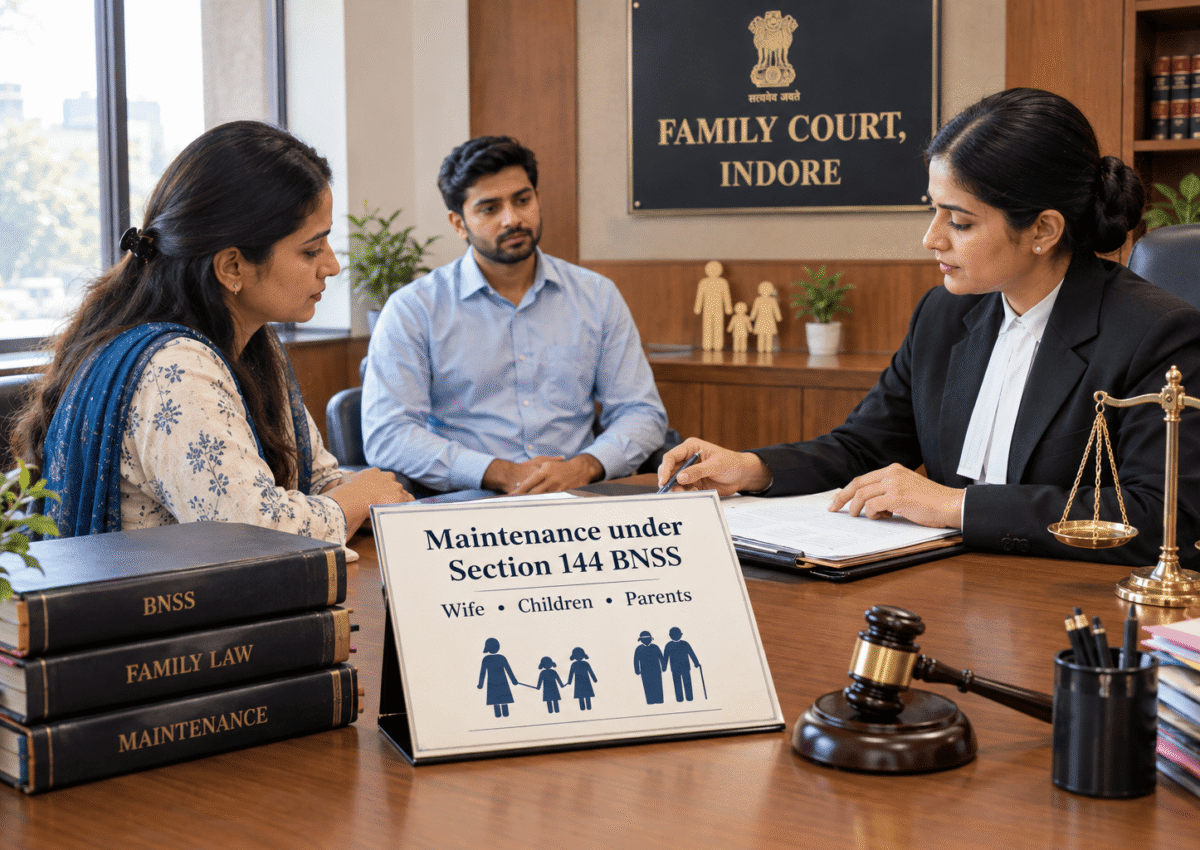
How Much Maintenance Can a Wife Get from Her Husband in Family Court Indore?
One of the most common questions asked by wives approaching the Family Court, Indore is:
“How much maintenance can I get from my husband?”
There is no fixed answer to this question.
Indian law does not prescribe a universal rule that a wife must receive a particular percentage—such as 25%, 30% or 50%—of her husband’s salary. The amount of maintenance depends upon the facts and financial circumstances of each case.
The Family Court, Indore may consider the husband’s actual income and financial capacity, the wife’s own income and assets, the reasonable needs of the wife and children, the standard of living enjoyed during the marriage, liabilities and dependants of both parties, and other relevant circumstances.
The Supreme Court’s landmark decision in Rajnesh v. Neha laid down detailed guidelines concerning determination of maintenance, financial disclosure, the date from which maintenance should ordinarily be awarded, and enforcement of maintenance orders.
Therefore, the correct question is not simply:
“What percentage of my husband’s salary will I get?”
The better question is:
“Considering the complete financial circumstances of both spouses, what amount is reasonably required and legally justified as maintenance?”
1. Is there a fixed percentage of the husband’s salary for maintenance?
No.
There is no universal statutory formula under which a wife automatically receives a fixed percentage of the husband’s salary.
For example, it would be incorrect to state as an absolute rule:
“The wife always gets 25% of the husband’s income.”
or:
“The wife is entitled to one-third of the husband’s salary.”
Such statements oversimplify maintenance law.
The Supreme Court has emphasised that maintenance must be determined after considering the relevant financial circumstances of the parties rather than through a rigid mathematical formula.
Two husbands earning ₹2 lakh per month may therefore face completely different maintenance orders depending upon:
- whether there are children;
- the wife’s own income;
- the husband’s other dependants;
- rental or business income;
- liabilities;
- medical expenses;
- the standard of living during marriage;
- assets;
- the wife’s reasonable needs; and
- other facts.
2. What is the basic legal principle under Section 144 BNSS?
Section 144 BNSS provides for maintenance of a wife who is unable to maintain herself where her husband, having sufficient means, neglects or refuses to maintain her.
The provision also permits the Court to grant interim maintenance and reasonable expenses of proceedings.
Therefore, while deciding a maintenance claim, the Court essentially has to examine questions such as:
- Is the applicant a wife within the meaning of the provision?
- Is she unable to maintain herself?
- Does the husband have sufficient means?
- Has he neglected or refused to maintain her?
- What is the reasonable amount required in the circumstances?
- What are the respective financial circumstances of both parties?
The amount cannot properly be determined by looking at the husband’s salary alone.
3. What factors does Family Court, Indore consider while determining maintenance?
The Court may consider several factors, including:
Wife’s financial position
- present salary;
- business income;
- professional income;
- rental income;
- investments;
- savings;
- property;
- other financial resources;
- liabilities; and
- reasonable monthly expenditure.
Husband’s financial position
- salary;
- business income;
- professional income;
- rental income;
- agricultural income;
- investments;
- properties;
- lifestyle;
- liabilities;
- other dependants; and
- other sources of financial resources.
Matrimonial circumstances
- standard of living during marriage;
- duration of marriage;
- lifestyle of the parties;
- age;
- health;
- children’s requirements;
- educational expenses;
- housing requirements; and
- other circumstances of the matrimonial relationship.
The Supreme Court has specifically recognised reasonable needs, earning capacity, educational and professional qualifications, independent income or property, family responsibilities and the husband’s financial capacity as relevant considerations.
4. Does the husband’s salary determine the amount of maintenance?
It is an important factor, but not the only factor.
Suppose a husband earns ₹2,00,000 per month.
That figure by itself does not tell the Court how much maintenance should be awarded.
The Court may want to know:
- Is ₹2 lakh gross or net income?
- Does he have income from other sources?
- Does he pay rent or home-loan instalments?
- Does he support aged parents?
- Does he have other children?
- Does he have medical expenses?
- Does he have business liabilities?
- Does he own property?
- Does the wife have independent income?
- Are there children?
- What are the children’s expenses?
- What was the standard of living during marriage?
Only after considering the complete picture can the Court determine the appropriate amount.
5. What if the husband earns ₹50,000 per month?
The maintenance amount cannot be predicted merely from this figure.
For example, the case may involve:
- wife with no income;
- one minor child;
- husband earning ₹50,000;
- husband having limited assets; and
- significant genuine liabilities.
That case will obviously be different from a case where the husband earns ₹50,000 as salary but also receives ₹1 lakh in monthly rental or business income.
The Court looks at the real financial position, not merely the salary slip.
6. What if the husband earns ₹1 lakh per month?
Again, there is no automatic percentage.
A wife may have a stronger claim for substantial support if:
- she has no independent income;
- the husband earns ₹1 lakh;
- there are children;
- she has significant reasonable expenses; and
- the husband has adequate financial resources.
But the exact amount will depend upon the evidence and circumstances.
7. What if the husband earns ₹2 lakh per month?
This is a common situation in maintenance litigation.
Suppose:
Husband: ₹2,00,000 monthly income
Wife: no independent income
Children: one minor child
The Court may examine:
- wife’s accommodation;
- food;
- clothing;
- medical expenses;
- transportation;
- personal expenses;
- child’s education;
- child’s medical expenses;
- school transport;
- extracurricular expenses where reasonably established;
- husband’s liabilities;
- husband’s assets; and
- standard of living during marriage.
The final amount could vary considerably depending upon the evidence.
There is no legally guaranteed percentage.
8. What if the husband earns ₹5 lakh per month?
A substantially higher income may obviously provide greater financial capacity.
But even in such a case, the Court does not mechanically award a particular percentage.
The Supreme Court has stressed that the financial capacity of the husband and reasonable needs of the wife and children must be assessed together.
A husband earning ₹5 lakh with substantial assets and no major liabilities presents a different financial picture from a husband earning the same amount but having significant genuine financial obligations.
9. Does the wife’s income reduce maintenance?
It can.
If the wife has an independent income, the Court may take that income into account while determining the amount of maintenance.
However:
Working wife does not automatically mean zero maintenance.
For example:
Wife earns: ₹30,000
Husband earns: ₹2,00,000
The wife’s income is relevant, but the Court may still consider whether ₹30,000 is sufficient for her reasonable requirements in the circumstances.
The Supreme Court has recognised the wife’s independent income and property as relevant factors while assessing whether she can maintain herself at the appropriate standard of living.
10. What if the wife is unemployed?
An unemployed wife may have a stronger financial need, but unemployment alone does not automatically guarantee a particular amount.
The Court can consider:
- her educational qualifications;
- previous employment;
- present income;
- earning capacity;
- reasons for unemployment;
- assets;
- savings;
- reasonable expenses;
- children’s responsibilities; and
- the husband’s financial capacity.
The Supreme Court has specifically recognised that the wife’s education and professional qualifications may be considered, but the actual availability of independent income and whether it is sufficient remain important.
11. What if the wife is highly educated?
Education is relevant, but education is not the same as income.
A wife may be:
- an MBA;
- engineer;
- doctor;
- lawyer;
- teacher;
- postgraduate; or
- otherwise professionally qualified,
but presently unemployed.
The Court may consider her potential earning capacity, but it should not simply assume that she is receiving a particular salary merely because she possesses a degree.
The circumstances of her employment history and family responsibilities can also be relevant.
12. What if the wife earns a low salary?
A low-paying job does not necessarily eliminate the maintenance claim.
Suppose:
Wife: ₹25,000
Husband: ₹2,00,000
The Court may consider whether the wife’s income is sufficient to meet her reasonable needs.
The wife should therefore provide a realistic account of:
- salary;
- rent;
- food;
- transportation;
- medical expenses;
- insurance;
- children’s expenses;
- liabilities; and
- other necessary expenditure.
The Court does not simply subtract the wife’s salary from the husband’s salary and divide the balance.
13. What if there are children?
Children can materially affect the financial calculation.
The Court can consider expenses such as:
- school fees;
- tuition;
- books;
- uniforms;
- transportation;
- medical expenses;
- food;
- clothing;
- extracurricular activities;
- accommodation; and
- other reasonable expenses.
The financial responsibility towards children should not be confused entirely with the wife’s personal maintenance.
Therefore, where a wife is seeking maintenance for herself as well as children, the overall amount may be substantially different from a case involving only the wife.
14. Can the wife claim separate maintenance and child maintenance?
Where the applicable statutory requirements are satisfied, yes.
The financial requirements of the wife and children can be separately considered.
For example:
Wife’s reasonable maintenance: one component
Child’s educational and living expenses: another component
The Court can consider the entire financial responsibility while making the appropriate order.
15. Does rent in Indore matter?
Yes.
Accommodation is an important practical component of a person’s reasonable expenditure.
If the wife is living in rented accommodation in Indore, she can place relevant evidence before the Court, such as:
- rent agreement;
- rent receipts;
- bank transfers;
- electricity bills;
- other evidence of residence and expenditure.
However, the Court will assess whether the claimed rent is reasonable in the circumstances.
A maintenance claim should therefore contain a realistic housing expense, not an arbitrary figure.
16. What if the wife lives with her parents?
Living with parents does not automatically mean that the wife has no maintenance requirement.
The Court can consider the circumstances.
For example, a wife may be staying with her parents because:
- she has separated from her husband;
- she has no independent income;
- she has returned to her parental home;
- she is caring for children; or
- she cannot presently afford separate accommodation.
The financial position of the wife’s parents is not automatically a substitute for the husband’s legal responsibility.
17. Does the husband have to disclose his actual income?
Financial disclosure is extremely important in maintenance litigation.
The Supreme Court in Rajnesh v. Neha laid down a framework for disclosure of assets, income and liabilities by the parties.
The framework continues to be applied in current maintenance litigation. In July 2026, the Supreme Court recorded directions requiring parties in a maintenance matter to file affidavits of assets and income, including assets and income in India and abroad, in accordance with Rajnesh v. Neha.
Therefore, the Court should have the benefit of a complete financial picture rather than relying solely upon unsupported statements.
18. What if the husband says he earns only ₹50,000 but has a luxurious lifestyle?
This can become an important evidentiary issue.
Suppose the husband claims:
“My income is only ₹50,000.”
But the evidence indicates:
- expensive vehicles;
- substantial properties;
- foreign travel;
- high-value purchases;
- multiple businesses;
- rental properties;
- significant bank transactions; or
- other indicators of greater financial capacity.
The wife can place appropriate evidence before the Court.
However, lifestyle alone does not automatically prove a particular monthly income.
It should be used together with other evidence.
19. What if the husband owns property?
Property ownership can be relevant.
The Court may examine:
- number of properties;
- ownership;
- whether property is self-occupied;
- rental income;
- commercial use;
- agricultural income;
- loans;
- beneficial ownership; and
- other financial benefits derived from the property.
But the value of property should not automatically be treated as monthly income.
A ₹1 crore house, for example, does not mean that the husband earns a particular monthly amount from it if he simply occupies it.
20. What if the husband receives rental income?
Rental income can be relevant to his financial capacity.
The Court may examine:
- ownership of the property;
- rent agreement;
- monthly rent;
- bank deposits;
- tenant details;
- property tax;
- maintenance expenses; and
- loan obligations.
The Court should distinguish between gross rent and the husband’s actual financial benefit after legitimate expenses and obligations.
21. What if the husband has agricultural land?
Agricultural land can also become relevant where it generates income.
The Court may examine:
- area of land;
- ownership/share;
- nature of cultivation;
- irrigation;
- crops;
- agricultural receipts;
- mandi transactions;
- bank deposits;
- agricultural expenses; and
- actual income attributable to the husband.
Again, the value of agricultural land should not automatically be equated with monthly agricultural income.
22. What if the husband owns a business?
Business income can be more complicated than salary.
The Court may examine:
- income-tax returns;
- GST records;
- bank statements;
- business accounts;
- ownership interest;
- drawings;
- remuneration;
- dividends;
- business assets;
- lifestyle; and
- other financial information.
Business turnover is not automatically the same as personal income.
A proper assessment requires examination of the husband’s actual financial benefit and resources.
23. What if the husband claims that he has many liabilities?
Genuine liabilities can be considered.
The Court may examine:
- home loan;
- business loan;
- medical expenditure;
- dependent parents;
- other children;
- statutory deductions;
- necessary expenses; and
- other genuine obligations.
However, not every financial commitment automatically receives the same weight.
There can be a distinction between:
necessary and genuine financial obligations
and
voluntary expenditure that is used merely to reduce apparent disposable income.
The Court assesses the circumstances.
24. Does the husband’s income alone determine maintenance?
No.
The Supreme Court has expressly recognised that maintenance cannot be decided solely by looking at one party’s income.
The Court should consider the financial circumstances of both parties, reasonable needs and other relevant factors.
For this reason, a wife earning ₹80,000 and a husband earning ₹90,000 may have a very different maintenance case from a wife earning nothing and a husband earning ₹3 lakh.
25. What about the standard of living during marriage?
The standard of living enjoyed during the marriage can be relevant.
The Court may consider:
- type of residence;
- household expenditure;
- education;
- travel;
- vehicles;
- medical facilities;
- social circumstances;
- lifestyle; and
- overall financial status.
The Supreme Court has recognised standard of living, earning capacity and the financial and non-financial contributions of the parties as relevant factors in maintenance and alimony decisions.
This does not mean that maintenance must fund every luxury previously enjoyed by the husband.
Rather, the Court seeks to arrive at a reasonable and legally appropriate level of financial support.
26. Is maintenance intended to make the wife rich?
No.
The purpose is not to provide a windfall.
Maintenance is intended to provide reasonable financial support consistent with the circumstances and legal requirements.
The wife should therefore avoid making an arbitrary claim simply by stating:
“My husband earns ₹5 lakh, therefore I want ₹2.5 lakh.”
The claim should be supported by:
- actual requirements;
- financial circumstances;
- children’s expenses;
- standard of living;
- husband’s capacity; and
- other relevant factors.
27. Can a wife claim ₹1 lakh per month?
She can claim whatever amount she believes is legally justified, but the amount ultimately awarded depends upon the Court’s assessment.
For example, a wife may claim ₹1 lakh per month because she says:
- she has no income;
- the husband earns ₹4 lakh;
- she has significant reasonable expenses;
- there are children; and
- the matrimonial standard of living was high.
The husband can contest the amount.
The Family Court, Indore will consider the evidence and determine the appropriate amount.
Therefore:
Amount claimed ≠ amount automatically awarded.
28. Can the Family Court award more or less than the amount claimed?
The precise relief depends upon the pleadings, applicable law and evidence before the Court.
A maintenance application should therefore contain a carefully calculated and factually supported claim.
An advocate should avoid making an arbitrary figure simply because it “sounds reasonable.”
A properly prepared monthly expenditure chart is usually more useful.
29. How should a wife calculate her maintenance claim?
There should be a realistic monthly budget.
For example:
| Expense | Approx. monthly amount |
|---|---|
| Accommodation | ₹20,000 |
| Food/household | ₹15,000 |
| Electricity/utilities | ₹5,000 |
| Transportation | ₹6,000 |
| Medical/health | ₹5,000 |
| Personal/essential expenses | ₹7,000 |
| Insurance/other necessary expenses | ₹4,000 |
| Child expenses | ₹20,000 |
| Total | ₹82,000 |
This is only an illustration.
The actual figures must be based upon the particular family’s circumstances.
The wife should not simply copy an expenditure table from another case.
30. What if the wife has her own income of ₹30,000?
Suppose her reasonable monthly expenditure is ₹70,000 and her net income is ₹30,000.
That does not necessarily mean that the husband must automatically pay ₹40,000.
The Court may consider:
- whether the expenses are reasonable;
- husband’s financial capacity;
- wife’s assets;
- children’s expenses;
- liabilities;
- standard of living; and
- all other circumstances.
The ₹40,000 difference is a starting factual consideration, not an automatic mathematical entitlement.
31. What if the husband earns ₹3 lakh and the wife earns nothing?
This may present a materially stronger case for substantial maintenance, depending upon the wife’s reasonable requirements and the husband’s other obligations.
But even here, there is no automatic formula.
The Court will examine the complete financial picture.
32. What if the husband earns ₹10 lakh per month?
A very high income can significantly affect the assessment of financial capacity and reasonable maintenance.
The wife’s reasonable needs may be assessed in the context of the parties’ actual standard of living and financial circumstances.
But even a very high salary does not mean that every expenditure claimed by the wife must automatically be accepted.
The Court remains required to determine a reasonable amount.
33. What is the difference between interim maintenance and final maintenance?
Interim maintenance
This is financial support during the pendency of the proceedings.
It is intended to provide support while the case continues.
Section 144 BNSS expressly provides for interim maintenance and reasonable expenses of proceedings.
Final maintenance
This is determined after consideration of the case and evidence, subject to the nature of the proceeding and relief sought.
The amount of interim maintenance does not necessarily have to be identical to the final determination.
34. Can the amount of maintenance later be changed?
Yes, depending upon the statutory provision and changed circumstances.
Section 146 BNSS provides for alteration in the allowance upon proof of a change in circumstances.
Therefore, circumstances such as:
- substantial increase in husband’s income;
- loss of employment;
- wife’s employment;
- change in children’s expenses;
- change in medical circumstances;
- remarriage in applicable situations; or
- other material changes,
may have legal consequences.
Maintenance is therefore not necessarily frozen forever at the amount initially ordered.
35. From which date can maintenance be awarded?
Section 144 BNSS permits the Court to direct payment from the date of the order or, if so directed, from the date of the application.
The Supreme Court has repeatedly emphasised the importance of considering the date of application in maintenance matters and has relied upon the principles in Rajnesh v. Neha.
Therefore, the date of filing the maintenance application can be extremely important.
36. Why is the date of application important?
Suppose a wife files a maintenance application in January 2026 but the Court passes an order in October 2026.
If maintenance is directed from the date of application, the arrears can accumulate from January rather than merely from October.
This can make a substantial difference in a long-pending case.
The Supreme Court has cautioned against allowing procedural delay to unnecessarily prejudice a maintenance claimant.
37. Can maintenance be awarded to a wife who is working?
Yes, depending upon the circumstances.
A working wife is not automatically disqualified.
The Court can examine whether her income is sufficient to maintain herself in the circumstances.
For example:
Wife: ₹35,000
Husband: ₹2,00,000
The Court can consider the relative financial positions.
Similarly, a wife earning ₹1.5 lakh may have a very different case from a wife earning ₹25,000.
38. Can an educated but unemployed wife receive maintenance?
Yes.
Education alone does not establish present financial independence.
The Court may consider:
- qualifications;
- previous employment;
- earning capacity;
- present unemployment;
- family responsibilities;
- actual financial resources; and
- husband’s financial capacity.
The Supreme Court’s Rajnesh v. Neha framework expressly recognises these factors.
39. What if the husband deliberately stops working to avoid maintenance?
A husband cannot necessarily defeat a maintenance claim merely by reducing or abandoning his apparent income.
The Court can examine:
- previous income;
- qualifications;
- business history;
- assets;
- timing of unemployment;
- lifestyle;
- voluntary resignation;
- business closure;
- transfers of assets; and
- other evidence of earning capacity.
The question is not simply what income the husband claims to have on paper, but what the evidence shows about his actual financial capacity.
40. What if the husband hides his business income?
The wife’s advocate can seek appropriate financial disclosure and production of relevant records, subject to the Court’s directions and evidentiary requirements.
The Rajnesh v. Neha framework makes financial disclosure a central part of maintenance litigation.
Possible evidence may include:
- income-tax returns;
- GST records;
- bank statements;
- company records;
- property documents;
- rental records;
- business documents; and
- other lawful evidence.
The wife should avoid making unsupported allegations and instead identify specific financial information that requires disclosure or verification.
41. What if the husband has transferred property to relatives?
A property transfer does not automatically prove that the transfer is fraudulent.
However, where relevant, the Court may examine:
- date of transfer;
- nature of transfer;
- consideration;
- possession;
- continuing control;
- rental income;
- use of the property;
- timing in relation to the matrimonial dispute; and
- whether the husband continues to derive financial benefit.
The broader question remains the husband’s actual financial circumstances.
42. What documents should a wife prepare before filing in Family Court, Indore?
A well-prepared maintenance case should ideally contain a complete financial file.
Wife’s documents
- Aadhaar/identity documents where required;
- bank statements;
- salary slips, if employed;
- income-tax returns;
- employment records;
- property documents;
- rent agreement;
- medical records;
- insurance documents;
- loan documents;
- children’s school-fee records;
- children’s medical bills;
- other regular expense records.
Husband’s financial evidence
Where available and lawfully obtainable:
- salary information;
- business information;
- property records;
- rental income;
- company/directorship information;
- agricultural income;
- lifestyle evidence;
- previous financial disclosures;
- documents filed in other proceedings.
43. What is the importance of the affidavit of assets and income?
It is extremely important.
The Supreme Court in Rajnesh v. Neha directed disclosure of financial information by the parties.
Current Supreme Court proceedings continue to require such affidavits. A July 2026 Supreme Court office report records an order directing both parties to file affidavits of assets and income in India and abroad in accordance with Rajnesh v. Neha.
Accordingly, an advocate handling a maintenance matter before Family Court, Indore should carefully scrutinise:
- income;
- assets;
- liabilities;
- expenditure;
- bank accounts;
- investments;
- property;
- business interests;
- loans; and
- dependants.
44. What if the husband and wife give completely different figures?
This is common in maintenance litigation.
For example:
Wife says: husband earns ₹3 lakh
Husband says: husband earns ₹80,000
The Court can examine documentary evidence and the parties’ financial disclosures.
Similarly:
Wife says: monthly expenses ₹1 lakh
Husband says: monthly expenses ₹30,000
The Court can assess whether the claimed expenditure is genuine and reasonable.
The case therefore becomes an evidence-based financial assessment.
45. Can the Family Court, Indore consider the husband’s lifestyle?
Yes, where relevant.
Lifestyle can provide contextual evidence concerning financial capacity.
However, lifestyle evidence should ideally be combined with documentary or other reliable evidence.
For example:
- ownership of luxury vehicles;
- multiple properties;
- foreign travel;
- expensive business premises;
- high-value investments;
- substantial business activity.
These may raise questions about whether the disclosed income represents the complete financial picture.
46. How should a lawyer argue quantum of maintenance?
A strong maintenance argument should be structured rather than simply demanding a large amount.
Step 1: Establish statutory entitlement
Show:
- marriage;
- wife’s inability to maintain herself, where applicable;
- husband’s sufficient means;
- neglect/refusal;
- jurisdiction.
Step 2: Establish wife’s actual financial position
Set out:
- income;
- assets;
- liabilities;
- expenditure.
Step 3: Establish husband’s actual financial position
Set out:
- salary;
- business;
- property;
- rent;
- investments;
- other resources.
Step 4: Establish reasonable requirements
Prepare a realistic expenditure chart.
Step 5: Address children separately
Identify their actual financial requirements.
Step 6: Address standard of living
Explain the matrimonial lifestyle with evidence.
Step 7: Address competing liabilities
Identify genuine liabilities of both parties.
Step 8: Apply Rajnesh v. Neha
Use the Supreme Court’s framework rather than relying upon an arbitrary percentage.
47. Is asking for a very high amount always better?
No.
An exaggerated maintenance claim without supporting evidence can weaken the credibility of the case.
For example, if a wife claims ₹2 lakh per month but produces no evidence of actual expenses and the husband earns ₹1.5 lakh, the Court will naturally examine the claim closely.
A reasonable, evidence-supported claim is generally more persuasive.
48. Is asking for too little also a problem?
Potentially.
A wife should not artificially suppress her genuine expenses merely because she is afraid that the Court will reject a larger claim.
The better approach is to prepare an honest and reasonable budget.
The Court can then determine the appropriate amount.
49. Practical examples of maintenance assessment
These examples are only illustrations and are not legal formulas.
Example A
Husband: ₹80,000
Wife: no income
Children: none
The Court will examine the wife’s reasonable expenses, husband’s liabilities, assets and other circumstances.
Example B
Husband: ₹1,50,000
Wife: ₹20,000
One child
The Court may consider both the wife’s income and the child’s expenses.
Example C
Husband: ₹2,50,000
Wife: no income
Two children
The overall financial requirement may be substantially higher because the Court must consider the children as well.
Example D
Husband: ₹3,00,000
Wife: ₹1,20,000
No children
The wife’s substantial independent income will be an important factor.
Example E
Husband claims ₹70,000 salary but owns several rental properties and operates a business.
The Court may examine whether the salary represents his complete financial position.
These examples demonstrate why income alone cannot produce an automatic maintenance figure.
50. What is the most important principle for Family Court, Indore?
The most important principle is:
Maintenance should be determined from the complete financial circumstances of the parties, not by applying an arbitrary percentage to the husband’s salary.
The Supreme Court has continued to apply Rajnesh v. Neha as the governing framework for determining maintenance. In June 2026, the Supreme Court again referred to Rajnesh v. Neha while remitting a maintenance issue to the Family Court for proper consideration of quantum.
51. Can the Family Court grant a lump-sum amount instead of monthly maintenance?
Depending upon the nature of the proceeding and relief sought, lump-sum financial support or permanent alimony can arise in matrimonial proceedings under the applicable law.
This should be distinguished from ordinary monthly maintenance under Section 144 BNSS.
The Supreme Court has, in appropriate matrimonial cases, considered lump-sum permanent alimony after examining factors such as duration of marriage, earning capacities, age, health, standard of living and financial/non-financial contributions.
Therefore, an advocate should first identify which statutory provision and which form of maintenance/alimony is being claimed.
52. Can the maintenance amount be increased later?
Yes, where the applicable law permits variation and there is a material change in circumstances.
For example:
- husband’s salary increases substantially;
- wife’s income falls;
- child’s educational expenses increase;
- medical expenses increase;
- husband acquires additional income;
- other material circumstances change.
Section 146 BNSS specifically deals with alteration of maintenance upon a change in circumstances.
Therefore, an initial maintenance order does not necessarily mean that the amount can never be reconsidered.
53. What if the husband earns abroad?
Income earned abroad can be relevant.
The financial disclosure framework is not limited to Indian income. The Supreme Court has continued to direct disclosure of assets and income in India and abroad in maintenance proceedings.
Accordingly, where a husband works in Dubai, the United States, the United Kingdom, Australia or another country, the wife should place reliable information concerning his overseas employment and financial position before the Court wherever available.
54. What if the husband says his salary is high only because of bonuses?
The Court can examine the nature of the income.
It may distinguish between:
- fixed salary;
- variable salary;
- annual bonus;
- commission;
- incentives;
- stock benefits;
- business income; and
- irregular receipts.
The Court can assess the overall financial circumstances rather than relying on one unusually high or low month’s income.
55. What if the husband has a home loan?
A home loan may be relevant.
But the Court may distinguish between:
- genuine necessary financial obligations; and
- voluntary financial commitments undertaken despite existing maintenance responsibilities.
The entire loan instalment cannot automatically be treated as a reason to deny reasonable maintenance.
The Court considers the overall financial picture.
56. What if the husband supports his parents?
Genuine responsibility towards dependent parents can be considered.
However, the husband cannot simply list every expenditure as a liability and expect the maintenance claim to disappear.
The Court can examine:
- whether the parents are actually dependent;
- their income;
- their assets;
- medical needs;
- other sources of support; and
- the husband’s actual responsibility.
57. What if the husband has remarried?
The existence of another wife can become relevant to the husband’s financial obligations and to the circumstances under Section 144 BNSS.
However, the legal consequences depend upon the facts and applicable law.
The husband cannot necessarily avoid an existing maintenance obligation simply by creating additional voluntary financial commitments.
58. What if the wife has remarried?
A divorced wife’s entitlement can be affected by remarriage under the applicable statutory framework.
Therefore, maintenance rights should always be examined with reference to the precise status of the parties and the provision under which maintenance is being claimed.
59. Practical checklist for calculating a maintenance claim in Indore
Before filing a maintenance case, prepare the following:
Wife’s income
- Salary
- Business
- Profession
- Rent
- Investments
- Other income
Wife’s expenditure
- Rent
- Food
- Utilities
- Medical
- Transportation
- Insurance
- Personal expenses
- Children’s expenses
- Other necessary expenses
Husband’s income
- Salary
- Business
- Profession
- Rent
- Agriculture
- Investments
- Other resources
Husband’s liabilities
- Loans
- Dependent parents
- Other children
- Medical expenses
- Other genuine obligations
Assets
- Residential property
- Commercial property
- Agricultural land
- Vehicles
- Investments
- Bank deposits
- Business interests
Matrimonial circumstances
- Standard of living
- Duration of marriage
- Children’s requirements
- Employment history
- Reasons for separation
- Previous maintenance orders
60. Suggested pleading on quantum of maintenance
Depending upon the facts, the following paragraph can be adapted for a maintenance petition before Family Court, Indore:
“That the petitioner is presently unable to maintain herself from her own independent resources and has no sufficient income to meet her reasonable monthly requirements. The petitioner has made complete and truthful disclosure of her income, assets, liabilities and expenditure. The respondent, on the other hand, has sufficient means and substantially greater financial capacity and is earning from salary/business/profession/rental income and other financial resources as set out in the accompanying pleadings and documents.
That the reasonable monthly requirements of the petitioner include expenditure towards accommodation, food, household requirements, transportation, medical expenses, insurance and other necessary expenses. In addition, the reasonable expenses of the minor child/children, including education, medical care and other necessities, are required to be considered, as applicable.
That the respondent has neglected and/or refused to provide reasonable maintenance and financial support to the petitioner and the child/children. The petitioner accordingly prays that, after considering the complete financial circumstances of both parties, including their actual income, earning capacity, assets, liabilities, reasonable needs, standard of living and other relevant circumstances, appropriate interim and final maintenance may kindly be awarded in accordance with law.”
Conclusion
The answer to “How much maintenance can a wife get from her husband in Family Court, Indore?” is:
There is no fixed amount and no universal percentage.
The amount depends upon the complete financial and matrimonial circumstances of the parties.
The Family Court, Indore may consider:
- husband’s actual income;
- wife’s actual income;
- earning capacity;
- assets;
- rental/business/agricultural income;
- liabilities;
- reasonable monthly expenses;
- children’s expenses;
- standard of living;
- duration and circumstances of the marriage;
- age and health;
- financial and non-financial contributions;
- previous maintenance orders; and
- other relevant facts.
The Supreme Court’s Rajnesh v. Neha guidelines provide the principal framework for approaching these issues, including financial disclosure and assessment of reasonable needs.
Most importantly, there is no legally guaranteed rule that a wife gets 25%, 30%, 33% or 50% of her husband’s salary.
A strong maintenance case before Family Court, Indore should therefore not be built around an arbitrary percentage. It should be built around a complete, truthful and evidence-supported financial picture of both parties.
The practical approach is:
Actual income + actual assets + genuine liabilities + reasonable needs + children’s expenses + matrimonial standard of living + complete financial disclosure = proper basis for determining maintenance.
And because the Supreme Court continues to apply the Rajnesh v. Neha framework in maintenance matters, careful preparation of the parties’ income, assets, liabilities and expenditure is now particularly important.
Disclaimer: This information is intended for general guidance only and does not constitute legal advice. Please consult with a qualified lawyer for personalized advice specific to your situation.
Advocate J.S. Rohilla (Civil & Criminal Lawyer in Indore)
Contact: 88271 22304
