
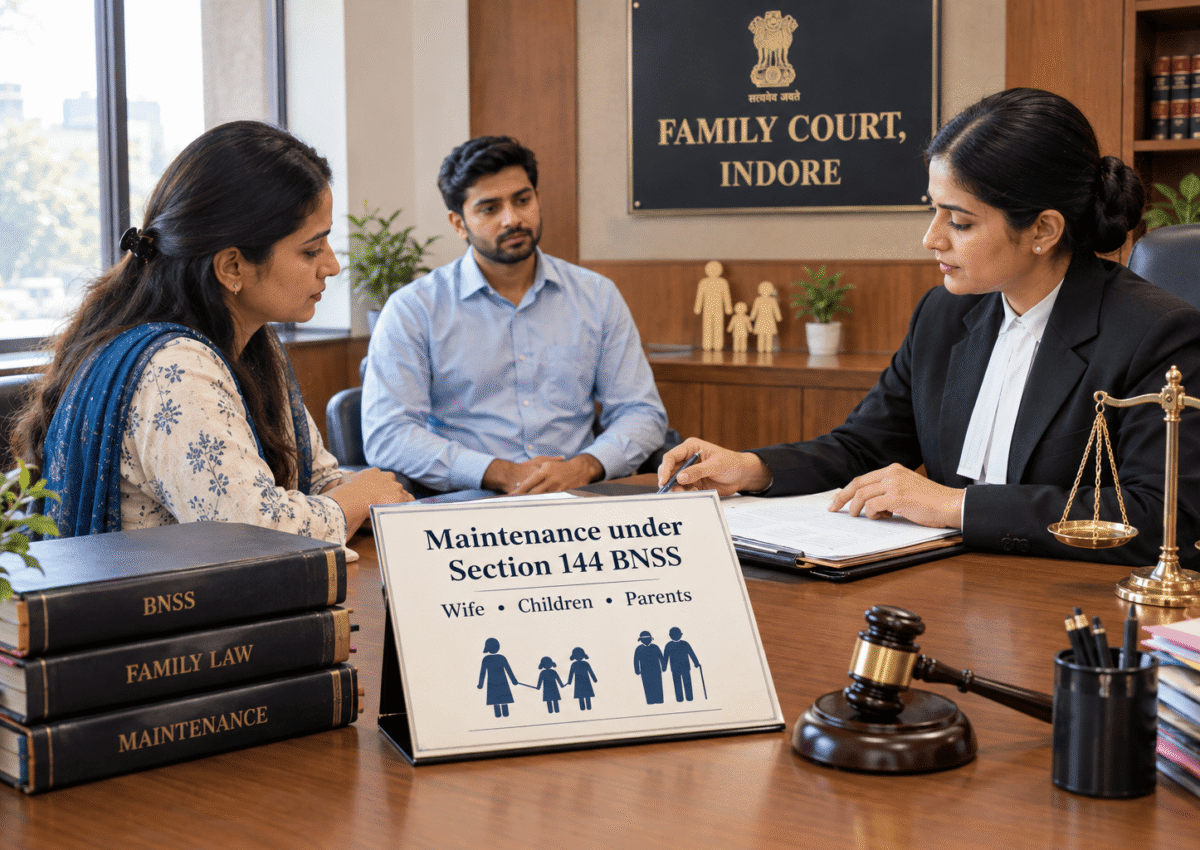
Can a Wife Claim Maintenance in Family Court Indore if Her Husband Deliberately Stopped Working?
Yes. A wife can claim maintenance in Family Court, Indore even if her husband has deliberately stopped working.
A husband cannot ordinarily avoid his legal obligation to maintain his wife simply by voluntarily giving up his employment, closing his business, refusing available work or deliberately reducing his income and then claiming that he has no money to pay maintenance.
The important distinction is between:
genuine inability to earn and deliberate avoidance of earning.
If a husband genuinely loses his job because of circumstances beyond his control, suffers a serious disability, becomes medically incapable of working or establishes some other genuine reason for his inability to earn, the court can take those circumstances into account.
But if an able-bodied husband deliberately stops working after separation or after a maintenance case is filed, particularly with the object of avoiding his financial responsibility towards his wife and children, the Family Court can examine his earning capacity rather than merely his declared present income.
The Supreme Court has recognised that an able-bodied husband cannot simply take the position that he has no source of income and therefore cannot maintain his wife. In one such case, the Court referred to the principle that an able-bodied person is presumed capable of earning sufficiently to discharge his obligation, unless cogent reasons beyond his control are shown.
For a wife approaching Family Court, Indore, this distinction can be extremely important.
What does Section 144 BNSS provide?
Section 144(1) of the Bharatiya Nagarik Suraksha Sanhita, 2023 provides for maintenance where a person having sufficient means neglects or refuses to maintain his wife who is unable to maintain herself.
The provision also permits interim maintenance and reasonable expenses of proceedings during the pendency of the case. The application for interim maintenance and proceeding expenses is to be dealt with, as far as possible, within sixty days from service of notice.
The basic ingredients of a wife’s maintenance claim are therefore:
- The parties are legally married.
- The wife is unable to maintain herself.
- The husband has sufficient means or financial capacity.
- The husband has neglected or refused to maintain her.
- The wife satisfies the applicable territorial jurisdiction requirements.
- There is no statutory bar to the wife’s claim.
The husband’s assertion that he has stopped working does not automatically answer these questions.
What is the difference between unemployment and deliberate unemployment?
This is the central issue.
Genuine unemployment
A husband may genuinely become unemployed because:
- his employer closed the establishment;
- he was retrenched;
- the company terminated his employment;
- his business genuinely failed;
- he suffered a serious illness or disability;
- circumstances beyond his control prevented him from working.
Such circumstances may legitimately affect the amount of maintenance.
Deliberate unemployment
The situation is different if the husband:
- voluntarily resigns without reasonable justification;
- closes a profitable business;
- refuses suitable employment;
- deliberately stops practising his profession;
- transfers his business to relatives while continuing to operate it;
- hides his actual business activity;
- deliberately reduces his declared income;
- becomes unemployed immediately after the wife seeks maintenance;
- claims no income despite having substantial earning capacity.
In such circumstances, the court may examine whether the husband’s alleged lack of income is genuine.
Can an able-bodied husband say: “I have no income, so I cannot pay maintenance”?
Not necessarily.
The Supreme Court has expressly dealt with this issue.
In Shamima Farooqui v. Shahid Khan, the Court considered the position of an able-bodied husband who claimed inability to maintain his wife. The Supreme Court emphasised that an able-bodied husband cannot simply avoid his obligation by taking the position that he has no sufficient income.
The principle is important:
A husband’s present income and his capacity to earn are not necessarily the same thing.
For example, a qualified engineer who voluntarily leaves his job may have no current salary, but that does not necessarily mean that he has no earning capacity.
Similarly, a businessman who closes one business shortly before a maintenance proceeding may still possess substantial assets, skills, business connections and capacity to earn.
Does Section 144 BNSS use the expression “earning capacity”?
Section 144 itself refers to a person having “sufficient means” who neglects or refuses to maintain his wife.
The question of earning capacity arises in determining whether the husband’s assertion of complete financial inability should be accepted.
The court can examine the total financial circumstances rather than mechanically equating:
present salary = total means.
The Supreme Court’s maintenance jurisprudence supports consideration of the husband’s capacity to earn when assessing his obligation.
What if my husband resigned after I asked him for maintenance?
This is a particularly important factual circumstance.
Suppose:
- Husband was earning ₹80,000 per month.
- Wife demanded maintenance.
- Husband subsequently resigned.
- He then says, “I am unemployed and therefore cannot pay anything.”
The wife should bring the chronology to the attention of Family Court, Indore.
The court can examine:
- when the husband resigned;
- why he resigned;
- his previous salary;
- his qualifications;
- his employment history;
- whether he made any effort to find alternative employment;
- whether he started another business;
- whether he has other income or assets;
- whether his lifestyle changed after the alleged loss of employment.
The timing of the husband’s unemployment can therefore become significant evidence.
What if he deliberately closed his business?
The same principle can apply.
For example, suppose a husband was operating a business and earning a reasonable income.
After his wife filed a maintenance case, he claims:
“My business has been closed and I have no income.”
The wife should not merely allege that the business is continuing.
She should collect whatever lawful evidence is available concerning:
- previous business activity;
- GST registration;
- GST returns;
- income-tax returns;
- business premises;
- bank transactions;
- vehicles;
- employees;
- social-media business pages;
- company records;
- partnership records;
- customers;
- invoices;
- business advertisements;
- other evidence of continuing activity.
The court can then assess whether the business genuinely closed or whether the husband has merely changed the manner in which the income is being received.
What if the husband says the business is now in his brother’s name?
This is a factual issue that can become important.
For example, the husband may say:
“I have no business. The business belongs to my brother.”
But if evidence shows that the husband:
- operates the business;
- deals with customers;
- controls employees;
- uses the business premises;
- represents himself as proprietor/manager;
- receives payments;
- manages the business;
the court may examine the actual circumstances.
The wife should avoid making unsupported allegations. The better approach is to identify specific facts and documentary evidence showing the husband’s continuing involvement.
What if the husband transferred his business to his parents?
Again, the transaction should be examined on its facts.
A genuine transfer is different from a sham arrangement.
The wife can bring to the court’s attention:
- date of transfer;
- consideration;
- relationship between transferor and transferee;
- continued involvement of husband;
- ownership and management records;
- bank transactions;
- business premises;
- evidence of who actually operates the business.
If the evidence indicates that the husband merely transferred the appearance of ownership while continuing to operate the business, that may become relevant to the assessment of his financial capacity.
What if the husband says he is unemployed but owns several properties?
Property ownership is highly relevant to the overall financial picture.
The wife should identify, where possible:
- residential properties;
- commercial properties;
- agricultural land;
- plots;
- rental properties;
- jointly owned properties;
- inherited properties;
- other substantial assets.
Even if a particular property does not presently generate rent, ownership of substantial assets can be relevant to understanding the husband’s overall financial circumstances.
Can the husband be treated as having income merely because he owns property?
Not automatically.
Property ownership and income generation are different questions.
The wife should therefore not argue that every property automatically represents monthly income.
Instead, the property can be relevant to:
- financial capacity;
- standard of living;
- availability of resources;
- rental income, if any;
- overall assets and liabilities.
The court will consider the evidence.
What if the husband is highly qualified but says he cannot find work?
This is another situation in which earning capacity may become important.
For example, if the husband is:
- an engineer;
- doctor;
- advocate;
- chartered accountant;
- architect;
- software professional;
- businessman;
- senior executive;
- other highly skilled professional;
and has voluntarily stopped working, the wife can place his qualifications and previous professional history before the court.
The question may then arise:
Why is a qualified and able-bodied person earning nothing?
The husband can certainly establish genuine circumstances preventing employment, but a bare assertion may not be sufficient.
What if the husband says that he is trying to find a job?
The court can consider that explanation.
The husband may produce evidence of:
- job applications;
- interviews;
- rejection letters;
- employment correspondence;
- medical circumstances;
- professional restrictions;
- genuine efforts to restart a business.
This can help distinguish genuine unemployment from deliberate unemployment.
The wife’s case should therefore focus on the evidence rather than merely alleging that the husband is intentionally unemployed.
Can the wife ask the husband to disclose his income and assets?
Yes.
Financial disclosure is extremely important in maintenance proceedings.
The Supreme Court’s decision in Rajnesh v. Neha established a structured approach to disclosure of income, assets, expenditure and liabilities in maintenance proceedings.
The Supreme Court continues to direct parties in current maintenance litigation to file affidavits of assets and income in accordance with Rajnesh v. Neha.
The prescribed disclosure framework can cover employment, income, assets, liabilities, expenditure and other financial information.
Therefore, if a husband claims:
“I am unemployed and have no income,”
the wife should seek appropriate financial disclosure rather than simply accepting that statement.
What should the wife’s lawyer look for in the husband’s financial affidavit?
Particular attention should be given to:
Employment history
- previous employer;
- designation;
- previous salary;
- date of leaving employment;
- reason for leaving;
- present employment.
Business interests
- proprietorships;
- partnerships;
- companies;
- directorships;
- GST registrations;
- professional establishments.
Property
- residential properties;
- commercial properties;
- agricultural land;
- plots;
- inherited property.
Bank and financial information
- bank accounts;
- investments;
- fixed deposits;
- securities;
- mutual funds;
- other investments.
Vehicles
- cars;
- commercial vehicles;
- other substantial vehicles.
Liabilities
- loans;
- EMIs;
- credit obligations;
- genuine dependent responsibilities.
Expenditure
- rent;
- travel;
- education;
- medical expenditure;
- lifestyle expenditure.
The purpose is to identify whether the claim of “zero income” is consistent with the husband’s overall financial circumstances.
What if the husband deliberately understates his income?
The wife should identify specific inconsistencies.
For example:
Husband claims income of ₹20,000 per month.
But the wife has documents showing:
- previous salary of ₹90,000;
- ownership of commercial property;
- business activity;
- substantial expenditure;
- expensive vehicle;
- regular travel;
- other financial resources.
This is much stronger than simply stating:
“My husband is lying.”
The court should be given the material from which the discrepancy can be assessed.
Does the husband have to prove that he is genuinely unable to work?
The evidentiary position depends upon the facts and pleadings, but once the wife places credible material showing previous income, qualifications, employment and apparent earning capacity, the husband’s explanation for his present lack of income becomes important.
The Supreme Court has stated that an able-bodied husband claiming inability to earn must show cogent grounds explaining why he cannot earn enough to discharge his obligation.
Therefore, a husband cannot necessarily rely on a bare sentence in his written statement:
“The respondent is unemployed and therefore cannot pay maintenance.”
What if the husband deliberately refuses suitable employment?
This can be a significant circumstance.
For example, if the husband is qualified and capable of earning ₹50,000–₹1,00,000 or more but deliberately refuses reasonable employment to avoid maintenance, the court may consider his earning capacity.
However, the court should not be asked to assume an arbitrary income merely because the husband is qualified.
The wife should present evidence regarding:
- previous salary;
- professional qualifications;
- experience;
- employment opportunities;
- previous business;
- standard of living.
Can the wife claim maintenance if the husband stopped working before she filed the case?
Yes, potentially.
The critical question is not simply when the maintenance case was filed.
The court can examine:
- why the husband stopped working;
- whether he was capable of working;
- what assets he has;
- whether he has other resources;
- whether he is genuinely unable to earn;
- whether he has neglected or refused to maintain his wife.
The wife should establish the circumstances as clearly as possible.
What if the husband stopped working because of the matrimonial dispute?
This requires careful factual analysis.
For example, if the husband says:
“Because of the matrimonial dispute I left my job.”
The court may examine whether this was genuinely unavoidable or whether the husband voluntarily chose unemployment.
A matrimonial dispute does not automatically suspend the husband’s financial responsibility towards his wife.
What if the husband is physically capable but says he does not want to work?
That is a particularly weak position in a maintenance proceeding.
An able-bodied husband ordinarily cannot escape his obligation simply by choosing not to work.
The Supreme Court’s jurisprudence recognises the principle that an able-bodied husband is presumed capable of earning sufficiently to discharge his obligation, unless cogent reasons are shown for his inability to do so.
What if the husband says that the wife should work instead?
This is not, by itself, a complete answer.
The court will consider the wife’s:
- actual income;
- qualifications;
- employment;
- reasonable needs;
- health;
- age;
- childcare responsibilities;
- standard of living;
- overall circumstances.
The Supreme Court has held that merely because a wife is capable of earning does not automatically disentitle her from maintenance; the court must examine whether her actual income is sufficient for her reasonable maintenance.
The same principle applies in reverse: the wife’s ability to earn does not automatically eliminate the husband’s obligation, and the husband’s ability to earn cannot be ignored merely because he has chosen not to work.
What if the wife is herself earning?
The wife’s actual income is relevant.
The wife should disclose it honestly.
The question is whether her income is sufficient to maintain herself in the circumstances of the marriage and what amount, if any, is reasonably required from the husband.
The Supreme Court has recognised that earning some income is not automatically a bar to maintenance.
Can a wife seek interim maintenance while the husband claims unemployment?
Yes.
Section 144 BNSS expressly permits interim maintenance during the pendency of the proceeding.
A wife should not necessarily wait until final disposal merely because the husband has taken a plea of unemployment.
The court can examine the available financial material and determine appropriate interim relief.
The statutory provision states that the interim-maintenance application should, as far as possible, be disposed of within sixty days from service of notice.
From what date can maintenance be awarded?
Section 144(2) BNSS provides that maintenance or interim maintenance may be payable from the date of the order or, if so directed, from the date of the application.
Therefore, the wife should clearly claim maintenance from the appropriate date in her application and preserve evidence of her financial circumstances.
Can a husband deliberately stop working after receiving notice of the maintenance case?
This can be particularly relevant.
Suppose:
January: Husband earns ₹1 lakh per month.
March: Wife demands maintenance.
April: Maintenance petition filed.
May: Husband resigns.
June: Husband files reply saying, “I have no income.”
The chronology itself does not prove deliberate unemployment.
But it is a circumstance requiring explanation.
The wife should place the employment records and chronology before the Family Court.
What if the husband transfers his salary or income to relatives?
The wife should identify specific evidence.
Possible indicators may include:
- sudden transfer of business;
- unexplained payments;
- income being received by relatives;
- husband continuing to operate the business;
- use of assets allegedly belonging to relatives;
- financial transactions inconsistent with his declared income.
The court can examine the overall evidence.
What if the husband has no bank balance?
A low bank balance does not necessarily establish absence of earning capacity.
A businessman may have fluctuating balances.
A person may hold assets rather than cash.
A professional may receive cash or other forms of income.
The wife’s case should therefore not depend upon one bank statement alone.
What if the husband claims that his business failed?
A genuine business failure can certainly be considered.
The husband should ideally produce credible financial material.
The court may examine:
- business accounts;
- tax records;
- GST records;
- loan statements;
- closure documents;
- business assets;
- liabilities;
- previous turnover;
- present business activity.
The wife can challenge the claim where there is evidence suggesting that the business continues.
What if the husband is capable of doing another job but refuses?
This can support the wife’s argument regarding earning capacity.
For example, a husband who voluntarily leaves a high-paying job may not necessarily be entitled to reduce his maintenance obligation simply by choosing a lower-paying occupation without reasonable justification.
The court can examine the circumstances surrounding the change.
What if the husband says he is preparing for competitive examinations?
This is a fact-specific situation.
The court may consider:
- age;
- duration of preparation;
- previous employment;
- financial resources;
- actual efforts;
- family responsibilities;
- whether the husband is genuinely preparing;
- whether the arrangement is being used to avoid maintenance.
The husband should not automatically be treated as having a particular income merely because he is preparing for an examination.
But the wife’s maintenance rights also cannot simply be suspended because the husband voluntarily chooses a period of unemployment.
What if the husband says he is starting a new business?
Again, the court can examine the circumstances.
A temporary period genuinely required to establish a new business may be relevant.
But if “starting a business” is merely a reason for avoiding employment while the husband possesses substantial resources, the wife can bring the relevant facts before the court.
Can the wife claim maintenance if her husband is living in another city?
Yes, subject to territorial jurisdiction.
Section 145 BNSS provides alternative places where a maintenance proceeding may be taken, including the district where the husband or wife resides and the district where the husband last resided with his wife.
Therefore, if the wife genuinely resides in Indore, the fact that the husband is working or living elsewhere does not automatically prevent her from approaching the competent Family Court at Indore.
Can the wife claim maintenance if the husband is living abroad and deliberately stopped working?
Potentially yes.
The husband’s foreign residence does not by itself eliminate the wife’s claim.
His foreign employment history, qualifications, assets and previous income may become particularly relevant.
Financial disclosure principles under Rajnesh v. Neha can extend to financial information concerning parties living abroad. The Supreme Court’s disclosure format specifically contemplates overseas employment, foreign income, foreign expenditure and assets.
What if the husband says he has no income but maintains an expensive lifestyle?
This can be important evidence.
The wife should document, where lawfully possible:
- expensive vehicles;
- foreign travel;
- costly accommodation;
- business expenditure;
- club memberships;
- luxury purchases;
- substantial educational expenditure for children;
- other significant expenses.
Lifestyle evidence should not replace proof of income, but it may help the court assess whether the husband’s claimed financial position is credible.
What documents should a wife collect?
A wife preparing a maintenance case in Family Court, Indore should ideally collect:
Husband’s previous employment
- appointment letter;
- salary slips;
- Form 16;
- employment ID;
- previous income-tax records;
- emails or correspondence relating to employment;
- evidence of designation and salary.
Husband’s business
- GST information;
- business registration;
- website;
- invoices;
- advertisements;
- company records;
- partnership information;
- photographs of business premises.
Assets
- property documents;
- land records;
- vehicle information;
- rental property information;
- investment information.
Evidence of deliberate unemployment
- date of resignation;
- resignation letter;
- previous salary;
- messages concerning his decision to stop working;
- evidence of subsequent business activity;
- evidence that he rejected employment opportunities, where available.
Wife’s own financial position
- bank statements;
- salary records;
- rent;
- medical bills;
- educational expenses;
- household expenses.
Children’s expenses
- school fees;
- tuition;
- medical expenses;
- transportation;
- extracurricular expenses where relevant.
Should the wife investigate the husband’s income herself?
Yes, but only through lawful means.
The wife should collect publicly available information and documents lawfully accessible to her.
She should not hack accounts, impersonate the husband, unlawfully obtain passwords or use illegally obtained private information.
The better approach is to:
collect lawful evidence + seek disclosure + request appropriate directions from the court.
How should the wife plead deliberate unemployment?
The pleading should contain specific facts rather than a general accusation.
For example:
“The Respondent was gainfully employed as ______ and was earning approximately ₹_____ per month. After the matrimonial dispute arose and particularly after the Petitioner demanded maintenance, the Respondent voluntarily ceased his employment on ______. Despite being physically fit, professionally qualified and having substantial work experience, the Respondent has deliberately remained unemployed and has failed to make any reasonable effort to secure alternative employment. The Respondent has sufficient earning capacity and financial resources, but has deliberately suppressed his actual financial position with a view to avoiding his obligation to maintain the Petitioner.”
The paragraph should be modified to match the evidence actually available.
What should not be pleaded?
The wife should avoid unsupported statements such as:
“My husband earns ₹5 lakh every month.”
if she has no basis for that figure.
Instead, plead:
- his known previous income;
- qualifications;
- employment;
- business;
- assets;
- lifestyle;
- specific evidence.
The court is more likely to find a factual and credible presentation persuasive.
Can the wife request financial disclosure?
Yes.
In appropriate proceedings, the wife can seek directions requiring the husband to disclose his:
- income;
- assets;
- liabilities;
- expenditure;
- employment;
- business interests.
The Supreme Court’s Rajnesh v. Neha framework is particularly important for this purpose, and the Supreme Court continues to apply that disclosure framework in current cases.
What if the husband does not cooperate with financial disclosure?
The wife should bring the non-compliance before the Family Court and seek appropriate procedural directions.
A party should not benefit from withholding financial information and then argue that the other spouse cannot prove the concealed information.
The wife should identify the specific information sought and explain why it is relevant.
Can the Family Court consider the husband’s previous income?
Yes, previous income can be relevant to understanding:
- earning capacity;
- standard of living;
- employment history;
- financial circumstances;
- reasons for current unemployment.
It does not mean that previous income automatically becomes the maintenance amount.
The court must still determine the appropriate amount on the facts.
Can the wife claim maintenance for children if the husband deliberately stopped working?
Yes, where the statutory requirements are satisfied.
Section 144 BNSS also provides for maintenance of children who fall within its terms.
The husband’s deliberate unemployment can therefore become relevant not only to the wife’s maintenance but also to the financial responsibility towards eligible children.
What if the husband says that his parents are dependent upon him?
Genuine responsibilities towards dependent parents and other family members may be relevant.
However, such responsibilities do not automatically eliminate the husband’s obligation towards his wife.
The court can assess all genuine liabilities and financial circumstances.
The husband should disclose them accurately.
What if the husband says that the wife can stay with her parents?
That is not necessarily an answer to the maintenance claim.
The wife’s parents may voluntarily support her, but the husband’s statutory obligation has to be considered independently.
A wife staying with her parents because the husband refuses to maintain her does not automatically lose her right to seek maintenance.
Can a wife living with her parents in Indore file the case in Indore?
Potentially yes.
Territorial jurisdiction under Section 145 BNSS should be examined carefully.
If the wife genuinely resides in Indore, Section 145(1) provides a statutory basis for proceeding in the district where the wife resides. The statute also recognises the district where the husband last resided with his wife as another jurisdictional basis.
Therefore, if the wife has returned to her parental home in Indore and genuinely resides there, this can be an important jurisdictional fact.
Does the fact that the husband stopped working automatically prove neglect?
No.
The wife still needs to establish the statutory ingredients of her maintenance claim.
The stronger case is:
husband stopped working + husband is able-bodied + no genuine explanation + previous income + earning capacity + financial resources + refusal to maintain wife.
Deliberate unemployment is evidence relevant to the husband’s financial capacity; it should not be treated as an automatic substitute for proving all statutory requirements.
What if the husband genuinely has no income and no assets?
The situation becomes more difficult.
The court must consider the actual circumstances of both parties.
The wife should not assume that every husband has an undisclosed income.
If the husband genuinely has:
- no employment;
- no business;
- no assets;
- no earning capacity due to genuine circumstances;
the court will consider those facts while determining appropriate maintenance.
The legal principle against deliberate unemployment should not be converted into an assumption that every unemployed husband is financially capable of paying an arbitrary amount.
How much maintenance can the wife claim?
There is no universal fixed percentage or automatic formula under Section 144 BNSS.
The court considers the facts, including:
- husband’s financial position;
- wife’s reasonable needs;
- wife’s income;
- standard of living;
- number of dependants;
- children’s requirements;
- liabilities;
- assets;
- earning capacity;
- other relevant circumstances.
The wife should therefore prepare a realistic monthly budget.
For example:
| Expense | Monthly amount |
|---|---|
| Accommodation | ₹_____ |
| Food | ₹_____ |
| Electricity/utilities | ₹_____ |
| Medical | ₹_____ |
| Transportation | ₹_____ |
| Personal expenses | ₹_____ |
| Children’s expenses | ₹_____ |
| Education | ₹_____ |
| Other reasonable expenses | ₹_____ |
| Total | ₹_____ |
The figures should be genuine and supported wherever possible.
Can maintenance be granted from the date of application?
Yes.
Section 144(2) BNSS provides that maintenance may be payable from the date of the order or, if so directed, from the date of the application.
Therefore, the wife should clearly seek appropriate relief from the date of filing where the facts justify it.
What if the husband starts working again after the maintenance case is filed?
That may materially change the financial picture.
The wife should bring the new employment or income information to the attention of the court.
The husband’s renewed employment may provide stronger evidence of his earning capacity.
What if the husband starts a business after claiming unemployment?
Again, this should be disclosed to the court.
A change in circumstances can be relevant to the determination or later alteration of maintenance.
The wife should preserve evidence of the new business.
Can maintenance later be increased if the husband’s income improves?
Yes, potentially.
Section 146 BNSS provides for alteration of maintenance upon proof of a change in circumstances.
Therefore, if the husband’s financial position materially improves, the wife may seek appropriate alteration in accordance with law.
What if the husband later genuinely becomes unable to work?
The husband can seek appropriate relief based upon a genuine change in circumstances.
Maintenance law is not intended to ignore genuine financial hardship.
The important requirement is that the change should be genuine and supported by appropriate evidence.
Practical example: husband quits a salaried job
Consider this example.
The husband was earning ₹1,20,000 per month in Indore.
The wife sought maintenance because the husband had stopped supporting her.
Two months later, the husband resigned.
He then files a reply stating:
“I am unemployed. My income is zero. Therefore, I cannot pay maintenance.”
The wife should place before the court:
- previous salary slips;
- employment records;
- husband’s qualifications;
- previous designation;
- date of resignation;
- circumstances surrounding resignation;
- evidence of his assets;
- evidence of any subsequent work;
- evidence of lifestyle;
- her own financial requirements.
The court can then examine whether the unemployment is genuine or deliberate.
Practical example: businessman claims business loss
Suppose the husband was operating a profitable business.
After the maintenance dispute arose, he claims:
“The business has closed and I have no income.”
The wife should obtain, where lawfully possible:
- GST details;
- business registration;
- photographs;
- advertisements;
- website information;
- company records;
- invoices;
- evidence of continuing business operations.
If the evidence demonstrates that the husband continues to operate the business, his claim of complete unemployment becomes questionable.
Practical example: qualified professional
Suppose the husband is a qualified professional who previously earned ₹1.5 lakh per month.
He voluntarily stops practising after the maintenance petition is filed.
He has no disability and owns substantial assets.
In such a case, the wife can strongly place before the court:
qualification + previous income + experience + ability to work + voluntary cessation + assets + refusal to maintain.
The court can then assess his actual financial capacity.
What is the strongest evidence of deliberate unemployment?
There is no single piece of evidence that automatically proves deliberate unemployment.
A combination can be persuasive:
- Previous substantial income.
- Voluntary resignation.
- No credible explanation.
- Good health.
- Professional qualifications.
- Continuing business activity.
- Substantial assets.
- High lifestyle expenditure.
- Evidence of income being diverted.
- Unemployment beginning around the maintenance dispute.
- Failure to make reasonable efforts to obtain alternative employment.
The case should be built around the totality of circumstances.
What is the correct legal argument before Family Court, Indore?
The wife’s argument should preferably not be:
“The husband must pay because he is capable of earning.”
It should be more precise:
“The Respondent is an able-bodied person who previously had substantial earning capacity and has voluntarily ceased employment/business without establishing any genuine circumstance beyond his control. His present plea of unemployment is inconsistent with his qualifications, previous income, assets, resources and financial conduct. His deliberate reduction of income cannot be permitted to defeat the Petitioner’s statutory right to maintenance.”
This places the emphasis on evidence and earning capacity rather than an unsupported assumption of income.
What should a wife do before filing a maintenance case in Indore?
A practical checklist is:
Step 1 — Collect proof of marriage
Keep:
- marriage certificate;
- photographs;
- invitation card;
- other marriage documents.
Step 2 — Establish separate residence
Keep proof of:
- present Indore address;
- rent;
- utility bills;
- correspondence;
- other residence documents.
Step 3 — Establish neglect
Preserve:
- messages demanding maintenance;
- bank records;
- notices;
- communications;
- evidence of refusal.
Step 4 — Establish husband’s previous income
Collect:
- salary slips;
- employment documents;
- business records;
- tax documents;
- professional information.
Step 5 — Establish deliberate cessation of work
Identify:
- date employment stopped;
- reason stated by husband;
- circumstances surrounding resignation;
- subsequent activities.
Step 6 — Identify assets
Collect information about:
- properties;
- vehicles;
- business interests;
- investments;
- rental properties.
Step 7 — Prepare realistic expenses
Prepare a monthly expense statement.
Step 8 — Disclose other cases
Inform the lawyer about:
- divorce proceedings;
- domestic violence cases;
- criminal proceedings;
- previous maintenance cases;
- child custody cases;
- existing maintenance orders.
Step 9 — Seek financial disclosure
Ask for appropriate disclosure of assets, income, expenditure and liabilities.
Step 10 — Seek interim maintenance
Where appropriate, file the interim-maintenance application rather than waiting for final disposal.
Model pleading regarding deliberate unemployment
Depending upon the facts and evidence, the following paragraph can be adapted for a petition before Family Court, Indore:
“That the Respondent is an able-bodied and professionally qualified person who was gainfully employed/engaged in business and had sufficient earning capacity. The Respondent was earning approximately Rs. ______ per month prior to the dispute between the parties. However, with an intention to evade his legal obligation to maintain the Petitioner, the Respondent voluntarily discontinued his employment/business on or about ______ and has thereafter falsely represented that he has no income. The Respondent has not placed any credible material demonstrating any circumstance beyond his control which prevents him from earning. His previous employment, qualifications, experience, assets, resources and financial standard clearly demonstrate that he possesses sufficient earning capacity. The Respondent cannot be permitted to take advantage of his own voluntary unemployment to defeat the Petitioner’s statutory right to maintenance under Section 144 of the Bharatiya Nagarik Suraksha Sanhita, 2023.”
This should be modified carefully according to the actual evidence. A lawyer should not plead deliberate unemployment unless there is a factual basis for the allegation.
Important distinction between “earning capacity” and “assumed income”
This distinction is important in professional drafting.
The court should not simply be asked to assume:
“My husband is educated, therefore he earns ₹2 lakh per month.”
That would be an overstatement.
Instead, the wife’s case should demonstrate:
- what he previously earned;
- what qualifications he possesses;
- what work he previously performed;
- why his present unemployment appears voluntary;
- what assets he possesses;
- what financial resources he controls;
- what lifestyle he maintains.
The court can then determine an appropriate amount based on evidence.
Can a husband deliberately reduce his income to defeat maintenance?
A deliberate reduction in income can be scrutinised.
For example:
- leaving a high-paying job;
- shifting business into a relative’s name;
- refusing profitable professional work;
- deliberately reducing business activity;
- transferring assets;
- concealing income.
The court can examine whether the change is genuine or designed to defeat the wife’s claim.
Can the husband be ordered to maintain the wife even if he currently earns nothing?
Potentially yes, particularly where he is able-bodied and the evidence establishes sufficient earning capacity or resources.
But the court must still determine the appropriate amount based on the actual circumstances.
It would therefore be incorrect to state that every unemployed husband automatically has to pay a fixed amount.
The legally safer proposition is:
Voluntary unemployment does not automatically extinguish the husband’s maintenance obligation.
Does the wife’s residence in Indore matter?
Yes.
If the wife genuinely resides in Indore, the territorial jurisdiction provisions of Section 145 BNSS may permit proceedings in Indore.
Section 145 provides several alternative territorial bases, including the district where the husband or wife resides and the district where the husband last resided with his wife.
Thus, where the wife is residing in Indore and the other statutory requirements are satisfied, she may approach the competent Family Court at Indore.
What if the husband lives in another State?
That does not automatically defeat Indore jurisdiction.
For example:
Wife: Indore
Husband: Delhi
Husband: voluntarily unemployed
Wife: unable to maintain herself
Husband: refuses financial support
The husband’s residence in Delhi does not by itself eliminate the wife’s statutory right or necessarily defeat territorial jurisdiction in Indore.
What if the husband lives abroad?
The same basic principle applies.
The wife’s claim is not automatically defeated because the husband is outside India.
His foreign employment history, assets, income and expenditure may become relevant to financial disclosure.
The Supreme Court’s Rajnesh v. Neha disclosure framework specifically contemplates parties living abroad and requires relevant information concerning foreign employment, foreign income and foreign assets where applicable.
Frequently Asked Questions
Can my husband stop working to avoid paying maintenance?
He may choose to leave employment, but he cannot automatically use voluntary unemployment as a defence to maintenance. The court can examine his earning capacity and the reasons for his unemployment.
What if he resigned after I filed the maintenance case?
The timing is relevant. It does not automatically prove deliberate unemployment, but the court can examine why he resigned and whether the unemployment is genuine.
What if he says he has no salary?
The court can consider other resources, assets, business interests and earning capacity.
What if he is educated and physically fit?
Those factors may be relevant to assessing his earning capacity, particularly if he has no credible explanation for remaining unemployed.
What if he genuinely lost his job?
Genuine job loss is a relevant circumstance. The court can consider it while determining the appropriate amount of maintenance.
Can I ask for his income and asset disclosure?
Yes. The Rajnesh v. Neha framework is highly relevant to financial disclosure in maintenance proceedings.
Can I claim interim maintenance?
Yes. Section 144 BNSS expressly provides for interim maintenance and proceeding expenses during the pendency of the proceeding.
Can I claim maintenance from the date of filing?
The court can direct maintenance or interim maintenance from the date of the application under Section 144(2) BNSS.
Can I file the case in Indore if my husband lives elsewhere?
Potentially yes. Section 145 provides alternative territorial bases, including the district where the wife resides.
What if I am earning?
Your actual income will be relevant, but earning some income does not automatically bar maintenance. The court examines whether your income is sufficient in the circumstances.
Can maintenance be changed later?
Yes. Section 146 BNSS permits alteration upon proof of change in circumstances.
Conclusion
A wife can claim maintenance before Family Court, Indore even if her husband has deliberately stopped working.
The husband’s deliberate unemployment should not automatically be allowed to defeat his legal obligation.
The crucial distinction is between:
“I genuinely cannot earn”
and
“I have chosen not to earn.”
Section 144 BNSS is concerned with a person having sufficient means who neglects or refuses to maintain his wife. The Supreme Court has recognised that an able-bodied husband cannot simply rely upon a bare assertion that he has no income when his capacity to earn and the surrounding financial circumstances demonstrate otherwise.
For a wife litigating before Family Court, Indore, the strongest case will ordinarily establish:
**Marriage
- wife’s inability to adequately maintain herself
- husband’s neglect/refusal
- husband’s previous income
- earning capacity
- deliberate cessation/reduction of work
- assets/resources
- financial disclosure
- reasonable monthly needs
- proper territorial jurisdiction.**
The wife should therefore avoid making the case merely about the husband’s present salary.
The more important question is:
Has the husband genuinely become unable to earn, or has he deliberately stopped earning in order to avoid maintaining his wife and children?
If the evidence shows that an able-bodied husband voluntarily stopped working, while retaining the ability and resources to earn, his plea of “no income” is not necessarily sufficient to defeat the wife’s maintenance claim.
Disclaimer: This information is intended for general guidance only and does not constitute legal advice. Please consult with a qualified lawyer for personalized advice specific to your situation.
Advocate J.S. Rohilla (Civil & Criminal Lawyer in Indore)
Contact: 88271 22304
